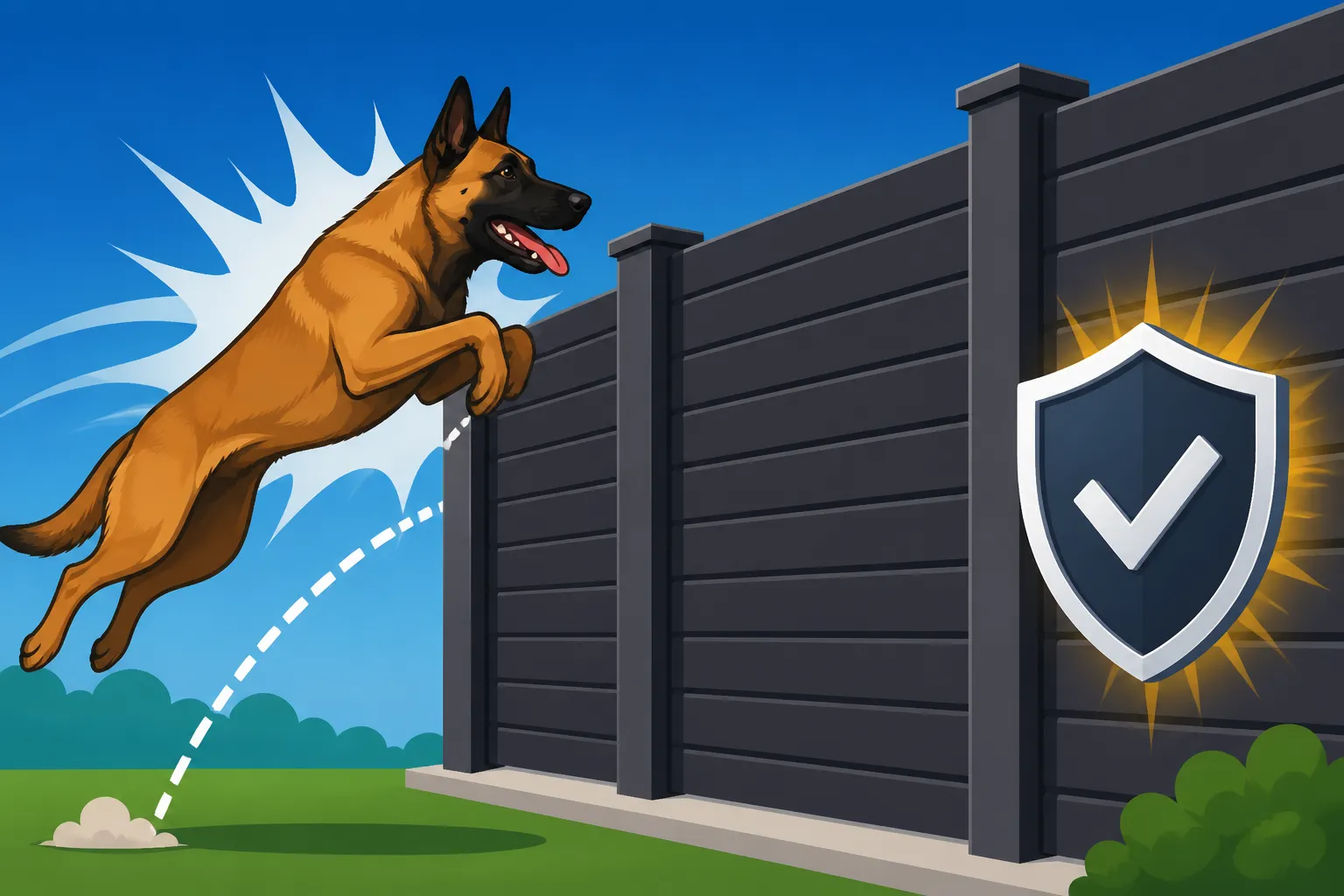
Fencing That a Belgian Malinois Cannot Clear
For so many Belgian Malinois owners, the dream of a secure yard quickly turns into a nightmare when their intelligent, athletic dog finds a way over, under, or through what they thought was a perfectly good fence. It's a truly frustrating experience, seeing your super-driven companion clear a boundary you spent good money on, leaving you wondering if any fence can truly contain such a force of nature. This guide is here to help you navigate the complexities of fencing solutions that might actually stand a chance against your incredibly capable Malinois.
Understanding the Belgian Malinois Escape Artist
Let's be honest, a Belgian Malinois isn't your average dog. They aren't content to simply sniff around the edges of a yard or sunbathe lazily. These are dogs bred for work, for thinking, for incredible athleticism, and for a drive that rarely quits. When a Malinois escapes, it's rarely accidental; it's often a calculated move born out of intense curiosity, high prey drive, or simply profound boredom. Understanding why they escape is the first step toward building a fence they cannot clear.
The Malinois's Athletic Prowess
Belgian Malinois are Olympic-level athletes in the dog world. Their jumping ability is legendary, clearing heights that would make other breeds gasp. A standard six-foot privacy fence? To a determined Malinois, that's often just a minor hurdle. They have the power in their hindquarters, the mental focus, and the sheer desire to get to whatever captivating scent or sight lies on the other side. It’s not just about jumping straight up; they can scale chain link, use fence posts as leverage, or even run up certain surfaces. This isn't naughtiness; it's instinct and incredible physical capability.
Think about how high they can jump in bite work or agility. They are conditioned to use their bodies in dynamic ways, often propelling themselves upwards and forwards with astonishing speed and agility. Many owners underestimate this raw athletic power until they see it firsthand with a fence they believed was adequate. The sheer frustration comes from realizing your fence isn't just a barrier; it's a puzzle for your Malinois to solve, and they often have all the tools.
The Malinois's Problem-Solving Mind
Beyond their physical gifts, Malinois are incredibly intelligent problem-solvers. They observe, they learn, and they adapt. If they can't jump over, they'll look for a way under. If they can't go under, they'll test the weakest point in the structure. A loose board, a gap in the gate, an unlatched clasp – these are not failures in your fence to a Malinois; they are opportunities. This relentless drive to explore and understand their environment means that any perceived weakness in your containment strategy will eventually be exploited.
This isn't just about simple learning; it's about active cognition. They might watch you open a gate and figure out how the latch works. They might systematically test every post for stability. This is why just having a tall fence isn't enough; it needs to be consistently robust and intelligently designed to counter their innate brilliance. If you've ever had a Malinois, you know they are always thinking, always strategizing, and sometimes, those strategies are aimed at getting to the perceived greener grass on the other side of your boundary.
Designing a Truly Malinois-Proof Fence
Given their unique talents, securing a Belgian Malinois requires more than just a standard fence. You need a multi-faceted approach that addresses jumping, digging, and climbing. It's about creating a perimeter that is as much a mental barrier as it is a physical one, but primarily, it needs to be physically impenetrable.
Height and Anti-Climb Features
When we talk about height for a Malinois, we're really looking at a minimum of eight feet, and even then, some highly motivated individuals might still find a way. Six-foot fences are, more often than not, simply not enough. But height alone isn't the only factor; the material and design are equally critical. A smooth surface that offers no paw holds is paramount. This is why chain-link, while tall, can be a ladder for a determined Malinois.
For truly escape-proof fencing, consider materials like solid wood, vinyl, or even masonry walls if your budget allows. These offer no grip points. Additionally, incorporating anti-climb features at the top, such as angled extensions inwards or even electric fence wires (used safely and ethically, of course, as a deterrent, not a primary barrier) can be incredibly effective. A "coyote roller" system, which is a round, unstable bar along the top of the fence, can prevent a dog from getting purchase to pull itself over. Remember, a fence is only as good as its weakest link, so ensure all gates are as tall and secure as the fence line itself.
Preventing Digging and Undermining
The second major escape route for a Malinois is digging. Their relentless nature means they can excavate impressive tunnels in a surprisingly short amount of time, especially if they are bored or sensing something exciting on the other side. Simply burying the fence line a few inches isn't sufficient. You need a much more robust anti-digging strategy.
One of the most effective methods is to bury a section of the fence or another barrier material horizontally, extending inwards from the base of the fence for at least 1-2 feet. This creates an L-shaped barrier that thwarts digging attempts. Materials like heavy-gauge wire mesh (welded, not woven, as woven can be chewed through), concrete, or even large rocks buried along the perimeter can work. For new fence installations, pouring a concrete footing along the entire base is the gold standard for preventing digging. This approach directly counters their instinct to go under, making their efforts futile and discouraging future attempts. When planning, consider factors like "Six Foot Fencing Prices for a Malinois Yard" as the cost will undoubtedly increase with these advanced features, but it's a critical investment to protect your dog and your peace of mind.
Gate Security and Latches
Gates are often the weakest point in any fencing system, and a Belgian Malinois will quickly identify and exploit this. A simple gravity latch might be fine for some dogs, but for a Malinois, it's an invitation to problem-solve. You need heavy-duty, multi-stage latches that require multiple actions to open, or even key-locked options. Spring-loaded self-closing hinges are also a wise investment, ensuring the gate never accidentally swings open.
Beyond the latch itself, consider how the gate is constructed. Is there a gap at the bottom that a nimble Malinois could wiggle under? Is the gate frame sturdy enough to resist a dog throwing its weight against it? Ensure the gate is flush with the ground and the adjacent fence panels, leaving no room for pushing or squeezing through. Double-gating systems, where you have two gates with a small vestibule in between, are an excellent, albeit more expensive, option for preventing accidental escapes when people enter or exit the yard.
Materials and Construction Considerations
Choosing the right materials and ensuring proper construction are paramount to building a Malinois-proof fence. Cutting corners here will almost certainly lead to future escape attempts and headaches.
Solid Panel Fences
Solid panel fences, such as those made from wood or vinyl, offer a visual barrier that prevents your Malinois from seeing tempting distractions on the other side. This "out of sight, out of mind" approach can significantly reduce their motivation to escape. However, the construction needs to be impeccable. For wood fences, choose sturdy, rot-resistant lumber and ensure panels are securely fastened to posts without gaps. For vinyl, look for commercial-grade panels that are reinforced.
The main challenge with solid panels is ensuring the top is also escape-proof. Many Malinois can get a paw over the top edge of a 6-foot fence and use their strength to pull themselves up. As discussed, extending the height to eight feet and adding an inward-facing angle or rollers can be crucial. Remember to routinely check these fences for loose boards or weak spots, as even the strongest Malinois can cause wear and tear over time.
Welded Wire and Chain Link (with modifications)
While a standard chain-link fence is generally not recommended for a Malinois due to its climbable nature, it can be made more secure with significant modifications. The key is to choose heavy-gauge, tightly woven chain link, preferably with no horizontal crossbars near the top that offer a perfect boost. Even better is welded wire mesh, which doesn't offer the same foot and claw holds as chain link. However, the height is still the primary concern.
For these types of fences, an eight-foot minimum is essential, and even then, adding an inward-angled top section made of smooth material or a coyote roller system is highly advisable. For the digger, burying the fence deep or adding that L-shaped apron along the bottom is critical. Without these modifications, a chain-link fence is an open invitation for a Malinois to demonstrate its agility. This is also where you might explore solutions from companies like Chewy for heavy-duty outdoor kennel systems or large, secure crates to use in conjunction with your primary fencing, giving your Malinois a safe space within the yard when unsupervised.
| Fence Type | Minimum Height | Anti-Dig Strategy | Anti-Climb Strategy | Malinois Effectiveness | Cost Range |
|---|---|---|---|---|---|
| Standard Wood Privacy | 6-8 ft | Buried wire apron (1-2 ft) or concrete footing | Inward-angled top or coyote rollers | Moderate-High | Medium |
| Heavy-Duty Vinyl | 8 ft | Concrete footing | Smooth surface, consider rollers | High | Medium-High |
| Welded Wire Mesh | 8 ft | Buried wire apron (1-2 ft) or concrete footing | Smooth, small mesh, inward-angled top or rollers | High | Low-Medium |
| Masonry/Block Wall | 6-8 ft | Built-in foundation | Smooth surface, can add inward cap | Very High | High |
| Chain Link | 8 ft+ | Buried wire apron (2 ft) & concrete tie-in | Small gauge wire, inward-angled top, no horizontal bars | Low-Moderate | Low |
Addressing "Invisible" Fences
This needs to be said plainly: an invisible fence, or electronic containment system, is generally not a suitable primary containment solution for a Belgian Malinois. These fences rely on a static correction to deter the dog from crossing a boundary. While effective for some breeds, a high-drive Malinois with a strong prey drive or an intense focus will often blow right through the correction if something sufficiently motivating is on the other side. They might take the momentary discomfort to get to a squirrel, a passing dog, or a person.
Not only can they ignore the correction, but they also learn that once they've crossed the boundary, there's no further correction. This means they may be unwilling to re-enter the yard. Moreover, these systems offer no protection from external threats or from your Malinois potentially interacting with people or animals outside your property. If you're considering "Why an Invisible Fence Will Not Stop a Malinois," it's because their drive often outweighs the deterrent, leading to dangerous situations for the dog and potentially others. A physical barrier is almost always superior for this breed.
Beyond the Barrier: Training and Management
Even the most robust fence can be compromised by a determined Malinois if their underlying needs aren't met. Fencing is a physical solution, but preventing escapes also requires a thoughtful approach to their mental and physical well-being. A happy, fulfilled Malinois is less likely to desperately seek escape.
Meeting Exercise Needs
A tired Malinois is a good Malinois, and a good Malinois is less likely to be an escape artist. These dogs require immense amounts of physical exercise and mental stimulation, far beyond what a simple romp in the yard can provide. If your Malinois isn't getting adequate outlets for its energy, it will find its own ways to entertain itself, and often, that involves testing the boundaries of its containment.
Think about activities like long, structured walks or runs (you could even be "Running a Belgian Malinois Beside a Bike"), vigorous games of fetch, or specific dog sports like agility, obedience, or protection work. A Malinois that's had a two-hour workout, followed by a training session, is much more likely to settle peacefully in a secure yard than one that's been left to its own devices all day. Companies like Chewy offer a fantastic range of interactive toys and enrichment tools that can help keep a Malinois mentally stimulated even when you're not actively training them.
Providing Mental Stimulation and Enrichment
Physical exercise is only half the battle. A Belgian Malinois needs to use its incredible brain. Without mental stimulation, they can become bored, destructive, and obsessive – all traits that contribute to escape attempts. Puzzle toys, scent work, advanced obedience training, or even just regularly rotating their toys and offering new challenges can make a huge difference.
Consider setting up a dedicated "play zone" within your fenced yard with safe, engaging items. Perhaps a sandbox for supervised digging (redirecting that natural instinct), a tetherball, or sturdy agility equipment. Training sessions, even short ones, several times a day will fulfill their need to work with you. A Malinois thrives on having a "job," even if that job is simply learning new tricks or finding hidden treats. If you're worried about "What Happens to an Unemployed Belgian Malinois," understand that escape artistry is often a symptom of under-stimulation.
Supervision and Crate Training
Even with the best fence in the world, direct supervision is invaluable, especially for a young or newly acquired Malinois. Leaving a Malinois unsupervised for extended periods, even in a secure yard, can give them the time and opportunity to find or create a weakness in your system. Pop out periodically, observe their behavior, and reinforce good habits.
When you cannot supervise, a secure crate is often the safest place for your Malinois. Crate training is an essential tool for Malinois owners, providing a safe den for your dog and peace of mind for you. Look for "Crash Tested Transport Crates for a Malinois" for ultimate security, even if just for use at home. This isn't about punishment; it's about providing a safe, comfortable space where they can relax and not feel the urge to escape. It's a fundamental part of managing a high-drive dog like the Malinois, especially when you're not actively engaging with them.
Cost and Long-Term Considerations
Investing in a Malinois-proof fence is not a small undertaking. It requires significant financial outlay and ongoing commitment to maintenance. However, the cost of an escape – lost dog, vet bills from injuries, potential liability, or even just the stress – far outweighs the initial investment in a proper containment system.
Initial Investment and Installation
The initial cost of installing a truly secure fence for a Belgian Malinois can vary dramatically based on the materials chosen, the size of your yard, and the complexity of the terrain. Custom-built fences with anti-dig footings, extra height, and anti-climb features will naturally be more expensive than a standard residential fence. It's crucial to get multiple quotes from reputable fencing contractors who understand the unique demands of containing a high-drive dog. Don't be afraid to explain why you need such a robust fence – their experience with similar breeds can be invaluable.
Remember to factor in not just the fence line itself, but also gate construction, any necessary land clearing, and potentially the cost of removing an old, inadequate fence. While it might seem like a large sum upfront, think of it as a long-term investment in your dog's safety and your peace of mind. It's part of "What a Year With a Working Belgian Malinois Costs," and a necessary one at that.
Maintenance and Longevity
Even the strongest fence needs regular maintenance to remain escape-proof. Inspect your fence line frequently for any signs of wear and tear: loose boards, cracked vinyl, bent wire, or signs of digging at the base. Pay particular attention to areas where your Malinois frequently patrols or attempts to dig. Wood fences may need staining or sealing periodically, and all fences should be checked for secure gate latches and hinges.
For areas prone to adverse weather, consider how ice, snow, or heavy rains might affect the fence's integrity. Tree roots can compromise buried footings over time, and zealous chewers might even manage to gnaw at certain materials if left unchecked. Proactive maintenance is key to ensuring your fence remains a secure barrier for the entire lifespan of your Malinois. Companies like Ollie, which focus on providing high-quality nutrition, understand the importance of overall wellness for a Malinois, and that extends to their environment. A well-maintained environment is part of caring for your dog.
Considering Future Needs
When planning your fence, think about your Malinois's entire life. While a puppy might not have the strength to clear an eight-foot fence, they will grow into their powerful adult bodies. If you plan to get additional dogs, will your fence be sufficient for multiple high-energy animals? Consider the long-term commitment and potential need for modifications down the line.
Also, think about the value of your Malinois. Whether it's a beloved family pet or a highly trained working dog, such as "The Twenty Five Thousand Dollar Trained Belgian Malinois," their safety is paramount. A secure perimeter protects not only your dog but also your investment and your peace of mind. While Healthy Paws or other pet insurance might cover unexpected health issues, preventing escapes in the first place is always the best strategy for avoiding potential incidents.
Conclusion
Successfully containing a Belgian Malinois in a yard is definitely a challenge, but it's not impossible. It requires a thoughtful, multi-pronged approach that combines robust physical fencing with a deep understanding of the breed's incredible athleticism and keen intelligence. By investing in adequate height, strong anti-dig solutions, secure gates, and consistent mental and physical stimulation, you can create a safe environment where your Malinois can thrive without constantly looking for a way out. Remember, this isn't just about building a fence; it's about building a fortress of security for your extraordinary companion.
Disclaimer
This article is for general informational purposes only and does not constitute professional advice. Laws, prices and regulations vary by location and change over time. Consult a qualified professional for guidance on your specific situation.