Whether a Belgian Malinois Is Confused With a Shepherd Mix
A Belgian Malinois can look like a German Shepherd mix at a glance, especially when it is young, lean, or missing a known pedigree. That uncertainty can matter when you are adopting, describing your dog to a vet, or checking housing rules. This guide explains which features offer clues, why appearance alone cannot prove ancestry, and how to handle an uncertain breed label.
Why Belgian Malinois Are Mistaken for Shepherd Mixes
The label “shepherd mix” is broader than it sounds
“Belgian Malinois” names a specific variety of Belgian Shepherd, while “shepherd mix” is often used informally for a dog that resembles a shepherd-type breed. A dog labeled “shepherd mix” might be a Malinois, a German Shepherd cross, another herding-breed mix, or a dog whose ancestry is simply unknown. In a shelter or online listing, the label may describe a visual impression rather than confirmed parentage.
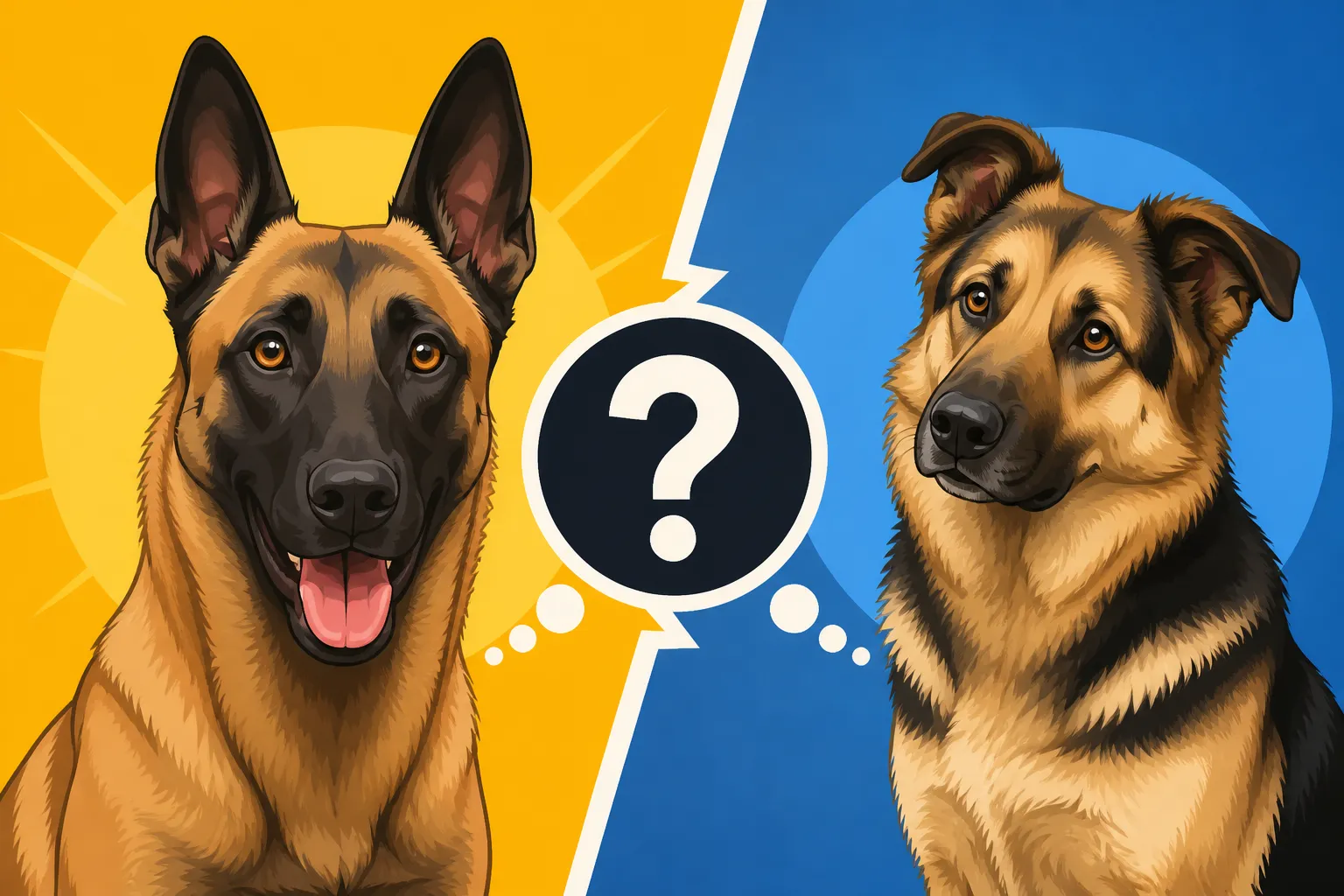
That overlap is understandable. Malinois and German Shepherds share some noticeable features: upright ears, a long muzzle, an athletic outline, and coat colors that can include shades of fawn with darker markings. A cross between either breed and another dog may also inherit a mix of traits that makes a tidy visual identification difficult. Even people familiar with working dogs can disagree when all they have is a photo.
The term can also be used as a practical placeholder. If a dog arrives at a rescue without reliable records, staff may record the type it most resembles to help describe it to potential adopters. That label should not be treated as a genetic result or proof of a dog’s exact breed mix. For related context, see Whether Shelter Malinois Mixes Are Correctly Identified.
Similar features do not establish ancestry
A black mask, a fawn coat, and erect ears can make a dog look Malinois-like, but none of those features on its own proves that the dog is a purebred Belgian Malinois. Similar traits occur across many breeds and mixes. Coat color can vary, ears may change as a puppy grows, and a dog’s overall build may be affected by age, body condition, and health.
A Malinois is generally a medium-sized, athletic dog with a short coat, upright ears, and a distinctive dark mask. German Shepherds are also athletic shepherd dogs, but they can differ in outline, coat length, head shape, and proportions. Those distinctions are easier to assess when comparing mature dogs side by side than when looking at a young puppy, a partial photograph, or a dog with unknown background. A closer comparison is covered in Telling a Belgian Malinois From a German Shepherd.
Even a collection of traits is still a clue, not a verdict. A lean dog with a short fawn coat may resemble a Malinois without having known Malinois ancestry. Conversely, a Malinois mix might have longer hair, less pronounced markings, or ears that do not stand fully upright. Appearance can guide a conversation, but it cannot replace reliable records or a genetic test.
How to Assess a Dog Without Guessing
Consider the whole dog, not one striking trait
If you are trying to understand whether a dog may be a Malinois or a shepherd mix, look at several features together: coat texture and length, coloring, ears, body proportions, head shape, gait, and adult size. Take age into account. Puppies can look different from their eventual adult selves, and their proportions may change substantially as they grow.
Size is only one part of the picture. Individual dogs vary, and mixed-breed dogs can fall outside the typical range associated with either parent breed. A dog’s weight can also shift with age, diet, health, and activity. Breed estimates based on size alone are especially unreliable. See The Weight Range a Belgian Malinois Falls In for more on why a number on the scale is only one piece of the picture.
Coat texture can offer another clue but not confirmation. A Malinois generally has a short, weather-resistant coat, while German Shepherd coats may be longer or fuller, though coat type varies. A cross can inherit a combination that does not neatly match either breed. If coat appearance is part of your comparison, The Harsh Outer Coat a Malinois Should Carry explains the general texture associated with the breed.
A useful approach is to write down what you can actually observe rather than jumping straight to a label. For example: “short fawn coat, dark facial mask, upright ears, lean adult build” is a more careful description than “definitely a purebred Malinois.” Separating observation from assumption helps you ask better questions of a shelter, breeder, veterinarian, or testing provider.
| Clue | What it may suggest | What it cannot prove |
|---|---|---|
| Short fawn coat and dark mask | A Malinois-like appearance | Purebred status or exact ancestry |
| Upright ears | A shepherd-type appearance | That the dog is a Malinois or German Shepherd |
| Athletic, lean build | A dog suited to active movement | Breed identity or temperament |
| Shelter or rescue label | The organization’s best available description | Verified parentage |
| Pedigree or registration records | Documented ancestry, if records are authentic | The dog’s health, behavior, or suitability for every home |
| DNA test estimate | Possible ancestry based on the test’s reference data | A definitive answer in every mixed-breed case |
Look for records and use DNA results carefully
When a dog comes from a breeder, ask what documentation is available and whether it connects the dog to identified parents. For a registered purebred dog, pedigree records and registration information can help establish documented lineage. Review the paperwork closely and ask questions if names, dates, or identifying details do not match. A photograph of a certificate or a seller’s verbal assurance is not the same as independently checked records.
For an adopted dog, ask the rescue or shelter what it knows about the dog’s history and how the breed description was determined. It is reasonable to ask whether the dog came in with records, whether a previous owner provided information, or whether the label is based only on appearance. A responsible organization should be able to distinguish confirmed details from its best estimate, even when the answer is simply that the dog’s background is unknown.
A commercial dog DNA test may offer an additional estimate of ancestry, but results should be read as estimates rather than an unquestionable family tree. The test compares a sample with the provider’s reference data, and results can vary among providers. Mixed ancestry, close genetic relationships between breeds, and a limited reference panel can make interpretation less straightforward. If the result matters for a consequential decision, read the provider’s explanation of what the test can and cannot establish.
Why Breed Labels Can Matter in Everyday Life
Adoption and household planning
A breed label can influence expectations before someone has spent time with the individual dog. A person may assume a Malinois will behave exactly like a working police dog, or assume a “shepherd mix” will be easy to manage because the label sounds familiar. Neither conclusion is reliable. Breed tendencies can be useful background, but they do not tell you everything about a dog’s energy, experience, sociability, or behavior in a particular home.
If you are considering adoption, ask about the individual dog’s daily routine, response to handling, comfort around other animals, ability to settle, and experience being alone. Whenever possible, observe the dog in more than one situation and speak with people who know it well. The questions should be practical: Can the dog relax indoors? What kind of exercise and training does it currently receive? How does it cope with visitors or unfamiliar dogs? These details are more useful for planning than a confident-sounding label.
Likewise, a possible Malinois mix is not automatically a poor fit for a home, and a dog described as a shepherd mix is not automatically low-maintenance. Household compatibility depends on the individual dog and the people caring for it. For a broader discussion of home suitability, see Whether a Belgian Malinois Suits a Family Home. If the dog is thought to have shepherd ancestry, What a Malinois Crossed With a Shepherd Becomes discusses why crosses can vary rather than producing one predictable type.
Housing, insurance, and official records
Some landlords, insurers, housing providers, or local authorities may ask about a dog’s breed. Rules and definitions differ by location and provider, so a casual description from an adoption listing may not settle the question. If a policy or housing decision depends on breed, ask the relevant organization what evidence it accepts and whether it has a formal assessment process.
Be accurate and consistent when describing a dog. Do not claim a breed is confirmed if you do not have documentation, but do not assume that an uncertain shelter label automatically determines how a landlord or insurer will classify the dog. Keep adoption papers, veterinary records, registration documents, or test results together so you can provide the information requested. For location-specific legal questions, check the applicable local rules rather than relying on general online discussions. Whether a Belgian Malinois Is Named in Breed Legislation offers related background on how breed-specific policies may be framed.
Retail product categories are another place labels can cause confusion. A breed filter on an online retailer such as Chewy may be convenient for browsing, but a product recommendation or breed category is not evidence of a dog’s ancestry. When choosing food, a collar, a crate, or grooming supplies, use the dog’s actual size, age, health needs, coat, and activity level—not an uncertain label alone. Chewy may be one place owners encounter breed descriptions while researching supplies, but those descriptions should not be treated as an identification service.
A Practical Way to Talk About an Uncertain Breed
Use clear language while you gather information
If you do not know a dog’s ancestry, it is perfectly reasonable to say “shepherd-type mix,” “Malinois-like,” or “breed mix unknown.” These descriptions make room for uncertainty without pretending to know more than you do. In a conversation with a vet, you can describe visible traits and the dog’s known history separately: “The rescue listed him as a shepherd mix; he has a short fawn coat and upright ears, but there are no parent records.”
That distinction is useful because medical care and training should be based on the dog in front of you. Your veterinarian needs a reliable account of symptoms, age, weight, medications, and medical history; a breed guess is not a substitute. A trainer needs to know what the dog does in real situations, not only what a listing says it might be. Accurate observations allow professionals to make more relevant recommendations.
If a dog’s ancestry is important to you, begin with the records and ask informed questions. If there are no records, consider whether a DNA estimate would help with your specific purpose. If you only want to understand your dog’s likely care needs, a careful assessment of health, behavior, and physical characteristics may be more useful than chasing a definitive label.
Keep temperament separate from breed certainty
It is tempting to explain a dog’s behavior by saying, “That’s the Malinois in him,” especially when the dog is energetic, alert, or highly engaged. But a breed label cannot explain every behavior. Age, early experiences, health, reinforcement, daily routine, and the environment all shape what a dog does. A confirmed Malinois can have a very different personality from another Malinois, and dogs with similar appearances can have very different needs.
If a dog resembles a Malinois, it may be sensible to learn about the breed’s typical activity and training needs while still evaluating the individual. You can explore Whether a Malinois Cross Inherits the Same Drive for why a mix’s behavior cannot be predicted from appearance alone. Then build a routine around the dog’s demonstrated needs: structured exercise, rest, training, enrichment, and appropriate veterinary care.
The most accurate answer may remain “unknown mix,” and that is not a failure. A breed label is one piece of context, not a complete description of a dog. When you separate visible traits, documented ancestry, and individual behavior, you can make better decisions without mistaking a resemblance for proof.
Disclaimer
This article is for general informational purposes only and does not constitute professional advice. Laws, prices and regulations vary by location and change over time. Consult a qualified professional for guidance on your specific situation.