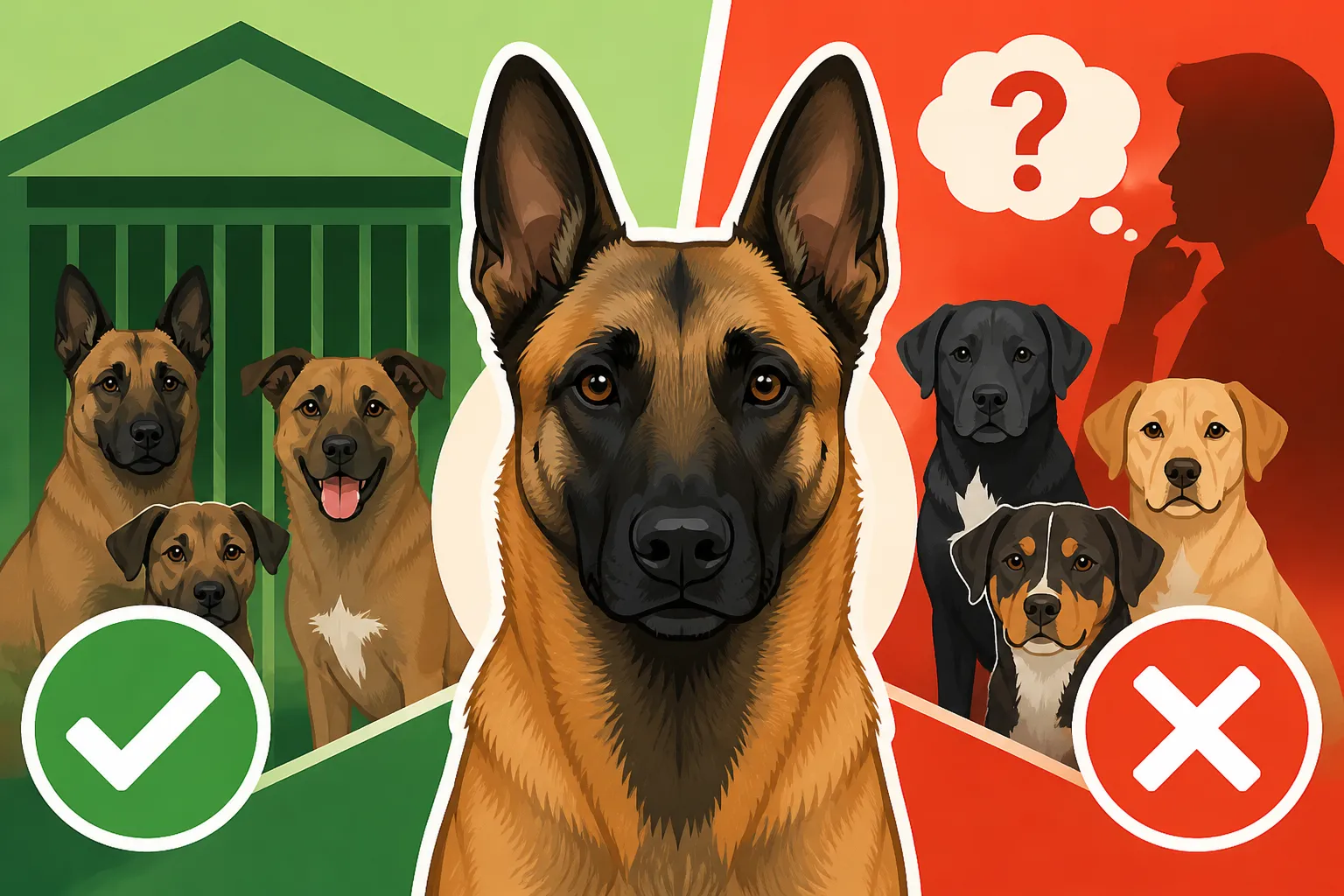
Whether Shelter Malinois Mixes Are Correctly Identified
A shelter dog with a dark mask, upright ears, and a lean build can look unmistakably like a Belgian Malinois, yet appearance alone cannot confirm breed. Shelter labels are often practical guesses rather than genetic findings. This guide explains how those identifications are made, what DNA tests can and cannot tell you, and how to choose a dog based on the individual in front of you.
Why a Shelter Might Label a Dog a Malinois Mix
A breed label is often a visual estimate
At a busy shelter, staff may need to assign a breed description before they know much about a dog’s history. They might base it on visible features such as coat color, a dark facial mask, upright ears, a narrow muzzle, or a lean, athletic frame. Those traits can make “Malinois mix” a reasonable shorthand for a dog that resembles the breed, but they do not establish ancestry.
Many dogs share those features. A mixed-breed dog can inherit a Malinois-like face or build from one ancestor while having little or no recent Belgian Malinois ancestry. Conversely, a dog with Malinois ancestry may not look much like the breed if it inherited more visible traits from other relatives. Coat color is not a reliable shortcut to a dog’s family tree; Whether a Malinois's Color Says Anything About Drive is a useful related read.
Shelter descriptions can also reflect what is known at intake. If someone surrendered a dog as a “Malinois mix,” that description may travel with the animal even if no one has verified it. In other cases, staff use the closest familiar breed type to describe an unknown dog to potential adopters. The label can help people picture the dog, but it should be treated as a starting point rather than a confirmed fact.
Similar-looking breeds and mixes complicate identification
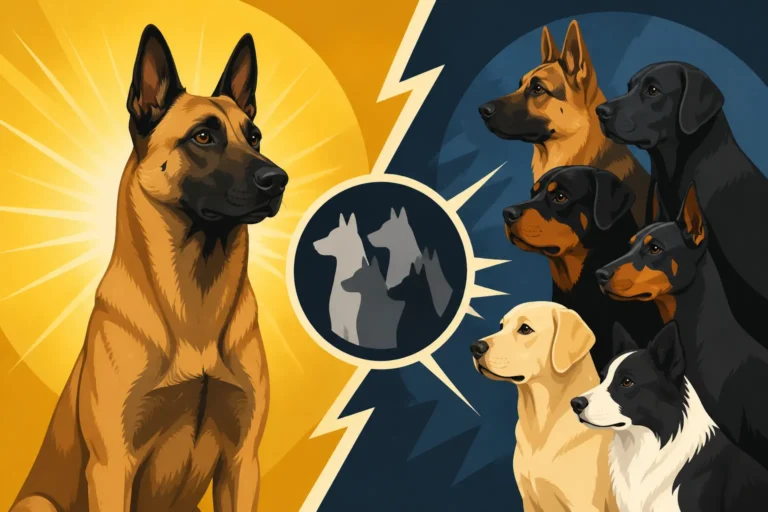
A Malinois can be confused with other shepherd-type dogs and mixes, especially when the dog is young, underweight, or has an unusual coat. German Shepherds, Dutch Shepherds, and mixed-breed dogs can overlap in size, coloring, ear shape, and general outline. A short coat and black mask may suggest a Malinois, but neither feature is exclusive to the breed.
Age and condition matter, too. Puppies have changing proportions and coats, and an adult dog arriving at a shelter may be thin, stressed, or carrying an injury that affects how it stands or moves. Those circumstances can make visual estimates less reliable. Even experienced people can disagree when a dog’s appearance combines traits from several breeds.
| What you notice | Why it may suggest Malinois | Why it does not confirm Malinois ancestry |
|---|---|---|
| Dark mask and fawn coat | Common in many Malinois | Similar coloring occurs in other breeds and mixes |
| Upright ears | Often associated with shepherd-type dogs | Ear shape varies, and some young dogs’ ears have not fully settled |
| Lean, athletic build | Consistent with many working Malinois | Fitness, age, health, and other ancestry affect body shape |
| Alert or energetic behavior | May remind people of working breeds | Behavior is shaped by the individual, environment, and experience |
| Shelter paperwork naming Malinois | May reflect prior owner information | The original description may never have been verified |
A dog that resembles a Dutch Shepherd or another shepherd mix may share visible traits with a Malinois without being one. For another comparison, see The Malinois Against the Dutch Shepherd. The practical takeaway is simple: visual resemblance can guide a conversation, but it is not a dependable substitute for documented lineage or DNA testing.
How Reliable Are Shelter Breed Identifications
Treat the label as a hypothesis, not a guarantee
Shelter breed descriptions can be useful, but they are not always based on a formal assessment. A listing might say “Belgian Malinois mix” because the dog looks like one, because that was the previous owner’s description, or because staff are making their best estimate from limited information. Unless the shelter explains that it has verified pedigree records or test results, assume the label is provisional.
It is fair to ask how the description was chosen. Was it supplied by a previous owner? Is it based on appearance? Did the dog arrive with paperwork? Has a DNA test been done, and if so, can the shelter share the report? These questions are not a challenge to the shelter’s honesty. They help you understand what the label means and how much weight to give it.
Keep expectations measured even when several people independently agree that a dog looks like a Malinois. Agreement may make the estimate feel more persuasive, but it is still an opinion based on appearance unless it is supported by records or a test. Breed estimates are particularly uncertain for dogs with mixed ancestry, where a few visible traits can strongly influence the impression a person forms.
Behavior is not a breed test
A dog that is quick to chase a ball, watch movement, or stay close to a handler may remind you of a working Malinois. But those behaviors cannot prove ancestry. Dogs develop habits and responses through genetics, individual temperament, learning, health, and life experience. A single observation at a shelter—where many dogs are stressed or overstimulated—may not reflect how the dog behaves at home.
It is also risky to assume that a dog labeled “Malinois mix” must be unusually intense, or that a dog not labeled Malinois will be easygoing. A breed label can influence what adopters expect, sometimes before they have met the dog properly. Instead, ask about specific, observed behaviors: how the dog responds to handling, settles after excitement, behaves around other dogs, or recovers after being startled.
When you are considering a rescue, make room for both curiosity and caution. Learn about the range of needs owners may encounter, but do not treat the label as a full personality forecast. Whether a Rescue Belgian Malinois Is a Realistic Option and The Questions a Malinois Rescue Asks Applicants can help you think through the broader adoption decision without making appearance the whole story.
What a Dog DNA Test Can and Cannot Tell You
What the result is useful for
A dog ancestry test can provide an estimate of the breeds represented in a dog’s DNA. For an adopter wondering whether a shelter’s “Malinois mix” description has genetic support, a test may offer additional clues. The result can also prompt useful questions about the dog’s likely size, care needs, or family history, although those questions should not be answered by breed percentages alone.
At-home kits generally involve collecting a cheek swab and sending it to a laboratory, following the kit’s instructions. Some online pet retailers, including Chewy, may carry dog DNA kits. Check the specific kit’s current details, including how the sample is collected, how results are delivered, and what the company says its report can establish. The retailer sells the kit; the testing provider is responsible for analyzing the sample and explaining its methodology.
If you decide to test, consider why you want the result. If your main goal is to understand a dog’s individual needs, shelter observations, veterinary guidance, and a careful transition plan may be more immediately useful than a breed estimate. If you are simply curious about ancestry, a test may satisfy that curiosity while still leaving some uncertainty.
Why DNA results are not an absolute answer
Ancestry reports are estimates based on the company’s reference data and testing methods. Different providers may produce different results, especially for highly mixed dogs or ancestry that is not well represented in a company’s database. A report should not be read as a perfect reconstruction of a dog’s entire family tree.
A small percentage in a report can also be easy to overinterpret. It does not automatically mean the dog will display a particular trait, and it should not be used to predict behavior with certainty. A dog’s temperament is more complicated than a list of breed components. If the results show Malinois ancestry, that still does not tell you exactly how much daily activity, training, or management this specific dog needs.
If you order a kit through Chewy or another retailer, read the testing company’s explanation of its results rather than relying on a product listing alone. Chewy is a place to shop, not the lab interpreting your dog’s sample. The most useful response to a result is often to bring any relevant questions to your veterinarian or a qualified behavior professional, especially if you are seeing a health or behavior concern.
How to Make an Adoption Decision Beyond the Label
Ask for evidence and observe the dog over time
Start by asking the shelter what it knows about the dog’s history. Find out whether the dog came in with records, whether a previous owner supplied the breed description, and what staff have observed during the dog’s stay. Ask about behavior in ordinary situations: settling in a quiet room, walking on leash, meeting familiar people, or returning to a calm state after excitement.
If the shelter offers a meet-and-greet, pay attention to more than the dog’s first burst of energy. A dog may be excited in a kennel and more settled outdoors, or the reverse. Ask whether you can meet in a quieter area and, if appropriate, arrange another visit. A short interaction is only one snapshot, so it helps to gather observations from different staff members and settings.
Think through your own routine, too. Would you be prepared to provide consistent training, enrichment, secure handling, and veterinary care if the dog turns out to be active and demanding? Those are sensible questions for any dog, and especially important when you are considering a high-energy shepherd-type mix. Whether a Malinois Cross Inherits the Same Drive explains why a mix’s ancestry does not translate into a predictable behavior package.
Focus on the dog in front of you
A breed label should not be the only reason to adopt—or the only reason to walk away. Consider the dog’s demonstrated temperament, health, age, activity level, and ability to fit safely into your household. If you have children, other pets, or frequent visitors, ask the shelter how the dog has behaved in relevant situations and what it has not yet been able to assess.
Make a realistic plan for the first weeks at home. Give the dog time to settle, keep introductions controlled, and avoid expecting a newly adopted dog to behave exactly as it did in the shelter. If you already have a dog, ask about a gradual introduction and follow professional guidance if either animal shows signs of discomfort. Breed ancestry can add context, but safe management depends on what the individual dog actually does.
Finally, remember that a shelter’s best guess is not necessarily a mistake. “Malinois mix” may simply be the most useful description staff can offer with the evidence available. Whether it is genetically accurate or not, the label can be a prompt to ask better questions—not a definitive answer about the dog’s identity, personality, or future.
Disclaimer
This article is for general informational purposes only and does not constitute professional advice. Laws, prices and regulations vary by location and change over time. Consult a qualified professional for guidance on your specific situation.