Why an Invisible Fence Will Not Stop a Malinois
One of the most common mistakes new Belgian Malinois owners make, or those considering bringing one of these incredible dogs into their lives, is believing an invisible fence system will reliably contain them. The heartbreaking reality is that these systems are almost always ineffective for a Malinois, often leading to escapes, dangerous situations, and a lot of frustration. This guide will dive deep into why an invisible fence simply doesn't stand a chance against the unique drives and physical capabilities of a Belgian Malinois, and what real containment actually looks like for this demanding breed.
The Core Problem: A Malinois's Drive Versus a Gentle Correction
It’s easy to look at an invisible fence system and think, "A little static correction should be enough to teach them!" For many dog breeds, a mild deterrent is indeed enough. But a Belgian Malinois is not "many dog breeds." Their entire genetic makeup and purpose are geared towards overcoming obstacles and focusing intently on a task, often to the exclusion of everything else.
What an Invisible Fence System Actually Does
Let's break down how these systems are designed to work. An invisible fence, sometimes called an electronic fence or a pet containment system, typically involves a buried wire that defines a boundary. Your dog wears a special collar that has a receiver. As the dog approaches the boundary, the collar emits a warning tone. If the dog continues, it then delivers a static correction – essentially a mild, startling zap – meant to encourage them to retreat. The idea is that the dog learns to associate the tone and correction with the boundary, thus staying within the defined area.
However, the crucial thing to remember here is that it is not a physical barrier. There's nothing tangible for your Malinois to hit, jump over, or dig under. It's an abstract concept based on a sensation, and that's where the fundamental flaw lies for a dog like a Malinois. It relies heavily on the dog’s sensitivity to the correction, their understanding of the boundary, and their general temperament.
The Unmatched Drive and Pain Tolerance of a Belgian Malinois
Belgian Malinois were bred for demanding work. From herding livestock in their native Belgium to serving as elite military and police K9s around the world, these dogs possess an incredible combination of intelligence, athleticism, and an almost obsessive drive. Their prey drive, in particular, is legendary. If a Malinois spots a squirrel, a rabbit, a cat, or even a person on a bicycle outside what you believe is their safe perimeter, that prey drive kicks in with an intensity that can override almost any discomfort.
Think about it from their perspective: they see something they're wired to pursue, and suddenly, there's a little tingle or a zap. For many breeds, this might be enough to make them pause and reconsider. For a Malinois, however, that surge of adrenaline and focus on the target often dwarfs the sensation of a static correction. They are known for their ability to push through discomfort, pain, and fatigue to complete a task. A mild static shock, while unpleasant, is often just a momentary annoyance in the face of their intense desire to engage with what they perceive as a "job" or a high-value target.
Moreover, working dogs often have a higher pain threshold than companion breeds, a necessary trait for surviving the rigors of their duties. This isn't to say they don't feel pain, but their mental fortitude allows them to disregard minor discomforts. A Malinois in full pursuit, whether it's a decoy in bite work or a deer bolting across a field, is often operating on such a high level of arousal that the brain simply filters out external stimuli like a static shock. They might yelp, they might flinch, but they will very likely keep going straight through that boundary without a second thought.
Psychological and Behavioral Pitfalls
Beyond the physical limitations, relying on an invisible fence for a Belgian Malinois can introduce significant psychological and behavioral problems, sometimes creating worse issues than simply having an unfenced yard.
The Concept of "Containment" Doesn't Compute
One of the biggest misunderstandings about invisible fences is how dogs perceive them. A dog doesn't understand "property lines" or "invisible walls." What they learn is, "When I get to this spot, I feel a strange, unpleasant sensation." They associate the correction with the location, not with the abstract idea of a boundary or the consequence of leaving the yard.
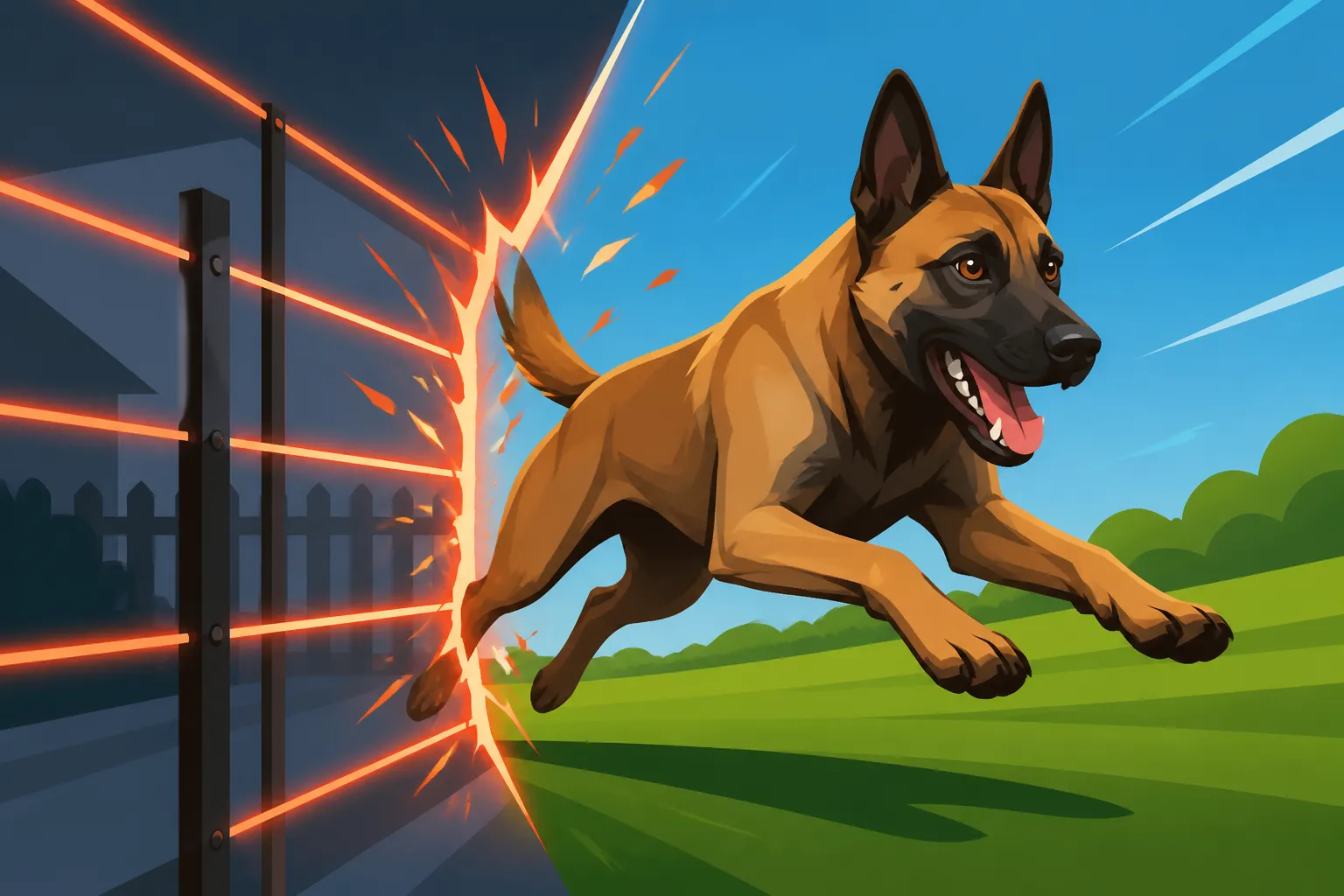
A Malinois, being incredibly smart, might eventually learn the exact spot where the correction occurs. But instead of respecting it as a barrier, they might learn strategies to circumvent it. Some will learn to simply take a running leap, pushing through the static correction as quickly as possible, knowing that once they are past that point, the discomfort stops. They effectively "take the hit" to get to the other side. The problem then becomes getting them to come back, as they've now learned that re-entering means another zap. This creates a psychological barrier to returning home, which can be just as dangerous as escaping in the first place.
Furthermore, a Malinois often needs clear, consistent rules. An invisible fence provides an inconsistent deterrent – sometimes it works, sometimes the drive is too high, sometimes the collar battery is low, sometimes the dog finds a dead spot in the line. This inconsistency can breed confusion and anxiety, rather than reliable understanding.
Barrier Frustration and Escalation
Imagine your Malinois is inside the invisible fence perimeter, and a person with a dog walks by on the sidewalk. Or a child on a scooter. Your Malinois's natural instinct to herd, protect, or simply investigate kicks in. They run to the boundary, get the warning tone, then the static correction. If they're trying to reach something interesting or perceived as a threat, this shock doesn't deter them from the target; it only causes frustration at the boundary.
This can lead to what's known as "barrier frustration." The dog is stimulated and highly aroused by something they want to get to, but they're being stopped by an unseen force. This can manifest as barking, lunging, spinning, or even redirected aggression towards other dogs or people within the "safe" zone. Instead of teaching them to stay calm, the invisible fence can amplify their reactivity and create negative associations with the perimeter of your property and anything that passes by it. This is a crucial point for a breed that needs careful socialization and management of its natural drives.
Safety and Practical Concerns for a Malinois
The consequences of an invisible fence failing with a Belgian Malinois can range from inconvenient to truly catastrophic. When you own a dog with the physical capabilities and drives of a Malinois, "containment" isn't just about keeping them home; it's about keeping them, and others, safe.
The Danger of Escape: When Drive Takes Over
A Malinois doesn't just "wander off" when they escape. They have purpose. If they've blasted through an invisible fence because they saw a deer, they are now committed to that chase. This means they are likely to run into traffic, potentially causing accidents. They could encounter other dogs, leading to fights, especially if the escaped Malinois is still highly aroused from the chase. They could trespass onto other people's property, creating liability issues, or even chase and injure livestock, bringing serious legal repercussions.
Imagine the panic of realizing your highly driven Whether a Malinois Is Ever Safe Off Leash Malinois has blown through the boundary. The sheer speed and athleticism of these dogs mean they can cover vast distances in minutes. Finding them can be a monumental task, especially if they are far from home and in an unfamiliar area. This is a dog bred to cover ground and stay focused on a job, not to dawdle. An escaped Malinois is a dog operating on pure instinct, and that instinct often doesn't align with road safety or polite neighborly conduct.
False Sense of Security for Owners
Perhaps the most insidious danger of an invisible fence for a Malinois owner is the false sense of security it provides. You invest in the system, you train your dog with it, and you believe your Malinois is safely contained. This can lead to less diligent supervision. You might leave them unattended in the yard for longer periods, or assume they'll be fine if you're briefly distracted.
The consequences of this misplaced trust are severe. That one moment of distraction, the one time your Malinois's prey drive is just a little stronger than the static correction, can lead to their escape. For a breed that requires constant management and stimulation, delegating their containment to an unreliable electronic system is a recipe for disaster. Owners might even avoid critical training because they think the fence handles the "staying home" part.
Potential for Behavioral Issues
Beyond just escaping, the chronic stress and confusion caused by an invisible fence can lead to genuine behavioral problems in a sensitive, intelligent Malinois. A dog that is constantly experiencing an unpleasant shock when trying to engage with its environment can develop:
- Anxiety and Fear: They might become generally anxious about being in the yard, or even about going outside at all. They might start to associate the outdoors with unpredictable and unpleasant sensations.
- Reactivity: As mentioned, barrier frustration can exacerbate reactivity to external stimuli. They might become more prone to barking, lunging, or displaying aggression towards anything they see beyond the boundary, because they're being stimulated but thwarted.
- Resource Guarding: In some cases, the stress can even generalize, making the dog more likely to guard resources within the "safe" zone, feeling insecure about their territory.
- Avoidance: While some Malinois will blast through, others might become avoidant, staying far from the boundary, which limits their usable yard space and can contribute to under-stimulation.
Ultimately, an invisible fence is trying to correct a natural drive with an artificial consequence that often doesn't "stick" or makes the situation worse. This is a disservice to a breed that thrives on clear communication, consistency, and purposeful work.
What Actually Works: Real Containment and Management
So, if invisible fences are out, what's a dedicated Malinois owner to do? The answer involves a combination of robust physical infrastructure, consistent training, and a deep understanding of the breed's needs.
Physical Fencing: The Non-Negotiable Reality
For a Belgian Malinois, there is simply no substitute for a physical, impenetrable fence. This isn't just any fence; it needs to be a Malinois-proof fence. This typically means:
- Height: At least six feet tall is a starting point, but many Malinois can easily clear six feet if motivated. Some owners opt for eight-foot fencing or add roll bars to the top to prevent climbing and jumping.
- Material: Strong, durable materials like chain-link (heavy gauge), privacy fence (sturdy wood or vinyl), or even solid kennel panels are necessary. A flimsy decorative fence will not hold a determined Malinois.
- Digging Prevention: Malinois are intelligent and will test boundaries. If they can't go over, they'll try to go under. The fence line needs to be buried or have a strong skirt (like L-footing or concrete) to prevent digging. Some owners bury sections of the fence itself or lay chicken wire/hardware cloth along the bottom perimeter to deter digging.
- Security: Gates need to be secure, with heavy-duty latches that a clever Malinois can't easily manipulate. Consider double-latching systems.
Think of your fence as the first line of defense, a solid, undeniable boundary. This allows your Malinois to understand "this is my space" without the confusing, stressful corrections of an invisible system. A secure physical fence means you can have a modicum of peace knowing your dog is contained. For more on this, you might find Fencing That a Belgian Malinois Cannot Clear helpful.
| Feature | Invisible Fence | Physical Fence (Malinois-Grade) |
|---|---|---|
| Containment Method | Static correction/tone, no physical barrier | Tangible, solid barrier |
| Malinois Perception | Confusing, unpleasant sensation at a location | Clear, visible, and tactile boundary |
| Effectiveness | Highly unreliable due to high drive/pain tolerance | Reliable if properly constructed and maintained |
| Safety | High risk of escape, traffic accidents, dog fights | Low risk of escape, better public safety |
| Behavioral Impact | Barrier frustration, anxiety, increased reactivity | Clear boundaries, reduced stress, confidence within space |
| Cost (Shape) | Initial setup plus ongoing battery/maintenance | Higher initial investment, less ongoing active cost for containment |
Structured Exercise and Mental Engagement
A physical fence, while crucial, is only half the battle. A contained Malinois is still a Malinois with boundless energy and a need for a job. A bored Malinois, even behind a Fort Knox-level fence, can become destructive, anxious, or develop obsessive behaviors. The absence of an invisible fence doesn't mean the absence of mental and physical stimulation.
Your Malinois needs a structured routine that addresses both their physical and mental needs. This goes far beyond just "running around the yard." Think about daily, vigorous exercise – not just undirected running, but purposeful activities like running alongside a bike, flirt pole play, or structured fetch sessions that involve commands and retrieves. Two Hours and a Job a Belgian Malinois Demands Daily is not an exaggeration.
Mental stimulation is equally vital. This breed thrives on problem-solving. Consider puzzle toys, interactive feeders, or engaging in scent work or obedience training every single day. Regular training sessions, even short ones, help to tire their minds. Retailers like Chewy offer a wide range of durable toys and enrichment tools that can help keep a Malinois's active mind occupied, preventing boredom that could lead to destructive behaviors, even within a secure yard. For high-quality nutrition to fuel this intense activity, exploring fresh food options like those from Ollie can also be beneficial, ensuring your working dog has the sustained energy they need. Understanding The Mental Work That Finally Tires a Malinois Out is key to a happy, well-adjusted Malinois.
Constant Supervision and Training
Even with the best physical fence and a robust exercise routine, a Belgian Malinois still benefits immensely from constant, attentive supervision. This isn't a breed you can simply put outside and forget about, even if your fence is eight feet high. They are too intelligent, too driven, and too focused on their environment.
Active supervision allows you to intervene before unwanted behaviors escalate, to redirect their attention from potential triggers, and to reinforce good habits. This goes hand-in-hand with ongoing, consistent training. Work on a rock-solid recall, even within the confines of your yard, so that if there's ever an accidental escape (perhaps a gate left open), you have a better chance of getting them back. Recall on a Belgian Malinois in Full Drive is a skill that takes diligent work.
Teach them a "place" command, a "leave it," and impulse control. These are skills that build their ability to manage their own powerful drives, making them safer and more reliable both on and off your property. And speaking of safety, if an accident were ever to happen, whether an escape leads to an injury or something else entirely, having comprehensive pet insurance can be a lifesaver. Providers like Healthy Paws can help manage the financial stress of unexpected vet bills, allowing you to focus on your dog's recovery. The combination of a strong physical boundary, purposeful mental and physical work, and consistent, engaged handling is the only real "invisible fence" that works for a Belgian Malinois – the one built on trust, training, and understanding.
Disclaimer
This article is for general informational purposes only and does not constitute professional advice. Laws, prices and regulations vary by location and change over time. Consult a qualified professional for guidance on your specific situation.