Famous Belgian Malinois in Police Service
A Belgian Malinois in a police vest can look like the whole story: fast, focused, fearless. The reality is more complicated. Many well-known Malinois worked in military or tactical units rather than routine patrol, and public accounts sometimes blur those roles. This guide separates the best-known dogs from the broader police history of the breed—and explains what their fame does and doesn’t tell you.
Famous Belgian Malinois in police and tactical service
Diesel, the French police dog remembered after the Saint-Denis raid
Diesel was a Belgian Malinois working with France’s RAID tactical police unit. She was killed during a police operation in Saint-Denis in November 2015, days after the coordinated terrorist attacks in Paris. News coverage of her death brought widespread attention to the risks faced by police dogs, particularly animals sent into dangerous spaces before human officers.
Diesel’s role is best understood as tactical police work, not ordinary patrol. A dog working with a unit such as RAID may be deployed in high-risk operations where officers need help searching a building, locating a person, or assessing an area. That differs from the daily work of a patrol K9, who might search for a missing person, track a suspect, or help an officer during a roadside stop.
Her story also illustrates an uncomfortable truth: police dogs can face lethal danger even when they are trained and handled by experienced professionals. Public recognition often comes after a loss, while the careful preparation, daily care, and teamwork behind a working dog are less visible. Diesel’s name remains associated with courage and service, but it should not turn a dangerous deployment into a spectacle.
Kye and the bond between a K9 and a handler
Kye, a Belgian Malinois serving with the Tarpon Springs Police Department in Florida, became widely known after he was killed in the line of duty in 2014. His death drew attention to the relationship between a police dog and the officer who works with him. A K9 is not simply equipment assigned to a shift; the dog and handler train together, rely on one another, and often spend a great deal of time together outside active calls.
That partnership matters to the dog’s work. The handler learns the dog’s behavior, signals, and limits, while the dog learns to respond to that particular person under pressure. In a search, for instance, the handler may need to interpret changes in the dog’s posture or pace rather than expect the animal to explain what it has found. Trust and consistent training are practical necessities, not just sentimental details.
The death of a police K9 can be especially difficult for the handler and the wider department. Communities may see a brief news report, but the handler has shared daily routines, training sessions, and working responsibilities with the dog. Kye’s story is one reason many departments and communities publicly recognize K9s who are injured or killed in service.
Cairo and Conan were military working dogs, not police K9s
Two other famous Belgian Malinois are frequently mentioned in conversations about police dogs: Cairo and Conan. Both became known through military operations, not routine police service. Cairo was associated with the U.S. Navy SEAL mission that killed Osama bin Laden in 2011. Conan was a military working dog who received public attention after an operation against Islamic State leader Abu Bakr al-Baghdadi.
Their stories are relevant because they show how the public often groups police, military, and other working dogs together. These jobs can share skills, such as searching, tracking, and working around armed people, but the organizations, training, and operational responsibilities differ. Calling every famous service Malinois a “police dog” can erase that distinction.
| Dog | Publicly known role | Why the distinction matters |
|---|---|---|
| Diesel | French RAID tactical police dog | A police K9 associated with a high-risk operation |
| Kye | Tarpon Springs police K9 | A local law-enforcement dog whose death brought public attention to K9 service |
| Cairo | U.S. Navy SEAL military working dog | Famous for military service, not municipal police work |
| Conan | Military working dog | Publicly recognized after a military operation, not a police deployment |
For more context on Cairo’s public profile, see Cairo and What One Raid Did to the Malinois and Whether the Bin Laden Raid Made Malinois Popular. The distinction is more than a technicality: it helps readers understand the range of jobs Malinois perform without treating every working dog as interchangeable.
Why Belgian Malinois became prominent in police work
Speed, athleticism, and a compact working build
Police agencies need dogs suited to the tasks they are expected to perform, and Belgian Malinois are often valued for their athleticism, agility, and ability to work closely with a handler. Their relatively light, muscular build can be useful when a dog needs to move quickly through varied environments or remain active through a demanding shift.
Those physical traits alone do not make a dog suitable for police work. A successful K9 also needs stable nerves, an appropriate temperament, sound health, and training suited to the job. A dog that is fast but cannot settle, recover from stress, or work reliably around distractions is not made effective by athletic ability. Selection is about the whole dog, not a dramatic sprint or an impressive bite.
The breed’s growing visibility in law enforcement reflects a wider history of working-dog selection and training. Police needs vary by department, and dogs may be assigned to patrol, detection, tracking, search, or specialized teams. How the Belgian Malinois Took Over Police Work explores the breed’s rise in that setting, while Why Dutch Police Turned to the Malinois looks at another part of its working history.
A working dog’s job is more than apprehension
Popular images often reduce police K9 work to chasing and catching a suspect. In reality, police dogs may be trained for different tasks, and some focus on detection or searching rather than apprehension. Depending on their training and assignment, they may help locate a missing person, find evidence, search a vehicle or building, or track a person through an outdoor area.
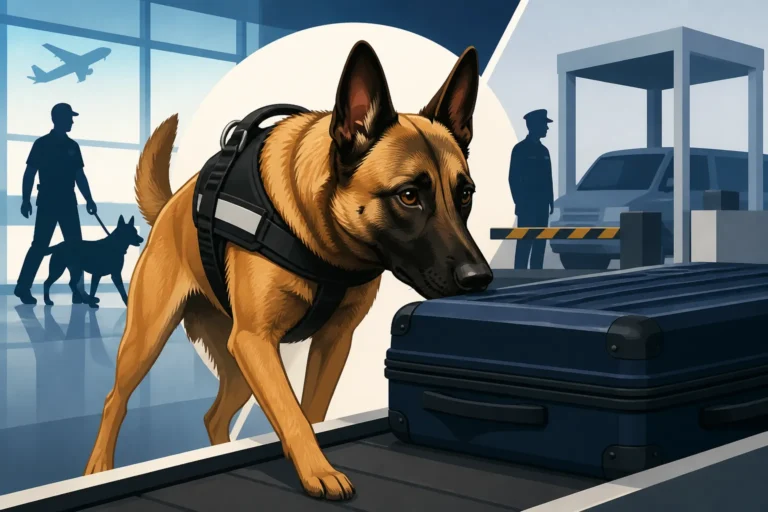
Detection work is a good example of why the breed’s reputation can be misleading. The important skill may be a dog’s ability to search methodically and communicate a find to the handler, not physical confrontation. Airport and other detection roles can require sustained concentration in busy environments, where people, noise, and unfamiliar smells compete for the dog’s attention. Learn more in The Belgian Malinois in Airport Detection Work.
Even within patrol work, dogs are not interchangeable tools. A department must match a dog’s abilities to its operational needs, then train the dog and handler as a team. Public videos tend to show the most dramatic moments, but the less visible work—obedience, controlled searching, environmental exposure, rest, and routine care—supports reliable performance.
Police-line dogs are not all the same
“Belgian Malinois” identifies a breed, not a single temperament or guaranteed working ability. Individual dogs can differ in confidence, sensitivity, energy, sociability, and willingness to work in unfamiliar settings. A strong reputation can tempt people to assume that any Malinois will naturally excel as a police dog. That is not how professional selection works.
Working lines and breeding choices also contribute to variation, but pedigree alone cannot predict how a dog will respond to real situations. A prospective handler or agency needs to assess the individual dog, its health, its behavior, and its suitability for the specific assignment. The Countries That Breed the Most Belgian Malinois offers broader breed context, but national origin is not a substitute for careful evaluation.
This matters for the public, too. Seeing a Malinois in a police unit does not mean the breed is automatically suited to an ordinary household. Police dogs receive structured training, have experienced handlers, and are selected for demanding roles. A family considering the breed should think about its own daily routine, skill, time, and ability to provide appropriate activity. Whether a Belgian Malinois Belongs in a Pet Home explores that question from the owner’s perspective.
What the fame of police Malinois can—and cannot—tell us
Public attention is selective
A K9 often becomes famous because of a particular event: a high-profile operation, a heroic search, an injury, or a death in service. That attention can make one dog a symbol of the entire breed, even though a single dog’s story cannot represent every Malinois or every police unit.
Media coverage also favors visually striking work. A short clip of a dog moving through a search may be memorable, while months of preparation and ordinary shifts are harder to capture. The result can be a distorted picture in which the most dramatic tasks seem like the only tasks these dogs perform.
This same pattern has shaped public interest in military Malinois. Cairo’s fame, for example, is tied to one widely discussed mission, although the dog’s life and work were broader than that single event. Keeping the context clear helps readers appreciate the dog without confusing public recognition with a complete account of police or military K9 service.
A police dog is trained and managed as part of a team
A K9’s performance depends on more than instinct. The handler must learn how to guide the dog, read its behavior, and manage the situation around it. Training is ongoing, and the dog’s work is shaped by department procedures, local laws, the assigned role, and the judgment of the people involved.
That teamwork also includes care. Working dogs need veterinary attention, conditioning suited to their role, recovery time, and safe handling. Their needs do not disappear when they leave the training field or finish a shift. For the public, that is a useful counterweight to the idea that a police dog is simply a tireless action hero.
Some working dogs eventually retire or move into a different home arrangement. A retired police K9 may need time to adjust to a quieter routine, and a prospective adopter should understand the dog’s history and behavioral needs rather than assume that its service record guarantees an easy transition. Routine supplies may be available through general pet retailers such as Chewy, but the right food, equipment, and transition plan should be discussed with the dog’s handler, rescue organization, or veterinarian. Chewy can be one place to compare everyday supplies, while a dog’s specific dietary or medical needs should guide any choice. For enrichment items, Chewy may offer familiar options, but introduce new items carefully and follow the advice of the people who know the dog’s background.
What not to infer from a famous K9
A famous police Malinois does not prove that the breed is naturally aggressive, that every Malinois can do police work, or that a household dog needs protection training. Those assumptions can lead to unsafe expectations. Police K9s are selected and trained for defined duties, and they work under professional supervision.
Nor does a police dog’s visible intensity mean it is constantly “on.” Working animals need downtime, routine, and rest. A dog that is expected to remain stimulated all day without structure or recovery may become difficult to manage, whether it is a working dog or a pet. The qualities that help a K9 perform—focus, energy, and responsiveness—need thoughtful direction.
The breed’s history is longer than modern police work. Belgian Malinois developed from herding-dog roots, and the breed’s public image has shifted as its roles have changed. For related background, see The Herding Job the Belgian Malinois Was Built For and Whether Belgian Malinois Served in Both World Wars. These histories help explain why a Malinois can appear in varied working settings, but they do not make police service the breed’s only meaningful identity.
How to understand a famous Belgian Malinois in service
Check the role before repeating the story
When you hear that a Malinois was a “police dog,” look for the specific unit and assignment. Was the dog part of a local patrol department, a tactical police team, a military unit, or a detection program? Those distinctions make an account more accurate and help avoid mixing together jobs that have different training and risks.
It is also worth separating confirmed details from viral retellings. A dog’s name may be widely shared, while details about its assignment or incident get simplified as the story travels. A careful description should identify what is known without adding dramatic claims that are not necessary to honor the dog.
Appreciate the dog without romanticizing the work
The best way to remember a police K9 is to recognize both the dog’s service and the people responsible for its welfare. Courage is part of the story, but so are selection, training, teamwork, safety decisions, and care. That fuller view respects the dog more than treating it as a symbol of toughness alone.
Famous Belgian Malinois such as Diesel and Kye help bring attention to the risks and relationships involved in K9 service. Cairo and Conan show why the labels “police dog” and “military working dog” should not be blurred. Taken together, their stories explain the breed’s public profile while leaving room for an important fact: each working dog is an individual, and its role depends on the team and circumstances around it.
Disclaimer
This article is for general informational purposes only and does not constitute professional advice. Laws, prices and regulations vary by location and change over time. Consult a qualified professional for guidance on your specific situation.