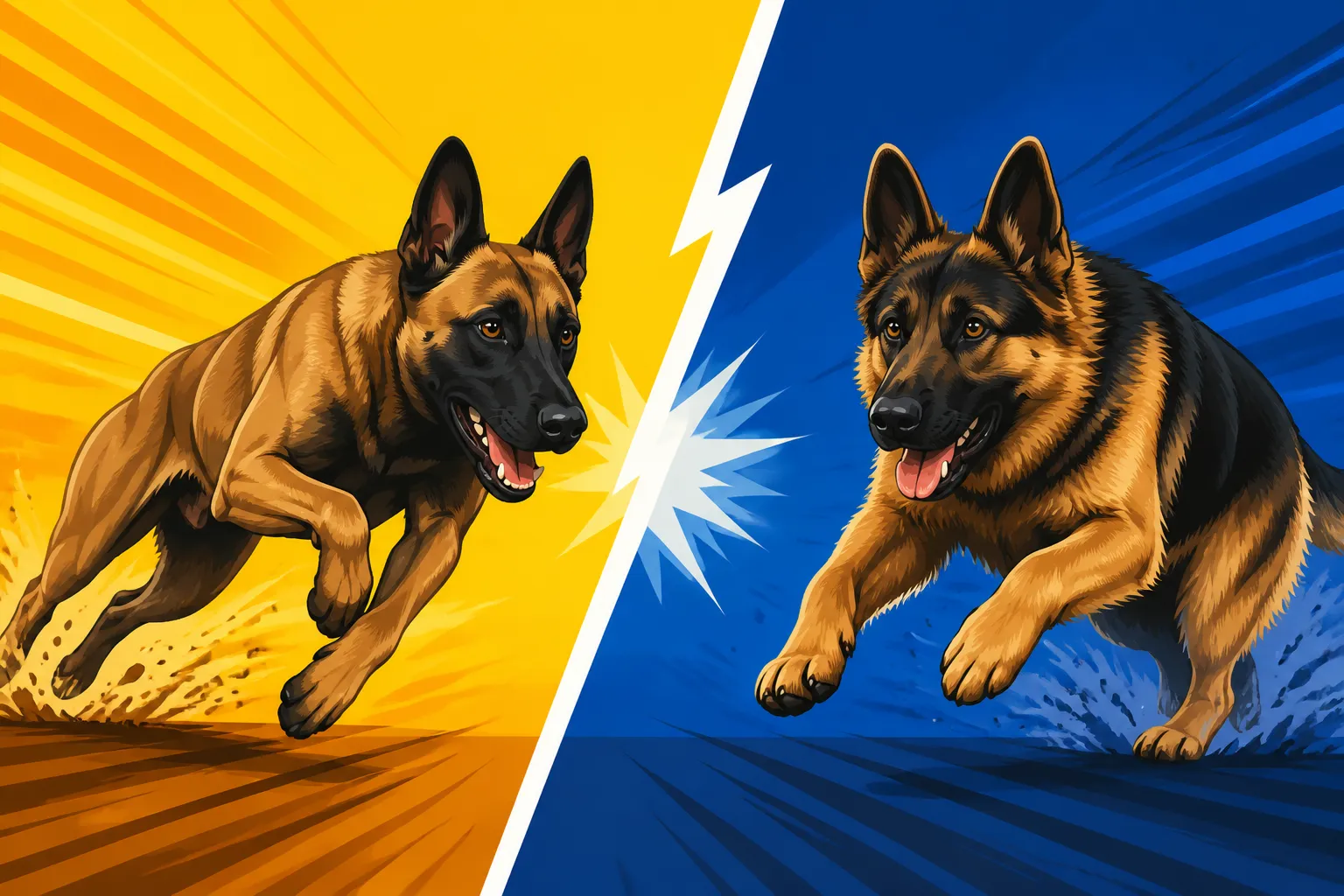
Whether a Belgian Malinois Is Faster Than a Shepherd
A Belgian Malinois can look startlingly fast beside a German Shepherd, especially in short bursts, but a few viral clips cannot settle which breed is faster. Speed depends on the individual dog, distance, footing, conditioning, and what “fast” means. This guide explains the differences, what affects performance, and how to compare the breeds without putting either dog at risk.
Is a Belgian Malinois faster than a German Shepherd
The short answer depends on the kind of speed
There isn’t one universal winner in every situation. A fit Belgian Malinois may have an edge in quick acceleration and nimble changes of direction, while an athletic German Shepherd can also run at impressive speeds and maintain a strong pace. Individual dogs vary substantially, so breed alone does not predict the result.
It also matters what you mean by “faster.” A dog that reaches top speed quickly over a short distance may not be the best at holding a steady pace over a longer run. And a dog that turns sharply through obstacles may look quicker than one running flat out in a straight line, even if their top speeds are similar.
That’s why claims comparing the breeds often conflict. Videos may show dogs of different ages, fitness levels, or training histories, running on different surfaces and over different distances. Without a consistent test, a comparison is more impression than measurement.
Why the Malinois often looks so quick
The Belgian Malinois is a lean, athletic working dog, and its build can lend itself to quick movement and rapid changes of direction. Many Malinois are also trained for activities that reward acceleration, agility, and fast responses. When you see one spring into motion or pivot after a toy, it can create a strong impression of exceptional speed.
German Shepherds vary widely in build and breeding, too. Some are powerful, athletic dogs; others may be heavier or less conditioned for fast running. A comparison between a very fit Malinois and a dog with a different build or training background says more about those two individuals than it does about every dog in either breed.
The breeds’ overall appearance and movement are shaped by more than body weight or leg length. If you’re comparing structure, The Square Outline a Belgian Malinois Should Have and The Height Limits a Belgian Malinois Is Judged Against offer useful background on the Malinois’s proportions. A dog’s physique can influence how it moves, but it cannot guarantee a particular race result.
What affects a dog’s running speed
Build, stride, and individual variation
A dog’s shape can affect how it accelerates and moves. Body proportions, muscle development, coordination, and overall soundness all matter. But there’s no single ideal body type that makes every dog the fastest. A dog’s confidence, willingness to run, and familiarity with the setting may affect what you see as much as its physical build.
Coat can create a visual impression, too, but it is not a speed measure. The Malinois has a short coat with an undercoat, described in The Harsh Outer Coat a Malinois Should Carry. A sleek appearance may make a dog look especially streamlined, but coat texture does not tell you how fast that dog can safely run.
Age and health are just as important. A young dog may be energetic but still growing, while an older dog may have a long history of conditioning and better pacing. Pain, fatigue, injury, or excess weight can change a dog’s stride and willingness to move. A sudden change in running style deserves attention rather than being treated as a simple loss of speed.
Training, motivation, and the surface
A dog that is highly motivated by a toy, scent, or handler may sprint with more enthusiasm than one that has no reason to run. That doesn’t mean the motivated dog has a higher top speed; it means the situation affects how much effort it gives. A dog’s response to cues and distractions can also shape how quick it looks during a training exercise.
Footing matters. Grass, sand, gravel, pavement, and slippery surfaces affect traction and the dog’s ability to push off or turn. Heat, cold, and uneven ground can change how safe and comfortable it is to exercise. A straight sprint on a level field is not comparable to a run that includes sharp turns or obstacles.
Training should build fitness gradually rather than trying to force a speed comparison. For a Malinois, The Age a Belgian Malinois Can Start Real Conditioning and Structured Work Against Random Running for a Malinois are useful related reads. If a dog is just starting to exercise, short, controlled sessions are generally a more sensible choice than repeated all-out sprints.
| Factor | How it can affect a comparison | What to keep in mind |
|---|---|---|
| Distance | A short sprint tests acceleration; a longer run tests pacing and endurance | Compare dogs over the same distance |
| Conditioning | A fit dog may outperform a faster-looking but unconditioned dog | Build fitness gradually |
| Surface | Footing influences traction, turns, and confidence | Avoid slippery or hazardous ground |
| Age and health | Growth, soreness, and injury can alter movement | Stop if a dog limps or seems uncomfortable |
| Motivation | Toys or cues can change a dog’s effort | Excitement is not proof of top speed |
| Individual build | Dogs within the same breed can differ considerably | Don’t assume every Malinois or Shepherd performs alike |
Comparing the breeds fairly and safely
A fair test needs consistent conditions
If you’re curious about two particular dogs, compare them in a safe, controlled setting. Use the same flat, open area, the same distance, and similar conditions. Give each dog a chance to warm up, and avoid testing in heat, on slick ground, or around hazards. A short, supervised run is safer than repeatedly asking dogs to race at maximum effort.
Do not use a vehicle, bicycle, or fast-moving object to make a dog chase. A dog focused on catching something may ignore fatigue, poor footing, or an obstacle. This is especially risky for high-drive dogs that can become intensely focused on the task. For practical exercise ideas, Running a Belgian Malinois Beside a Bike discusses the need for care and preparation before adding a moving bicycle to a dog’s routine.
Avoid turning a casual comparison into a competition the dogs cannot opt out of. If one dog slows down, veers away, or seems uncomfortable, stop. A dog may be reluctant because it is tired, stressed, distracted, or sore—not because it needs more pressure to “try harder.”
Use activity goals rather than race results
For most owners, the more useful question is not which breed wins a sprint. It is whether the dog can participate comfortably in the activities you have planned. A Malinois that enjoys structured training may thrive with suitable work and recovery, while a German Shepherd may be a better fit for a different household or activity. Neither breed should be expected to perform at maximum intensity every day.
If you’re considering agility, speed is only one part of the picture. Coordination, safe jumping technique, confidence, and recovery matter as well. Whether a Malinois Has the Body for Agility provides relevant context, while Whether Jumping Damages a Young Malinois's Joints is worth reading before introducing repeated impact to a growing dog.
Pay attention to how each dog moves before, during, and after exercise. A persistent limp, reluctance to put weight on a leg, unusual stiffness, or a sudden change in gait is a reason to stop the activity and contact a veterinarian. A dog that looks fast is not necessarily sound, and a dog that runs less enthusiastically may be communicating discomfort.
Helping a fast dog stay fit without overdoing it
Build fitness through gradual, varied activity
Start with a level of exercise your dog can handle comfortably, then increase duration or intensity in small steps. Mix walking, controlled play, training, and rest instead of relying on repeated high-speed runs. A short session with pauses can be more appropriate than pushing for a long stretch at full effort, especially if the dog is young, returning from time off, or new to exercise.
Warm-ups and cool-downs can help make activity more thoughtful. Begin with easy movement before faster work, and finish with a calm walk rather than stopping abruptly after an intense sprint. Keep water available and allow recovery between demanding sessions. For help thinking through structured exercise, How Many Hours a Belgian Malinois Should Work Daily offers a related perspective on balancing activity with a dog’s needs.
Also watch the weather and the ground. Hot pavement can injure paws, and warm conditions can make vigorous exercise risky. Check your dog’s feet after running, particularly after training on rough or unfamiliar surfaces. If you’re choosing a harness or other walking gear, Chewy’s listings can help you compare product sizing information, but check the maker’s fitting guidance and adjust the equipment so it does not rub or restrict movement.
Choose equipment for control and comfort
Good equipment does not make a dog faster, but it can make everyday exercise safer and easier to manage. A well-fitted harness or collar should allow comfortable movement without rubbing. For outdoor training, a leash or long line can provide control while giving the dog room to move in appropriate areas.
Fit matters more than appearance. Check the straps for pressure points, watch for chafing, and make sure the dog can walk, turn, and lie down comfortably. Chewy may carry a range of options, but the right choice depends on the dog’s shape, behavior, and activity. Always inspect gear for wear before using it, especially if a strong dog has been pulling or chewing on it.
If your dog is difficult to handle around distractions, work on control and calm responses before adding speed or distance. More excitement is not always better conditioning. A dog that can respond to cues, settle between repetitions, and move comfortably is better prepared for regular activity than one being pushed through a race-like workout.
The Belgian Malinois may look quicker than a German Shepherd in certain bursts, particularly when the Malinois is fit, motivated, and changing direction rapidly. But there is no fair breed-wide verdict that applies to every dog or every distance. Compare individual dogs under consistent conditions, focus on comfort and sound movement, and choose exercise that suits the dog in front of you. When selecting everyday gear, Chewy can be one place to check fit details, but the dog’s comfort and safe handling should guide the decision.
Disclaimer
This article is for general informational purposes only and does not constitute professional advice. Laws, prices and regulations vary by location and change over time. Consult a qualified professional for guidance on your specific situation.