Handling a Belgian Malinois at the Groomer
Taking your high-drive Belgian Malinois to the groomer can feel like preparing for battle. Many owners face the unique challenge of managing a dog that views every new environment, sound, and touch as a potential threat or an invitation to go, go, go, making even a simple bath or nail trim an incredibly stressful experience for everyone involved. This comprehensive guide will walk you through practical strategies, from foundational home training to selecting the right professional, to help make grooming a calmer, more positive routine for your Malinois.
Understanding Why Grooming is a Challenge for a Malinois
It’s not just about a dog being "naughty" or "stubborn" at the groomer; with a Belgian Malinois, there are often deeper, breed-specific reasons why these appointments can escalate into high-stress situations. Understanding these underlying factors is the first step toward finding effective solutions.
The High Drive and Environmental Sensitivity
Belgian Malinois are incredible dogs, built for work, intensity, and unparalleled situational awareness. This hyper-vigilance, while fantastic for their working roles, can be a real hurdle in a busy, novel environment like a grooming salon. Think about it: a typical grooming shop is a sensory overload. There are unfamiliar dogs barking, the whir of clippers, the splash of water, the scent of dozens of different shampoos and other animals, and multiple strangers moving quickly.
For a Malinois, this isn't just "noise"; it's a cacophony of potential triggers. Their finely tuned instincts tell them to react to every change, every unexpected touch, and every sudden sound. They thrive on predictability and control, and a grooming table offers neither. When they feel their control slipping, their instinct to defend, to flee, or to simply redirect their intense energy can kick in, making them difficult to handle. It's not malice; it's often a manifestation of their deeply ingrained drive and a nervous system that is always on high alert, struggling to cope with an environment that feels chaotic and unpredictable. This is often why owners find their Malinois becoming anxious or defensively snapping during nail trims, or thrashing around when being bathed – they are simply overwhelmed and reacting to what feels like an uncontrollable situation.
Lack of Early Exposure and Positive Association
One of the biggest pitfalls for many Malinois owners, especially those who acquire their dogs as puppies, is underestimating the critical importance of early, consistent, and positive exposure to handling and novel environments. Malinois puppies, despite their tiny size, are already exhibiting the foundational traits of their breed. They can be mouthy and prone to using their teeth to explore their world, often entering The Shark Phase Every Malinois Puppy Goes Through. If a puppy isn't consistently handled from nose to tail, having their paws touched, ears gently examined, and mouths opened, they will grow into an adult who finds these sensations alarming or intolerable.
Without these crucial early experiences, a trip to the groomer becomes a trial by fire. The dog associates the groomer's touch with restraint, discomfort, or an unknown threat, rather than a neutral or even pleasant experience. It's incredibly difficult to undo months or years of negative associations (or simply lack of association) once a Malinois is fully grown and its strong will and physical capabilities are developed. The goal isn't just to tolerate grooming, but for the dog to ideally view it as something that happens, with minimal fuss, because they were taught from a young age that human touch and strange tools are nothing to fear when associated with positive outcomes like treats and praise.
Pre-Groomer Prep: Laying the Groundwork at Home
Successfully navigating grooming appointments with a Belgian Malinois largely depends on the work you put in before you ever step foot in a salon. Think of your home as the primary training ground, where you can systematically desensitize your dog and build positive associations without the added stress of a professional setting.
Desensitization to Touch and Tools
This is where the real magic happens, though it requires consistency and patience. Start small, in a calm environment, and always end on a positive note. The goal is to make every touch and every tool a predictor of something good.
Begin by gently touching your Malinois all over their body, especially sensitive areas like paws (between the toes!), ears, tail, and muzzle. Use a soft, reassuring voice, and immediately follow each touch with a high-value treat. For instance, touch a paw, say "good," give a treat. Repeat. Gradually increase the duration of the touch. When you introduce a brush, don't just start brushing. Let your Malinois sniff the brush, then reward. Gently touch their coat with the brush, reward. Build up to short strokes, always pairing it with treats and praise.
For things like nail trims, which are often a huge point of contention, get your dog used to the sound and feel of clippers or a dremel before you even try to trim a nail. Turn the dremel on, let them hear the sound, and immediately give a treat. Do this repeatedly, moving the dremel closer to their paw without touching them, then touching the dremel to a nail for a split second, then immediate reward. This slow, methodical desensitization is paramount. You might find a program like BAXTER & Bella incredibly helpful in structuring these early training sessions, as they often emphasize foundational handling and positive reinforcement techniques that can be applied to grooming. The key is never to push to the point of fear or aggression; always stay below that threshold. Short, frequent sessions (5-10 minutes, several times a day) are far more effective than long, infrequent ones.
Building a Strong "Relax" or "Place" Command
One of the most valuable commands you can teach your Malinois for grooming (and life in general) is a solid "Place" or "Relax" command. This teaches them to settle calmly on a designated mat or bed, even amidst distractions. For a breed that struggles to settle, this is an absolute game-changer. Teaching your dog Building an Off Switch Into a Belgian Malinois is critical for managing their intense energy in situations where they need to be still.
Start by luring your Malinois onto their mat with a treat. Once they're on it, reward them. Gradually increase the time they spend on the mat, continuously rewarding for staying put and being calm. As they get better, introduce mild distractions. The ultimate goal is for them to understand that "Place" means "lie down and chill, no matter what." Practicing this command extensively at home, in different rooms, and eventually in mildly distracting outdoor settings, will build a reliable behavior that you can lean on when they're at the groomer. If your dog can settle on command, even on a strange table, it drastically reduces their stress and makes the groomer's job safer and easier.
Physical and Mental Exertion Before a Grooming Appointment
You wouldn't expect a child hyped up on sugar to sit still for an hour-long haircut, right? The same principle applies, in spades, to a Belgian Malinois. These dogs are intelligent, athletic powerhouses that require significant physical and mental stimulation daily. Taking an under-exercised Malinois to the groomer is almost guaranteed to result in a challenging experience.
Before any grooming appointment, dedicate ample time to thoroughly exercise your Malinois. This isn't just a leisurely walk around the block; this means a vigorous run, a demanding fetch session, or some intensive training that engages their mind and body. Think about getting them to the point where they are genuinely tired, not just "fresher for later." Intense mental games, like extended scent work or puzzle toys, can also help The Mental Work That Finally Tires a Malinois Out. The goal is to drain some of that boundless energy and focus, making them more amenable to standing still and less likely to react out of pent-up frustration or excitement. A physically and mentally satisfied Malinois is a far more relaxed and cooperative client for any groomer.
Navigating the Grooming Appointment Itself
Even with all the home preparation, the actual grooming appointment can still present its own set of hurdles. Strategic choices and clear communication are key to ensuring the experience is as smooth as possible for your Malinois.
Choosing the Right Groomer and Communication
This is perhaps the most crucial decision. Not all groomers are equipped, or willing, to handle a high-drive, potentially sensitive Belgian Malinois. You need a professional who understands working breeds, exhibits patience, and prioritizes safety and positive reinforcement over speed.
What to look for in a groomer:
- Experience with challenging breeds: Ask directly if they have experience with Malinois, German Shepherds, or other intense working dogs. Do they understand their drives and potential for reactivity?
- Patience and force-free methods: A good groomer will take their time, use treats, and avoid harsh corrections. They should be willing to do "mini-sessions" or take breaks if your dog is struggling.
- Clear communication: They should ask you about your dog's temperament, triggers, and past grooming experiences. Crucially, they should also be willing to tell you if they believe they are not the right fit for your dog.
- Safety protocols: Are they comfortable using a muzzle if necessary? (More on this below.) Do they have safe restraint methods that don't cause undue stress?
Before booking a full appointment, ask if you can bring your Malinois in for a short "meet and greet." This allows your dog to briefly sniff around the salon, meet the groomer, and receive some treats, building a positive first impression without the pressure of a full groom. This small step can make a huge difference in how your dog perceives subsequent visits. Don't be afraid to interview several groomers until you find one who truly understands your Malinois's needs.
Strategies for a Smoother Grooming Session
Once you've found the right groomer, there are several strategies you can employ during the session itself to mitigate stress and ensure safety.
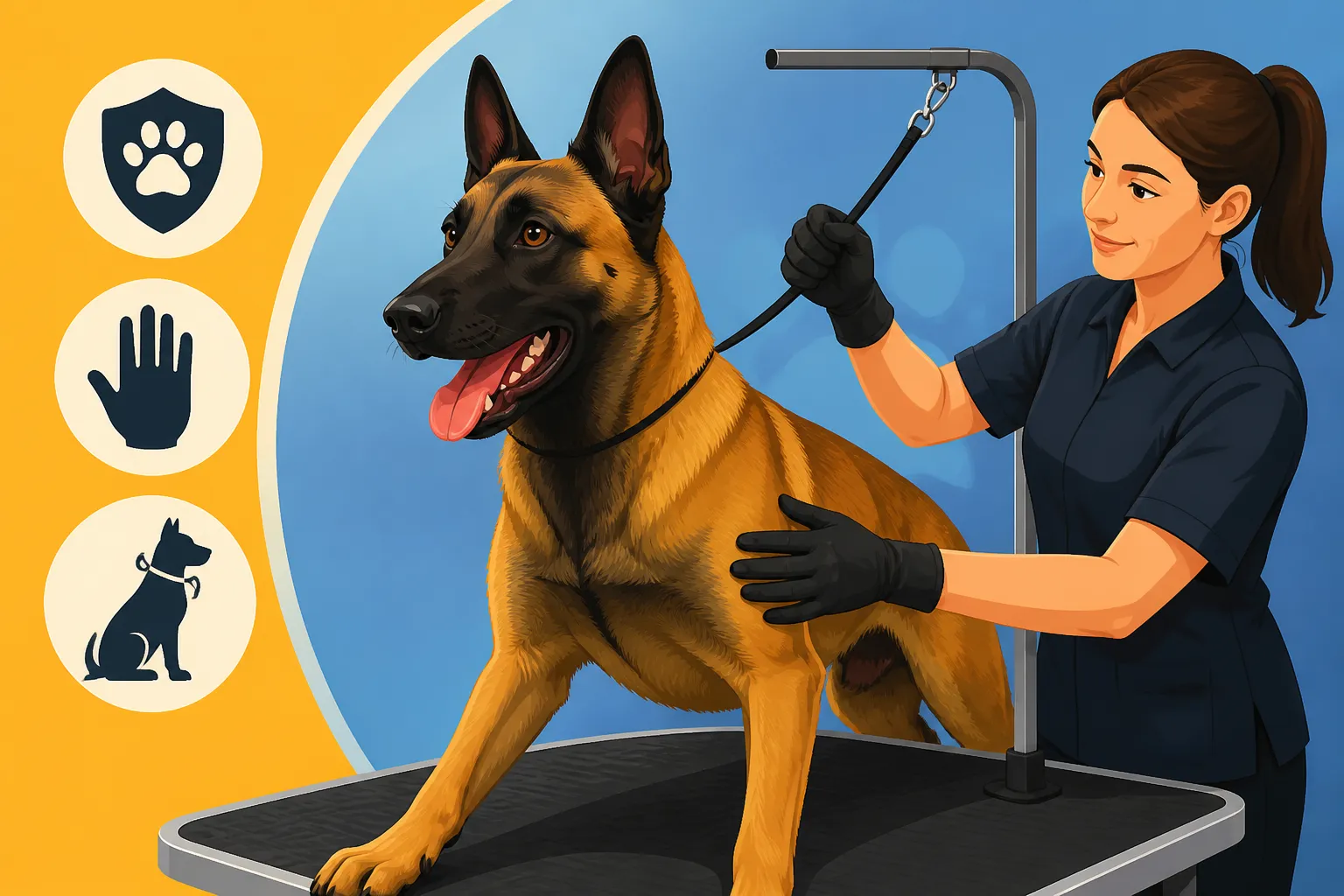
One of the most important tools, often misunderstood, is muzzling. For a Malinois, a well-fitted basket muzzle is not a punishment; it's a safety tool that allows the groomer to work without fear of being bitten, which in turn allows them to be calmer and more patient with your dog. A dog that is muzzled can still take treats and pant comfortably. The key is to condition your Malinois to wear a muzzle positively, long before they ever need it for a stressful situation. Treat it like any other piece of equipment, pairing it with high-value rewards. Read up on Muzzle Conditioning Before a Malinois Ever Needs One to learn how to introduce it correctly. If your Malinois is accustomed to wearing a muzzle, it can greatly reduce tension during grooming.
Discuss with your groomer the possibility of breaking up the session. Instead of trying to do everything at once, perhaps your dog gets their nails done one day, and a bath a few days later. This can prevent sensory overload. High-value, long-lasting distractions, like a frozen lick mat covered in peanut butter or pureed pumpkin, can also be invaluable. These types of enrichment tools can be easily found on platforms like Amazon and can provide a much-needed mental break and positive association during potentially uncomfortable procedures. Some groomers might even allow you to stay in the room, or to drop off your dog for a short period and pick them up later, reducing the duration of stress. Make sure your groomer knows your Malinois's "tells" – the subtle signs they give when they're starting to get uncomfortable, so they can take a break before a full meltdown.
At-Home Grooming as an Alternative or Supplement
For many Malinois, especially those who are particularly sensitive, doing some or most of the grooming at home can significantly reduce stress. While professional groomers have specialized equipment (like high-velocity dryers) and expertise for certain tasks, you can handle a lot of the routine maintenance yourself.
Benefits of home grooming:
- Controlled environment: You can choose a quiet time and place, free from the overwhelming stimuli of a salon.
- Paced sessions: You can go at your dog's pace, taking breaks as needed, and keeping sessions short and positive.
- Builds trust: Consistent, positive handling at home reinforces your bond and helps your dog trust your touch.
- Cost-effective: Regular home grooming reduces the frequency of costly professional appointments.
Invest in quality grooming tools appropriate for a Malinois's short, dense double coat, such as a sturdy bristle brush, a de-shedding rake, and a good nail grinder or clippers. Resources for training your Malinois to accept nail trims, like Getting a Malinois to Hold Still for Nail Trims, can be found through various online guides and videos. While you can often manage brushing and even bathing, some tasks like anal gland expression, ear cleaning, or intricate clipping might still require a professional. Even if you only go to the groomer for these specific tasks, you've significantly reduced the overall stress for your dog by handling the rest at home.
It's about finding a balance that works for your individual Malinois, knowing their limits, and advocating for their comfort.
| Feature / Task | Home Grooming (Pros) | Home Grooming (Cons) | Professional Grooming (Pros) | Professional Grooming (Cons) |
|---|---|---|---|---|
| Environment | Controlled, familiar, low-stress | Limited equipment, can be messy | Specialized tools (high-velocity dryer, tubs) | Noisy, unfamiliar, high-stress for some Malinois |
| Pace | Owner-controlled, flexible, short sessions | Time-consuming for owner | Efficient due to experience and tools | Can be rushed, less sensitive to individual dog's pace |
| Trust/Bond | Reinforces positive handling, strengthens bond | Owner might lack confidence or skill | Expertise in handling difficult dogs | Can be traumatic if handled poorly |
| Cost | Initial tool investment, then free | Requires owner's time and effort | Convenient, all-inclusive pricing | Can be expensive, especially for reactive dogs |
| Specific Needs | Good for routine care (brushing, basic nails) | May struggle with difficult tasks (anal glands, teeth) | Handles complex tasks, specialized cuts, sedation | Potential for over-restraint or misunderstanding dog |
| Safety | Safer for dog if owner is calm and skilled | Risk of owner injury if dog is reactive | Trained to handle and ensure safety | Risk of groomer injury, dog injury if not careful |
Disclaimer
This article is for general informational purposes only and does not constitute professional advice. Laws, prices and regulations vary by location and change over time. Consult a qualified professional for guidance on your specific situation.