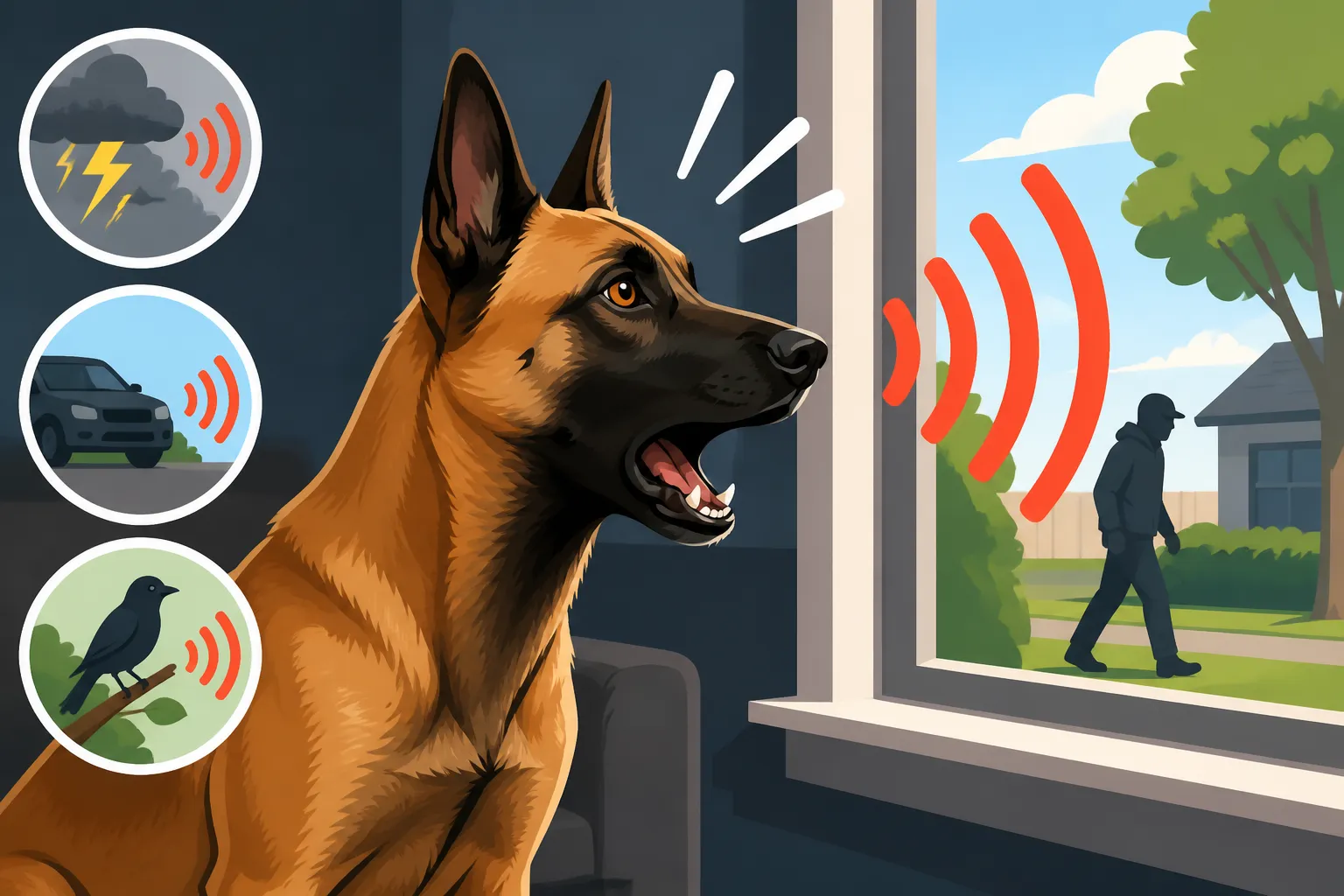
A Malinois That Alerts to Every Sound Outside
You got a Belgian Malinois, probably dreaming of that focused, intense partner you saw in videos, but instead, you're living with a four-legged alarm system that barks at falling leaves, distant sirens, and the ghost of a squirrel from last week. This constant vigilance can be incredibly frustrating, leaving you feeling like you're always on edge, apologizing to neighbors, and wondering if your dog will ever just relax. This guide is going to dive deep into why your Malinois might be alerting to every sound outside, and more importantly, how you can actually do something about it.
The Malinois's Built-In Alarm System: Understanding the "Why"
It's easy to feel like your Malinois is just being "naughty" or deliberately disruptive when they bark at every little sound. But for these incredible dogs, this behavior is often deeply rooted in their genetics and purpose. Understanding this isn't about excusing the behavior, but about approaching it with empathy and the right training mindset.
A Legacy of Hyper-Awareness
Let's face it: Belgian Malinois weren't bred to be couch potatoes. They were developed in Belgium as robust, intelligent, and highly vigilant herding dogs. Their job was to protect livestock, manage flocks, and alert their handlers to any potential threats or changes in their environment. This meant being exquisitely tuned into every sight, sound, and smell. That distant rustle in the bushes might be a sheep straying, or a predator approaching. That faint sound on the horizon could signal an intruder.
This historical role has been further amplified by modern breeding for police, military, and protection sports. These lines prioritize dogs with intense drive, incredible focus, and an acute awareness of their surroundings. They are literally selected for their ability to detect and react to stimuli that others might miss. So, when your Malinois barks at a delivery truck three streets away or the faint chirp of a bird, they're not necessarily trying to annoy you; they're often just doing what centuries of breeding have hardwired them to do. It’s their brain shouting, "Alert! Something is happening! Investigate!"
The Thin Line Between Alertness and Over-Responsiveness
There's a big difference between a dog that is appropriately alert and one that is over-responsive or reactive. An appropriately alert Malinois might give a single, deep bark at a stranger at the door, then settle when you acknowledge it. An over-responsive Malinois, however, might launch into a sustained, frantic barking spree at the same stimulus, perhaps even pacing, panting, or jumping at the windows. This isn't just "being a Malinois"; it's a sign that their stress threshold is low, or they lack the coping mechanisms to process the stimulus calmly.
Often, this over-responsiveness stems from a combination of factors: genetics, insufficient mental and physical exercise, lack of an "off switch" in training, or even anxiety. Without proper guidance and a structured environment, that innate vigilance can quickly spiral into a disruptive habit. They learn that barking works, whether it's to scare off the perceived threat (the mailman) or simply to get your attention. It becomes a self-reinforcing cycle, and breaking it requires consistent effort and a deep understanding of your dog's needs. Many owners find themselves accidentally reinforcing this behavior without realizing it, perhaps by rushing to the window or trying to soothe the dog, both of which can inadvertently confirm that there was something worth barking at.
Decoding the Triggers and Assessing Your Environment
Before you can effectively address the problem, you need to become a detective. What exactly is your Malinois reacting to? When does it happen? And how much of it is within your control to change? This observational phase is crucial for developing a targeted training and management plan.
Common Culprits: What Sets Them Off?
The list of potential triggers for an external-sound-alerting Malinois can feel endless, and often, it's a combination of several things. Here are some of the usual suspects:
- Auditory Stimuli: This is the most obvious category. Sirens, distant car alarms, children playing down the street, barking dogs in other yards, delivery trucks, construction noises, the chime of an ice cream truck, even certain high-pitched bird calls or the subtle rustle of leaves in the wind. Malinois hearing is incredibly acute, and sounds that are barely perceptible to us can be a full-blown concert to them. They can discern subtle changes in frequency, intensity, and location, making them highly sensitive to their acoustic environment.
- Visual Stimuli: Sometimes the sound is just the precursor to a visual. A shadow moving past the window, someone walking their dog on the sidewalk, a car pulling into a driveway across the street, or even reflections. If your Malinois has access to windows and doors that offer a view of the outside world, they're constantly taking in data, and any visual coupled with a sound can intensify their reaction.
- Olfactory Stimuli: Don't underestimate the power of scent! A Malinois's nose is highly developed. The smell of a passing person, another dog, or a wild animal can trigger an alert, even if there's no visible or audible cue for us. They might sniff the air, then move to a window or door, and then the barking starts. They're processing a whole world of information that remains invisible to us.
- Routine Disruptions: Malinois thrive on routine and predictability. Any deviation can be a trigger. If the mail arrives at an unusual time, if a neighbor has guests over, or if there's construction equipment where there usually isn't, this can throw them off and increase their alert behaviors. They perceive these changes as potential threats to their perceived territory.
Understanding these triggers allows you to predict situations and either proactively manage them or integrate them into desensitization exercises. Keep a log of when and what your Malinois barks at; you might uncover patterns you didn't notice before.
Your Home Environment as a Contributing Factor
Your home environment plays a significant role in either exacerbating or mitigating your Malinois's sound sensitivity. If your dog has unrestricted access to windows and doors with clear views, you're essentially providing a constant stream of triggers. This can build reactivity over time, as they feel compelled to "do their job" by alerting to everything they see and hear.
Consider how your living space might be setting your dog up for failure:
- Window Access: Dogs that spend all day staring out a window, barking at everything that moves, are practicing and reinforcing that behavior. It becomes a habit, deeply ingrained.
- Sound Transmission: Is your home poorly insulated, allowing every outside noise to permeate? Do you live on a busy street? The sheer volume of incoming sensory information can be overwhelming for a Malinois.
- Lack of "Safe" Spaces: Does your Malinois have a quiet, den-like space where they can truly relax and feel safe from external stimuli? A crate covered with a blanket, or a specific room away from windows, can be invaluable for teaching them to settle. Crate Work With a Malinois Puppy That Screams touches on the importance of calm in a crate.
- Insufficient Enrichment: A bored Malinois is often a noisy Malinois. If they don't have enough appropriate outlets for their intelligence and energy, they will find their own "jobs," and often that job becomes guarding the perimeter from imaginary threats. This is where puzzle toys, chew items, and structured play come in.
Making thoughtful adjustments to your dog's immediate environment can often be the first, most impactful step in reducing excessive alerting. Sometimes, it’s about reducing the opportunities for the behavior to occur, allowing you to then focus on teaching alternative responses.
| Trigger Category | Common Examples | Management Strategy (Initial) | Training Strategy (Long-term) |
|---|---|---|---|
| Auditory | Sirens, delivery trucks, distant barking, loud conversations | White noise machine, music, fan, closed windows, soundproof curtains | Desensitization (controlled exposure), "Quiet" command, redirection |
| Visual | People walking by, other dogs, squirrels, cars, shadows | Window film (frosted/privacy), curtains/blinds, baby gates to block access | "Leave it" command, focus on handler, positive reinforcement for ignoring |
| Olfactory | Animal scents, strong neighborhood smells | Limited outdoor access (supervised), scent work for appropriate outlet | Scent discrimination training (channel drive), redirection |
| Routine Disruption | Unexpected visitors, unusual delivery times, new sounds | Consistent schedule, positive reinforcement for calm during changes | General resilience training, "place" command during disruptions |
Strategies for Quieting the Commotion: Training and Management
Now that we understand the "why" and have identified potential triggers in your environment, it's time to talk about practical solutions. Managing a Malinois's reactivity to outside sounds requires a multi-pronged approach combining environmental management with consistent, thoughtful training. This isn't a quick fix; it's a commitment to reshaping your dog's emotional and behavioral responses.
Building an Internal "Off Switch"
One of the biggest challenges with a Malinois is their intense drive and perpetual "on" state. Teaching them an "off switch" is paramount for managing their reactivity. This means actively training them to settle, relax, and ignore environmental stimuli rather than constantly scanning for something to react to.
- "Place" Command Mastery: A strong "place" command is invaluable. This isn't just about lying down; it's about staying on a designated spot (a bed, a mat) regardless of distractions, for extended periods. Start in a quiet environment, slowly introduce minor distractions, and then gradually increase the challenge. The goal is for your Malinois to go to their place and stay there calmly when you need them to disengage from the outside world. This can be particularly useful when a delivery truck pulls up or children start playing loudly outside. It gives them a job: "Your job right now is to be calm on your place."
- Relaxation Protocols: Actively train your Malinois how to relax. This sounds simple, but for many Malinois, it's a learned skill. Use a specific phrase like "relax" or "settle" when they are naturally calm, rewarding them with quiet praise or a gentle stroke. Gradually, you can pair this command with a mat or bed. The objective is to create a positive association with calmness. Games like "mat work," where you reward them for simply being on their mat and not interacting with you, help build this. Teaching a Belgian Malinois to Lie Down and Do Nothing delves deeper into this essential skill.
- Scheduled Downtime: Just like children, Malinois need enforced quiet time. After a stimulating training session or a vigorous walk, mandate crate time or "place" time where they are encouraged to settle. This isn't punishment; it's a vital part of teaching impulse control and preventing overstimulation. Many owners find that a predictable schedule, including periods of active engagement followed by enforced calm, works wonders.
- Enrichment for Calm: Instead of always providing high-octane toys, focus on enrichment that encourages calm, focused chewing or licking. Durable chew toys stuffed with treats, lick mats, or high-quality chews can help redirect their energy and provide a positive, soothing outlet for their drive. Puzzle Work for a Belgian Malinois Indoors can offer many ideas for this. You can find a huge variety of these types of enrichment toys on Amazon.
Environmental Modifications for Peace of Mind
While training is crucial, sometimes the fastest way to reduce alerting is to manage the environment. If your Malinois can't see or hear the triggers as clearly, they're less likely to react.
- Block the View: This is often the simplest and most effective first step. Use frosted window film on lower window panes, or simply keep blinds and curtains closed during times when external triggers are most prevalent. Baby gates can block access to specific rooms with large windows or front doors, creating a buffer zone. The less they see, the less they have to react to.
- Sound Masking: Introduce white noise or calming music. A fan, an air purifier, or a white noise machine (easily found on Amazon) can help mask or soften sudden outside sounds, making them less jarring for your sensitive Malinois. Calming classical music or specially designed dog-specific music can also contribute to a more relaxed atmosphere. Whether a Malinois Handles Loud Environments discusses how they process noise.
- Secure Outdoor Space: If your Malinois barks excessively in the yard, ensure your fencing is solid enough to prevent them from seeing beyond your property line. Consider privacy screening or hedges to create visual barriers. Supervise outdoor time closely and bring them inside if they start to escalate. Remember, Why a Fenced Yard Does Nothing for a Malinois if it doesn't provide visual barriers and prevent escape.
These environmental adjustments are not a substitute for training, but they are powerful tools to reduce the opportunities for your Malinois to practice unwanted behaviors, giving you a better starting point for behavior modification.
Structured Training for External Distractions
Once you've managed the environment and started working on the "off switch," you can begin more direct training to help your Malinois cope with external distractions.
- "Look at That" or Counter-Conditioning: This technique involves associating the trigger (e.g., the sound of a distant car) with something positive, like a high-value treat. As soon as your Malinois hears a trigger, before they react, say "Look at that!" (or similar), and immediately give them a treat. The goal is to change their emotional response from "danger/alert!" to "Yay! Treats!" Start with very low-intensity triggers that barely register, and gradually increase the intensity.
- "Quiet" Command: This is tricky, but achievable. When your Malinois barks, wait for a slight pause, then mark that pause with a "Quiet!" command and reward them. Alternatively, if they are barking at a sound, teach them to "speak" on command, then immediately follow it with "quiet" and reward. The trick is to reward the silence, not the barking.
- Focus and Engagement Games: Building strong engagement with you is vital. If your Malinois is focused on you, they're less likely to be scanning the environment for triggers. Play short, high-energy games like "find it" with treats, tug (with rules!), or quick obedience drills indoors, then gradually move to areas with mild distractions. Practice Building Engagement With a Belgian Malinois so that you become more interesting than the outside world. Online training platforms, such as those offered by BAXTER & Bella, can provide structured programs for building this foundational engagement and focus, which are critical skills before tackling environmental reactivity.
- Desensitization and Habituation: This involves controlled exposure to triggers at a very low intensity, so your Malinois barely notices them, or learns they are not a threat. For sounds, you could use recordings of common triggers, playing them at a volume so low that your dog doesn't react, while rewarding calm behavior. Slowly increase the volume over many, many sessions. For visual triggers, gradually expose them to windows for very short periods, rewarding calm, then closing the curtains again.
- Redirection and Alternative Behaviors: When your Malinois starts to alert, redirect their attention to an appropriate activity. A quick game of fetch, a puzzle toy, or a short obedience sequence can shift their focus. The key is to redirect before the barking escalates, if possible. Give them an alternative behavior that is incompatible with barking.
Consistency is key. Every time your Malinois practices the unwanted barking, it becomes more ingrained. Every time you successfully redirect or get a calm response, you're building a new, more desirable habit.
When Expertise is Needed: Seeking Professional Guidance
While many of these strategies can be implemented by a dedicated owner, there are times when your Malinois's reactivity goes beyond what you can handle alone. Knowing when to call in a professional is a sign of responsible ownership, not failure.
Identifying When You're Out of Your Depth
It's natural to feel overwhelmed, but certain signs indicate that professional intervention might be necessary:
- Escalating Behavior: If the barking is becoming more intense, more frequent, or harder to interrupt despite your best efforts, it's time for help.
- Aggression or Fear: If the alerting turns into growling, lunging, snapping, or if your Malinois exhibits significant fear (excessive panting, trembling, hiding) in response to triggers, these are serious red flags.
- Impact on Quality of Life: If your Malinois is constantly stressed, unable to relax, or if the problem is severely impacting your household's peace and quiet, it's affecting both your quality of life and theirs.
- Lack of Progress: If you've been diligently applying training and management techniques for several weeks or months and see no improvement, or even regression, a fresh pair of expert eyes can be invaluable.
- Safety Concerns: If you fear your Malinois might injure themselves, escape, or cause harm due to their reactivity, professional help is non-negotiable.
Remember, a Malinois with severe reactivity issues might be suffering from underlying anxiety or other behavioral challenges that require a specialized approach beyond basic obedience.
Finding the Right Trainer or Behaviorist
Not all trainers are equipped to handle the unique challenges of a highly reactive Belgian Malinois. When seeking professional help, look for someone who understands working breeds and uses positive, force-free, or balanced reinforcement methods, focusing on behavior modification rather than just suppression.
- Certified Professional Dog Trainers (CPDT-KA/KPA-CTP): These professionals have demonstrated knowledge in dog training and behavior.
- Certified Applied Animal Behaviorists (CAAB) or Veterinary Behaviorists (DACVB): For more severe cases, especially if there's an underlying anxiety component, a veterinary behaviorist (a vet with specialized training in behavior) can prescribe medication if necessary, alongside a behavior modification plan. A CAAB has a deep academic understanding of animal behavior.
- Experience with Working Breeds: Crucially, look for a professional with specific experience working with Belgian Malinois or similar high-drive, reactive breeds. They will understand the breed's nuances and won't be easily intimidated. Ask for references and observe a session if possible.
- Focus on the Root Cause: A good behaviorist won't just tell you how to stop the barking; they'll help you understand why it's happening and develop a holistic plan that addresses your Malinois's emotional state, environmental factors, and training needs.
Addressing a Malinois that alerts to every sound outside is a journey, not a destination. It requires patience, consistency, and often, a willingness to adapt your own lifestyle. But with the right approach and, when necessary, professional guidance, you can help your hyper-vigilant partner find a greater sense of calm and build a stronger, more harmonious relationship. The Structure a Belgian Malinois Needs Every Day isn't just about physical activity, it's about mental and emotional stability too.
Disclaimer
This article is for general informational purposes only and does not constitute professional advice. Laws, prices and regulations vary by location and change over time. Consult a qualified professional for guidance on your specific situation.