Getting a Malinois to Ignore People at the Door
One of the most common and often exasperating challenges Malinois owners face is the absolute chaos that erupts the moment someone approaches or knocks on the door. That intense barking, lunging, and spinning can be overwhelming, making simple deliveries or welcoming guests feel like a high-stakes event. This guide aims to walk you through understanding why your Malinois behaves this way and, more importantly, how to systematically train them to remain calm and composed when visitors arrive.
Understanding the "Why" Behind the Door Chaos
It’s easy to feel frustrated when your Belgian Malinois transforms into a whirling dervish of barks and bounds every time the doorbell rings. But before we can address the behavior, it helps immensely to understand the deep-seated reasons why your Malinois acts this way. These aren't just random acts of defiance; they're often rooted in instinct, breed traits, and learned responses.
The Instinctual Guard Dog
Let’s be real: your Malinois was bred to be vigilant. Historically, they were farm dogs, herding livestock and protecting property in Belgium. That inherent desire to be aware of their surroundings and to alert their family to anything new or perceived as a threat is deeply ingrained. When someone comes to the door, whether it’s the mail carrier or Aunt Carol, your Malinois's instinctual alarm system goes off. They are essentially saying, "Hey! Something's here! Look!" at the top of their lungs, often with an accompanying physical display. For many Malinois, this isn't aggression, but rather an overzealous fulfillment of their perceived job. It’s part of their protective nature, and without proper direction, that energy can manifest as reactivity. A Malinois That Starts Guarding at Two often highlights this shift as they mature, where their innate protective tendencies become more pronounced and require careful management and training.
Over Arousal and Lack of Impulse Control
Beyond instinct, a significant factor in door reactivity is often an extreme state of arousal coupled with a lack of impulse control. Malinois are high-drive dogs, known for their intensity and incredible work ethic. When something exciting or novel happens, their arousal levels can skyrocket almost instantly. The doorbell, a knock, or even the sound of footsteps on the porch are powerful triggers. This high arousal makes it incredibly difficult for them to think clearly or respond to known commands. They might know "sit," but in that moment of intense excitement, their brain is too flooded with adrenaline and cortisol to process it. It’s not that they’re being stubborn; it’s that their emotional state has completely overridden their ability to control their impulses. This is why Building an Off Switch Into a Belgian Malinois is so critical for this breed, especially for common triggers like door arrivals. Without that ability to regulate their own excitement, every arrival at the door becomes a full-blown emergency in their mind.
Laying the Foundation: Management and Basic Obedience
Before you even think about tackling the door directly, you need to set your Malinois up for success. This means two things: managing the environment to prevent rehearsals of unwanted behavior and solidifying foundational obedience cues that will serve as the bedrock for more advanced door manners. Skipping these steps is like trying to build a house without a foundation – it’s just not going to stand up to the Malinois whirlwind.
Strategic Management for Immediate Relief
Let's face it, you can't stop the mail from being delivered or friends from visiting. So, the first step is to manage the environment to prevent your Malinois from practicing the unwanted behavior. Every time your dog barks and lunges at the door, they are essentially rehearsing and reinforcing that behavior. We want to stop that immediately.
Consider a baby gate or an exercise pen to create a physical barrier between your Malinois and the front door area. This allows them to see (or not see) what’s happening but prevents the direct lunging and barking at the immediate threshold. When you know a delivery is coming or a guest is due, put your Malinois behind this barrier with a high-value chew toy or a stuffed Kong. This diverts their attention and rewards them for being calm and contained. You might even find it helpful to install a tether point a safe distance from the door where you can clip them when expecting visitors. This provides a clear boundary without having to constantly hold a leash. You can find excellent, durable tether systems on Amazon that can withstand a determined Malinois. Another strategy is to simply remove them from the room entirely. If you have a secure crate that your Malinois enjoys, placing them in their crate in a quiet room with a special treat during high-traffic door times can be a lifesaver. This isn't a punishment; it's a way to remove the trigger and allow them to remain calm.
Reinforcing Core Obedience Cues
Your Malinois probably knows basic commands like "sit" and "stay," but how solid are they under distraction? For door manners, you need these commands to be rock-solid, especially a "place" command. The "place" command teaches your dog to go to a designated spot (like a dog bed or mat) and stay there until released. This is an incredibly powerful tool for managing door greetings.
Start practicing "place" in low-distraction environments, rewarding heavily when they go to their spot and remain there. Gradually add distractions, like someone walking by the window, another family member moving around, or even a soft knock on a distant wall. The goal is to build duration and reliability. You'll want to review Building a Malinois's Place Command as this will be your go-to strategy. Beyond "place," ensure their "sit" and "down" commands are equally strong. Practice them frequently, in different locations, and with varying levels of distractions. Make it a game! Use high-value treats and enthusiastic praise. Building engagement with your Malinois outside of specific tasks, through play and positive reinforcement, will make them more inclined to listen to you when distractions hit. For those looking for structured online guidance on these core obedience skills, BAXTER & Bella offers comprehensive puppy and dog training programs that emphasize building these foundational skills, including reliable "place" work, which is invaluable for this exact issue.
Implementing Door Manners Training
Once you've got management strategies in place and your basic obedience, especially the "place" command, is becoming more reliable, it's time to intentionally train for door manners. This isn't a quick fix; it requires patience, consistency, and a systematic approach, but it is achievable with a Malinois.
The "Place" Command and Controlled Introductions
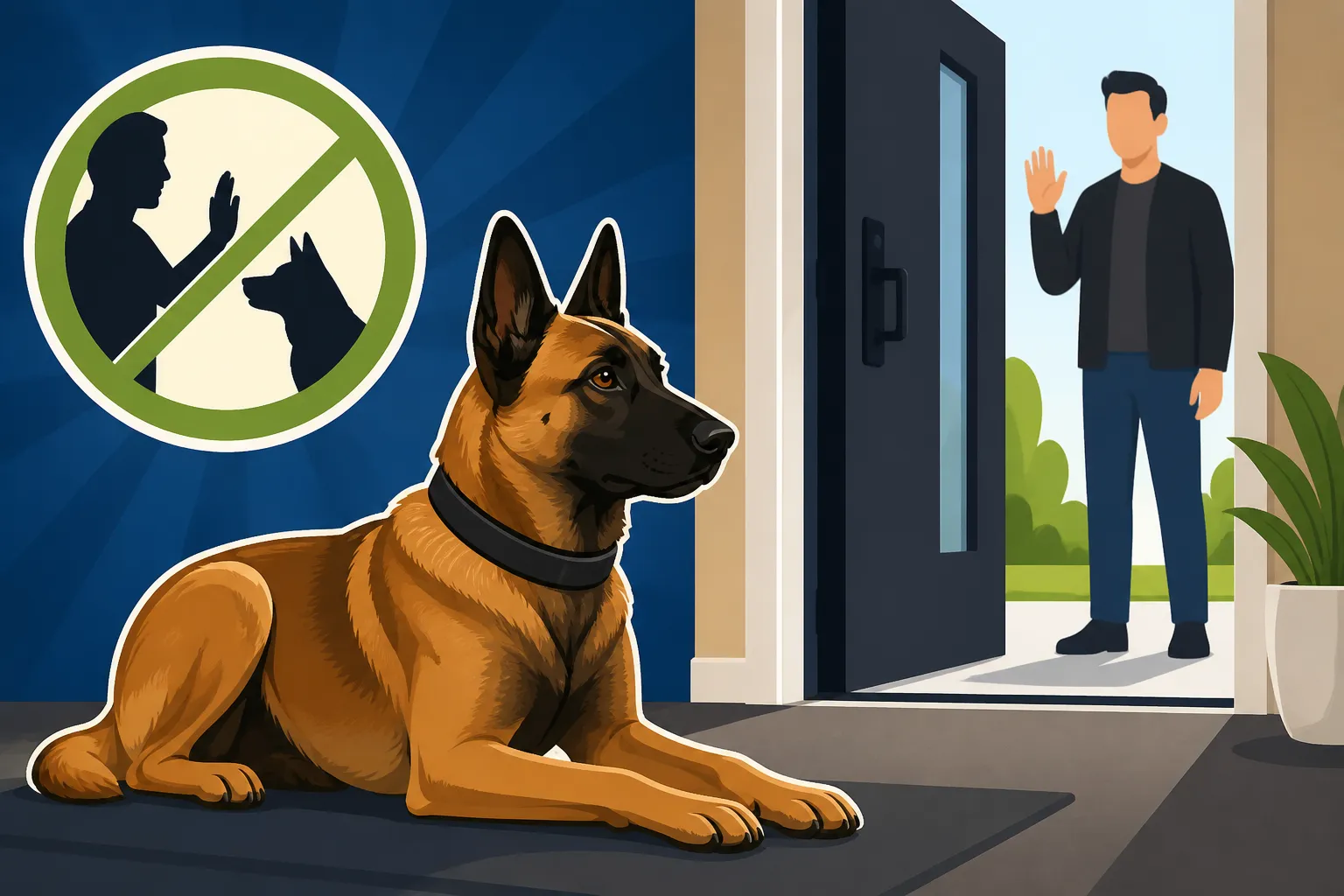
The "place" command is going to be your absolute best friend here. The idea is to teach your Malinois that when the doorbell rings or there's a knock, their default response is to calmly go to their place and stay there until released.
- Start with Pretend Scenarios: Don't just jump into having real guests over. Begin by having a family member or friend pretend to be a visitor. While your Malinois is on their place, have the "visitor" approach the door and lightly knock. As soon as your dog hears the knock and remains on their place (or moves to it calmly if you're cueing them), reward them heavily with a high-value treat. Repeat this many, many times, slowly increasing the intensity of the knock, then moving to a doorbell ring. The key is to reward the calm behavior on their place, not the reaction.
- Controlled Door Openings: Once they're consistent with staying on place for a knock/ring, move to opening the door. Have your "visitor" knock/ring, your Malinois goes to place, you open the door a crack. If your dog stays, reward. Slowly increase the door opening, and have the visitor take a step inside. Always close the door and reset if your dog breaks their place command. This is why Teaching a Belgian Malinois to Lie Down and Do Nothing is so important—it reinforces the idea that there's no need to spring into action.
- Real Guests, Controlled Environment: When you're ready for real guests, brief them beforehand. Ask them to ignore your dog completely upon entering. Have your Malinois on their place (maybe tethered initially for extra security if needed). When the guest arrives and your Malinois is calm on place, reward them. The guest should not acknowledge the dog until your Malinois is completely settled, which could be minutes or even longer. This teaches your dog that calm behavior gets rewards and attention, while frantic behavior gets nothing.
Desensitization and Counter-Conditioning
This part of the training is about changing your Malinois's emotional response to the trigger. Instead of associating the doorbell with a frantic alert, you want them to associate it with something positive and calm.
- Doorbell = Treat: Start by having someone else ring the doorbell very softly from outside, or even just press it slightly so it makes a low sound. The moment the sound occurs, immediately toss a high-value treat away from the door, creating distance and giving your dog something to find. Don't worry about "place" yet; this is purely about changing the emotional association. Repeat this dozens of times over several sessions. The idea is that the sound of the doorbell predicts good things happening, not an intruder.
- Gradually Increase Intensity: As your Malinois starts to look for the treat upon hearing the soft ring, gradually increase the volume and duration of the doorbell sound. Continue to toss treats away from the door. If your Malinois barks or reacts, the sound was too loud or too sudden; go back to a lower intensity. This is a slow, methodical process.
- Combining with "Place": Once your dog has a positive association with the doorbell, you can start combining it with the "place" command. Ring the doorbell (at a comfortable intensity), cue "place," and reward them for going to and staying on their spot. This helps your Malinois learn that the doorbell means "go to your spot and get rewarded," rather than "go crazy at the door."
Adding Real-World Distractions and Practice
The real world is full of distractions, and your Malinois needs to be able to perform these calm door manners amidst them. This is where you really build reliability.
- Vary Visitors and Scenarios: Practice with different people – friends, family, even strangers (if you can arrange safe, controlled setups). Have visitors bring things, like a package (simulating a delivery), or come at different times of day. The more varied the scenarios, the more generalized your dog's calm behavior will become.
- Outdoor Distractions: Practice these door manners even when there are outdoor distractions, like people walking by on the sidewalk, or other dogs. Your Malinois needs to learn that the "place" command applies regardless of what's happening outside the window. This is similar to Building Focus on a Belgian Malinois in a Crowd, where the challenge is maintaining attention amidst high-level stimulation.
- Consistency is Key: Every single time someone comes to the door, whether it's a planned visit or an unexpected delivery, you must be consistent with your training. If you let them bark and lunge "just this once," you'll undo a lot of your hard work. Always have your management tools (tethers, gates, high-value treats) ready. Remember that The Structure a Belgian Malinois Needs Every Day extends to every interaction, especially those as high-arousal as door greetings. Inconsistency is the enemy of progress with a Malinois.
Common Pitfalls and Troubleshooting
Training a Belgian Malinois is rarely a straight line from problem to perfect. There will be bumps, plateaus, and moments where you feel like you're starting from scratch. Recognizing these common pitfalls and knowing how to troubleshoot them can make all the difference in your success.
When Training Plateaus or Regresses
It's absolutely common to feel like you're hitting a wall, or worse, that your Malinois is regressing right back to their old habits. Don't despair; this is part of the learning process for such an intense breed.
- Re-evaluate Your Step-by-Step Approach: If progress stalls, it usually means you've moved too fast or the challenge is too great for your dog at that moment. Go back to an easier step where your Malinois was consistently successful. For example, if they're reacting to an actual person at the door, go back to just the sound of the doorbell and rewarding their calm.
- Increase Reward Value: Is your Malinois really motivated by the treats you're offering? Sometimes, when the distraction level is high, you need to pull out the big guns: cooked chicken, cheese, or even small pieces of hot dogs. These higher-value rewards can help your dog override their instincts and focus on you.
- Check Your Management: Are you still allowing your Malinois to rehearse the unwanted behavior when you're not actively training? If they're still getting to bark and lunge during casual arrivals, it's a huge step backward. Ensure gates, crates, or tethers are consistently used during times you can't actively supervise or train.
- Consider a Training Break: Sometimes, both you and your Malinois need a mental break. Take a day or two off from door training and focus on fun, low-pressure activities. Then, approach the training with fresh eyes and renewed patience.
Dealing with Intense Barking and Lunging
The sheer intensity of a Malinois's door reaction can be incredibly difficult to manage. Their barking can be ear-splitting, and their lunging feels powerful. Here’s how to approach these more extreme displays.
- Prevent the Rehearsal: The absolute priority is to prevent them from practicing the barking and lunging. This means ramping up your management significantly. If a baby gate isn't enough, consider a sturdy crate in a separate room or a tether far enough from the door that they can't even see the person. What an Untrained Malinois Does With an Intruder gives a stark picture of why controlling this behavior is paramount.
- Redirection, Not Correction (Initially): When your Malinois starts to bark or lunge, your first response should be redirection. Before they escalate too much, try to interrupt with a known, strong command like "sit" or "down," then reward heavily if they comply, even for a split second. Then immediately put them back into their management setup (place, crate).
- Positive Interrupters: Teach a positive interrupter sound (like a kissy noise or a specific word) that signals "look at me, a treat is coming!" Practice this in low-distraction environments until your Malinois reliably turns to you. Then, when the doorbell rings, use your interrupter sound, and immediately reward them for disengaging from the door and looking at you.
- Seek Professional Help: If the barking and lunging are truly uncontrollable, disruptive to neighbors Handling Neighbor Complaints About a Malinois, or you feel unsafe, it’s always best to consult with a qualified professional dog trainer or behaviorist experienced with working breeds. They can assess your specific situation, identify underlying issues, and provide tailored guidance and hands-on support. Sometimes, an extra pair of experienced eyes can spot nuances you might be missing.
Remember, success with a Belgian Malinois takes time, dedication, and an understanding of their unique drives. But with consistent effort and the right approach, you can transform door chaos into calm greetings.
Disclaimer
This article is for general informational purposes only and does not constitute professional advice. Laws, prices and regulations vary by location and change over time. Consult a qualified professional for guidance on your specific situation.