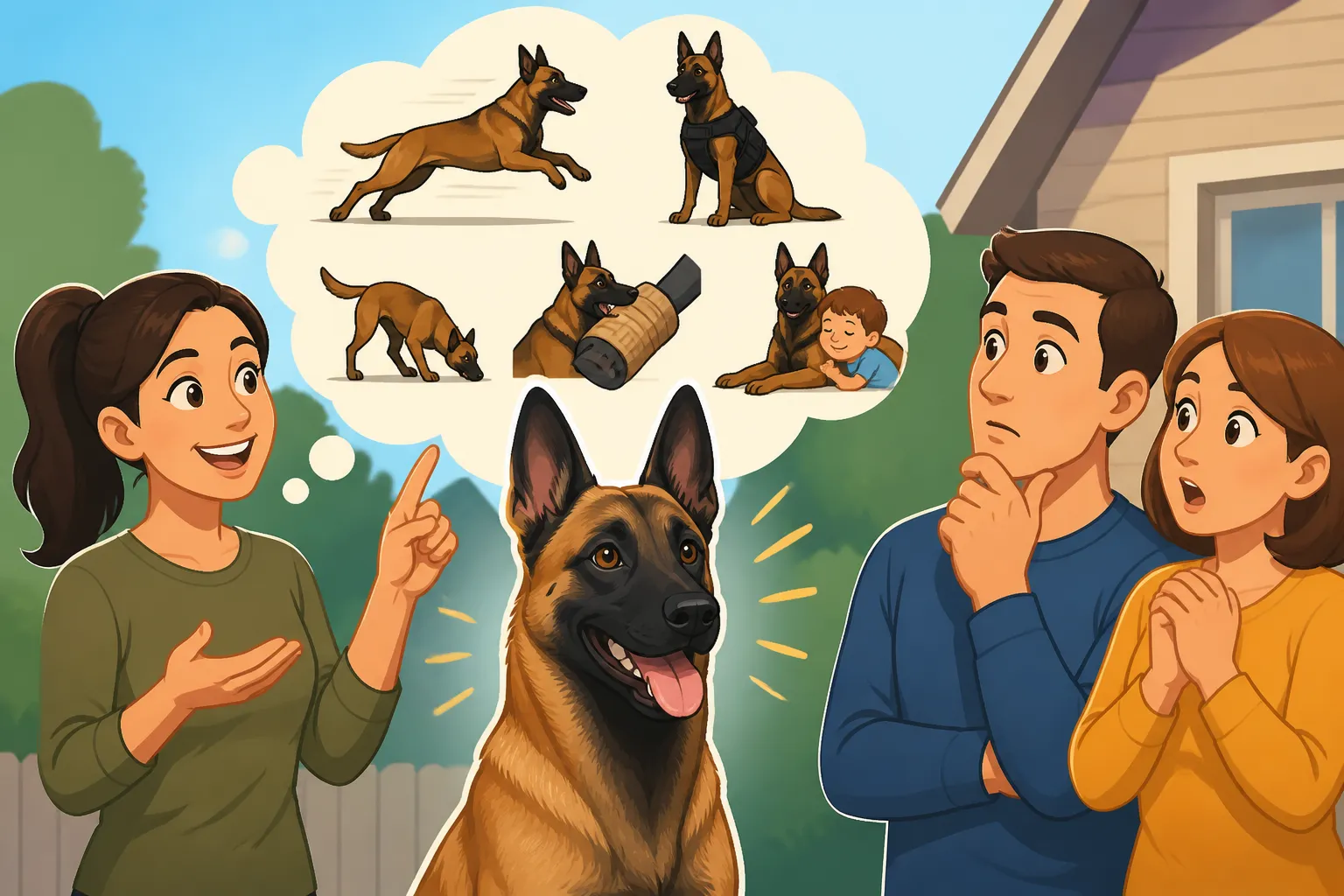
How Owners Explain a Belgian Malinois to Neighbors
A neighbor sees a muscular, alert dog watching the sidewalk and may assume the worst. Meanwhile, you may be trying to explain that your Belgian Malinois is energetic, highly trainable, and not automatically a protection dog. This guide offers clear, calm ways to describe the breed, answer common questions, and build trust through everyday actions rather than arguments.
Why neighbors may have questions about a Belgian Malinois
The breed has a public image that can outpace reality
Belgian Malinois are often associated with police, military, and protection work. Their athletic build, focused expression, and quick reactions can make them look intimidating, especially to someone who has only seen them in videos or working settings. Neighbors may not know that a dog’s appearance or breed alone doesn’t tell them how it behaves at home.
A useful explanation is that the Malinois was developed as a herding dog and is now also seen in many demanding working roles. That history helps explain the breed’s energy and responsiveness without suggesting that every Malinois is trained for security work. You can point curious neighbors toward How the Malinois Went From Herding to Police Work if they want a fuller picture of how the breed’s roles have changed.
It’s also fair to acknowledge why people may be wary. A powerful, fast-moving dog can feel like a lot to encounter on a narrow sidewalk, even when the dog is leashed and under control. Saying “I understand why he looks intense” can lower the temperature of a conversation far more effectively than telling someone they’re overreacting.
High drive does not mean a dog is looking for trouble
Malinois are known for being energetic, quick to learn, and attentive to their surroundings. Those qualities can be wonderful in the right home, but they may also mean the dog notices a jogger, a rolling skateboard, or a delivery cart before a less alert dog does. A dog that watches something closely isn’t necessarily being aggressive; the important details are its body language, distance, and response to its handler.
Avoid making sweeping promises like “He would never hurt anyone.” No one can guarantee exactly how any dog will react in every situation. A more reassuring answer is specific: “He’s on leash, I’m keeping space, and I’m asking him to focus on me.” That tells your neighbor what you are doing now, rather than asking them to trust an absolute claim.
For a deeper explanation of the breed’s intensity, Whether a Belgian Malinois Is More Intense Than It Looks can help put that alert, busy temperament in context. And if you’re still working out what daily life with this kind of dog requires, The Kind of Owner a Belgian Malinois Requires gives useful background for understanding why structured activity and clear handling matter.
What to say when someone asks about your dog
Keep your explanation short, honest, and tailored to the person
You don’t need to give every neighbor a lecture on breed history. A friendly, simple description is usually enough: “She’s a Belgian Malinois, a working breed with a lot of energy. We’re practicing calm leash manners, so I’m giving her space to focus.” That answer identifies the dog, explains what the neighbor is seeing, and describes your plan without turning the moment into a debate.
If someone is interested, you can add that Malinois thrive when their physical and mental needs are met. If someone seems nervous, keep it shorter: “I hear you. I’ll move over and give you room.” The aim is not to persuade every person to love the breed. It’s to make shared spaces feel predictable and respectful.
Here are a few examples you can adapt to your own dog and neighborhood:
| What a neighbor says | A calm, useful response |
|---|---|
| “Is that a police dog?” | “She’s a Belgian Malinois. Some work in police roles, but this one is my companion and training partner.” |
| “Is he aggressive?” | “He can look very focused, but I’m managing his space and keeping him close while we pass.” |
| “Can my child pet her?” | “Thanks for asking. We’re not greeting people right now, so please give her a little room.” |
| “Why does he need so much exercise?” | “He’s a working breed, so we give him structured activity and training, not just a quick walk.” |
| “That dog looks scary.” | “I understand. I’ll step aside and keep him with me while you pass.” |
The best wording depends on the dog in front of you. If your Malinois is relaxed around people, you can say so while still asking before any greeting. If the dog is anxious, reactive, or in training, don’t minimize that. A straightforward “We’re working on this, so we’re keeping distance” is more trustworthy than pretending there is no challenge.
Explain the dog you have, not the breed stereotype
Neighbors may expect every Malinois to behave like a trained patrol dog, or they may assume that any dog with a strong working-breed appearance is dangerous. Neither assumption is a reliable description of your individual dog. Explain your dog’s routine and boundaries instead: “He’s learning to settle on his mat,” or “She’s comfortable watching people pass as long as we don’t crowd her.”
It can help to mention that Malinois vary. Temperament, training, social experiences, health, and the environment all shape behavior. The breed gives you clues about likely needs, but it doesn’t replace observing and managing the particular dog you live with. That nuance is central to Whether a Belgian Malinois Belongs in a Pet Home, especially for people who are weighing the breed’s demanding traits against everyday home life.
If the conversation turns to why some Malinois struggle in ordinary homes, stay factual rather than defensive. You might say, “They can be a lot of dog if their needs aren’t met, which is why we plan our training and downtime carefully.” There’s no need to claim the breed is easy or to suggest that every problem comes from bad owners. Why So Many Belgian Malinois Are Rehomed explores some of the pressures that can lead to a mismatch between dog and household.
How everyday handling builds neighborhood trust
Make calm behavior visible in shared spaces
Neighbors are more likely to feel comfortable when they repeatedly see you managing your dog thoughtfully. Keep your Malinois on a secure leash where required, leave room for people to pass, and avoid letting the dog rush toward gates, parked cars, or strangers. If a sidewalk is narrow, stepping onto a driveway or waiting at a wider spot can prevent a tense close encounter.
Consistency matters more than a polished explanation. A neighbor may forget what you said about the breed, but they will notice whether you shorten the leash before passing, call your dog away from a fence, and stay attentive instead of scrolling on your phone. Those small actions show consideration without requiring anyone to agree about Malinois in general.
Training can make these moments easier, but don’t expect a young or highly stimulated dog to behave perfectly in every setting. Practice calm observation at a distance your dog can handle, reward check-ins, and leave before excitement builds too far. If your dog tends to fixate on people approaching the house, Getting a Malinois to Ignore People at the Door offers a useful related topic. For broader challenges, Handling Neighbor Complaints About a Malinois can help you respond without letting a difficult exchange turn into a feud.
Give the dog structured outlets and deliberate downtime
A Malinois that has had appropriate activity and training may find it easier to settle at home, though exercise alone is not a complete fix for every behavior. Many dogs benefit from a mix of movement, learning, sniffing, and rest. A long, repetitive walk may not satisfy a dog that also needs to think, practice skills, and learn how to switch off.
That balance can matter in a neighborhood. A dog that is restless in the yard may bark at passersby or patrol the fence line, which can make neighbors feel watched or disrupted. Rather than relying on a fenced yard to occupy the dog, build a routine that includes supervised activity and quiet time indoors. Building a Malinois's Place Command is a relevant starting point for teaching a dog to settle in a designated spot.
Practical enrichment can be simple: a supervised food puzzle, a scatter of kibble in a safe area, or a chew suited to the dog’s size and chewing style. If you need supplies, Chewy is one place owners may look for puzzle feeders or durable enrichment options; choose items based on your dog’s habits, and supervise anything that could be chewed apart or swallowed. Chewy may also be useful when you’re comparing basic training and feeding supplies, but no toy or product substitutes for active supervision and a suitable routine.
Handling difficult conversations and setting clear boundaries
Respond to fear without taking it as a personal insult
It can sting when someone calls your dog scary, especially when you work hard on training and care. Still, a neighbor’s discomfort may come from a past bite, a fear of large dogs, or simply not knowing what to expect. You don’t have to agree with every judgment to respond respectfully. “I understand you’d rather have space; I’ll make sure we keep distance” is often enough.
If a neighbor asks you not to let the dog approach their fence or child, take the request seriously and adjust your route or handling. Don’t use the conversation to insist that the person should meet the dog. A greeting is optional, and your dog can have a good life without being introduced to every person on the block.
If the exchange is about a real disturbance, such as repeated barking, address the specific behavior rather than arguing about the breed. Ask what times it happens, observe the dog’s routine, and consider whether the dog is reacting to a predictable trigger. If you need help, a qualified trainer or behavior professional can assess the situation in context. Chewy’s training and enrichment supplies may help with practical management at home, but persistent fear-based or aggressive behavior calls for individualized professional guidance.
Set boundaries while keeping the tone neighborly
You can be warm and still say no. If someone reaches toward your dog without asking, use a clear sentence: “Please don’t pet him; we’re training.” If a child runs toward the dog, calmly create distance and explain to the adult that your dog needs space. Protecting the dog’s boundaries is not rude; it prevents avoidable pressure on both the dog and the person.
Avoid inviting an argument about whether the breed is “good” or “bad.” You might say, “Malinois are a demanding breed, and I take that seriously. I’m responsible for keeping him controlled.” That statement recognizes the breed’s needs without treating every neighbor’s concern as an attack. It also keeps the focus on the part you can control: your dog’s management.
If you want to share more, choose reliable educational material rather than a dramatic clip of a Malinois performing bite work. Videos of working dogs can reinforce exactly the assumptions you’re trying to clarify. A calm explanation of the breed’s history, needs, and individual variation is more helpful than trying to prove that your dog is harmless. You can also mention The Reputation a Belgian Malinois Carries in Public as a way to discuss why people may have strong reactions to the breed.
Make the message consistent across the household
Neighbors may meet different family members at different times, so agree on basic rules at home. Decide who handles the leash, whether greetings are allowed, what phrase everyone uses to ask for space, and how the dog is managed when visitors come to the door. If one person invites strangers to pet the dog while another consistently avoids greetings, the mixed signals can make the dog’s routine less predictable.
A simple shared approach is enough: keep the dog close when passing people, don’t allow unsupervised fence-line interactions, and let one adult handle introductions. If the dog is uncomfortable, skip the greeting. If the dog is calm and you choose to allow one, ask the other person first and keep it brief. Never make a neighbor feel they have to prove they are not afraid by approaching.
For households with several adults or children, practice the same calm responses before you need them. A child can learn to say, “Please give my dog space,” while an adult steps in to manage the leash. Chewy may be a convenient option for household basics such as treat pouches or food toys that support training routines, but the most important shared tools are consistent handling and clear communication.
Disclaimer
This article is for general informational purposes only and does not constitute professional advice. Laws, prices and regulations vary by location and change over time. Consult a qualified professional for guidance on your specific situation.