What Tracking Training Involves for a Belgian Malinois
For anyone living with a Belgian Malinois, the challenge isn't just about physical exercise; it's about finding outlets for that incredible brain and relentless drive. Many of us grapple with a dog that seems to have an endless battery, chewing through furniture or pacing restlessly even after a long run. This guide is all about channeling that boundless energy into a highly rewarding activity: tracking training, offering a structured, mentally stimulating job that can truly tire out your Malinois and strengthen your bond like never before.
Understanding the Malinois's Natural Tracking Abilities
Before we even talk about specific exercises, it's crucial to understand why tracking is such a natural fit for a Belgian Malinois. These dogs weren't just bred to look pretty; they were developed for demanding work, originally herding livestock in Belgium and later excelling in police and military roles. This heritage means they come pre-loaded with an intense prey drive and an incredible sense of smell, qualities that make them phenomenal at following a scent trail.
The Innate Drive to Follow Scent
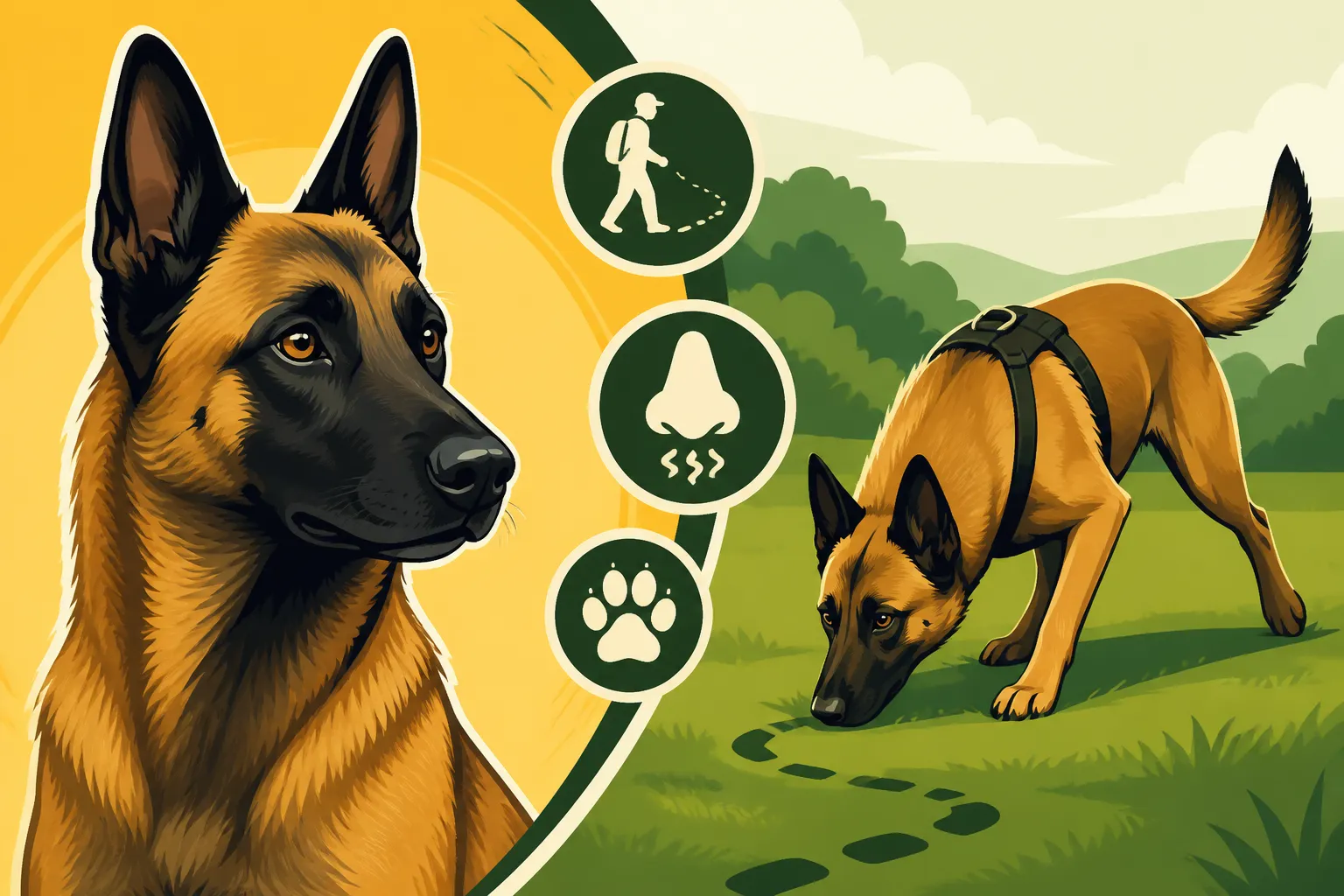
Imagine for a moment, a young Malinois puppy in a field. What does it do? It's sniffing, exploring, its nose constantly to the ground, trying to make sense of the world through scent. This isn't just idle curiosity; it's an intrinsic behavior tied to their survival instincts as hunters and herders. Their brains are wired to detect subtle changes in odor, to follow a path laid down by another creature, whether that's a sheep, a rabbit, or a person. When you introduce tracking training, you're not teaching them something entirely new; you're simply giving structure and purpose to an ability they already possess in spades. It's like giving a natural artist paint and a canvas.
This innate drive is what makes a Malinois so focused when they finally latch onto a scent. It becomes their world, an all-consuming puzzle they are desperate to solve. This intensity can be overwhelming in other contexts, leading to excessive chasing or hyper-vigilance, but in tracking, it's a superpower. We want to harness that focus, that single-minded determination, and direct it towards a productive and enriching activity. It's a fantastic way to engage their minds, offering far more mental stimulation than a simple game of fetch, though that has its place too.
Why Tracking is More Than Just "Walking and Sniffing"
Some people might think tracking is just letting your dog wander around with their nose down. Oh, if only it were that simple! True tracking training is a highly disciplined sport and skill that demands intense concentration, problem-solving, and a deep understanding between dog and handler. It’s about teaching your Malinois to discriminate specific human scent from a myriad of other odors in the environment, ignoring distractions, and communicating subtle changes in the trail back to you. It's a profound mental workout, far beyond what even intense physical exercise can provide. If you've ever wondered how to genuinely tire out your Malinois when Two Hours and a Job a Belgian Malinois Demands Daily feels like not enough, this is it.
Consider the complexity: a track isn't a continuous line of scent. It's a series of scent pools, disturbed ground, and environmental indicators. Your Malinois needs to learn to piece together these fragments, to understand how scent behaves in different wind conditions, on various surfaces, and over time. This requires incredible mental stamina and decision-making from the dog, and keen observation and trust from the handler. It builds a powerful partnership where both of you are working towards a common goal, relying on each other's strengths. It's a journey, not a destination, and every track presents a new challenge.
Early Signs of Tracking Aptitude in Your Malinois Puppy
Even as a young puppy, you might start noticing little hints that your Malinois has a knack for tracking. Do they spend an unusual amount of time with their nose glued to the ground on walks? Do they easily find hidden treats you've tossed in the grass? Are they particularly persistent in trying to locate something they saw or smelled disappear? These are all early indicators of a strong scenting ability and an underlying drive to follow a trail. Don't mistake this for just random sniffing; a purposeful, engaged nose is a Malinois nose at work.
If your puppy shows these tendencies, it's a wonderful opportunity to gently encourage them. You can start by playing simple "find it" games indoors, hiding treats under cups or blankets and letting their nose lead the way. Outdoors, you might walk a short, interesting path and then loop back, seeing if they naturally follow your exact footsteps. Early positive experiences lay a fantastic foundation. Remember, even at a young age, you can start building engagement with your Malinois. Keep it fun and low-pressure, always ending on a high note, so they associate using their nose with positive rewards. Socializing a Belgian Malinois Puppy Safely also involves exposing them to various environments where they can practice these natural behaviors.
Essential Gear for Starting Malinois Tracking Training
You don't need a huge array of specialized equipment to start tracking, but having the right basics can make a world of difference in your comfort and your Malinois's performance. Think of it as investing in tools that facilitate communication and safety, rather than just buying "stuff."
The Right Harness and Line Make All the Difference
For tracking, you absolutely need a comfortable, non-restrictive harness that allows your Malinois full range of motion. A front-clip harness can sometimes interfere with shoulder movement, so a Y-front or H-back harness, or a specifically designed tracking harness, is often preferred. The goal is to distribute pressure evenly across their chest and shoulders, allowing them to lean into the harness comfortably without choking or causing discomfort. You don't want anything that pulls at their throat, as this can impede breathing and distract them from the scent. I've seen countless handlers start with a regular collar, only to quickly realize it causes more problems than it solves.
Equally important is a long line. We're talking 15 to 30 feet, sometimes even longer as you progress. This allows your Malinois to work ahead of you, to fully immerse themselves in the scent trail without feeling tugged or controlled. The line is there for safety and guidance, not for corrections. Choose a material that’s easy to handle, doesn't tangle too easily, and won't burn your hands if it slides through quickly. Leather or biothane lines are popular for their durability and grip. You can often find excellent options on platforms like Amazon that are durable and designed for working dogs. Think of it as an extension of your communication, a safety tether, and a way to practice Long Line Work With a Malinois in Open Ground.
Choosing High-Value Rewards for Motivation
A Malinois lives for reinforcement. While some dogs are naturally motivated by the "find" itself, especially as they gain experience, high-value rewards are absolutely critical, particularly in the beginning stages of tracking. These aren't your everyday kibble; these are the jackpot treats, the things your Malinois would do backflips for. Think cooked chicken, cheese, hot dogs, or specially made soft, smelly treats. The smellier, the better! You want something that will make them light up the moment they find the "prize" at the end of the track.
The delivery of the reward is just as important as the reward itself. When your Malinois finds the article or the end of the track, make it a huge celebration. Praise them enthusiastically, give them a generous handful of treats, and maybe even a quick, joyful game of tug with a favorite toy if they enjoy that. This helps them associate the successful completion of a track with an incredibly positive experience, reinforcing that seeking behavior. Remember, we are Channeling a Belgian Malinois's Prey Drive Into a Tug or into food, making the activity inherently rewarding.
Weather-Appropriate Attire for the Handler (and Dog)
Tracking isn't always glamorous! You're going to be out in fields, woods, and various terrains, often in less-than-ideal weather. Dress for success, meaning comfort and protection. Layered clothing, waterproof boots, and rain gear are often non-negotiable. You'll be moving slowly, sometimes crawling, sometimes standing still, so consider warmth and flexibility. Don't forget bug spray, sunscreen, and plenty of water for both you and your Malinois.
While your Malinois has a natural coat, consider the conditions for them too. In extreme heat, you might track in the early morning or late evening. In freezing temperatures, ensure their pads are protected, and consider a coat for shorter-coated dogs if they'll be standing still for periods. If you're tracking in thorny or rough terrain, paw balm or even dog boots can be a wise investment to prevent injury. A happy, comfortable handler and dog make for a much more productive and enjoyable tracking session.
Step-by-Step Introduction to Basic Tracking
Starting tracking training can feel daunting, but breaking it down into small, achievable steps makes it manageable for both you and your Malinois. The key is to build confidence and understanding gradually, always setting your dog up for success.
Laying Your First Short, Straight Track
This is where the magic begins. For your very first tracks, choose a quiet, undisturbed area with short grass, like a local park or an open field. You want minimal distractions. Have your Malinois wait (or be held by a helper) a short distance away, where they can see you but are not directly at the starting point. Take a small, high-value food reward, show it to your dog, then walk a perfectly straight line, maybe 10-15 steps, dropping a small piece of food every step or two. At the very end of your track, place a larger "jackpot" of food or a favorite toy. This creates a clear, easy-to-follow scent trail of both human footfall and delicious food.
The "scent picture" you're creating is very strong and obvious. The food on the track encourages your Malinois to keep their nose down and follow the visible trail. This is not about being stealthy; it's about making the connection between your steps, the ground, and the reward. Keep it short, keep it straight, and keep it fun. You're building enthusiasm for the game, not testing their limits. Consistency in how you lay the track is important in these early stages.
Guiding Your Malinois Along the Scent Trail
Once your track is laid and you've given it a minute or two to "age" slightly, bring your Malinois to the starting point. Put them in their tracking harness and attach the long line. Point to the start of the track, encouraging them with a verbal cue like "Find it!" or "Track!" Let them sniff around, giving them time to find that initial scent. As soon as their nose goes down and they start moving forward, let the long line slide through your hand, allowing them to lead. You are merely a follower at this point.
Resist the urge to pull or direct them. Your job is to observe and move with them, maintaining a loose line. If they veer off slightly, just gently guide them back with your body language, or let them circle back to the scent themselves. This is about teaching them to trust their nose. When they reach the end and find the jackpot, throw a party! Massive praise, all the treats, and make it clear they've done something amazing. Repeat these short, straight tracks several times over a few sessions until your Malinois confidently follows them every time. This foundational success is key before progressing.
Progressing to Longer Tracks and Gentle Turns
Once your Malinois is confidently crushing those short, straight tracks, it's time to slowly increase the challenge. Gradually extend the length of your tracks, adding 5-10 steps at a time. Instead of dropping food every step, you can start spacing it out a little more, perhaps every 3-4 steps, ensuring there's still enough incentive to keep their nose engaged. This encourages them to work harder to follow the scent rather than just picking up individual food pieces. The dog should still be finding food regularly enough to maintain interest.
The next progression is introducing very gentle, wide turns. Start with a 45-degree turn at the end of a straight section, still dropping plenty of food. Then move to 90-degree turns. Again, always make these turns very clear with generous food placement. Your Malinois needs to learn that the scent doesn't always go in a straight line, and turns require more concentrated sniffing. Observe their body language at turns: do they slow down, circle, or seem to work harder? These are good signs they're actively problem-solving. Remember the goal: building confidence and skill incrementally. It is a slow process, but highly rewarding to see your Malinois focus. The Mental Work That Finally Tires a Malinois Out is exactly what this kind of thoughtful progression provides.
Advanced Tracking Techniques and Problem Solving
As your Malinois gains confidence and proficiency in basic tracks, you'll naturally want to introduce more complexity. This is where tracking really becomes a challenging and deeply engaging activity, pushing both you and your dog to refine your skills.
Introducing Aging Tracks and Variable Surfaces
One of the biggest leaps in tracking is working with "aged" tracks. Instead of walking the track and immediately bringing your dog to it, you'll lay the track and then wait. Start with just 5-10 minutes of aging, then gradually increase the time to 30 minutes, an hour, or even several hours. As a track ages, the scent dissipates and becomes more diffuse, requiring your Malinois to work harder and rely more on the subtle, residual scent. This is where their incredible nose truly shines, and it teaches them persistence. How Many Hours a Belgian Malinois Should Work Daily is less about physical exertion and more about this kind of focused mental effort.
In addition to aging, introduce variable surfaces. Start on short grass, but then move to taller grass, mown fields, gravel paths, dirt trails, or even patches of concrete if the rules of your chosen tracking sport allow it. Each surface holds and dissipates scent differently. A track on pavement, for instance, might be almost entirely residual scent, while a track in damp grass holds odor longer. This teaches your Malinois adaptability and resilience. Some commercial brands like BAXTER & Bella offer online resources or courses that delve into these advanced concepts, giving handlers a structured approach to learning. This type of progressive challenge keeps a Malinois engaged and prevents boredom.
Working Through Distractions and Environmental Challenges
Real-world tracking isn't done in a vacuum. There will be distractions: other animal scents, curious bystanders, distant noises, or even the smell of nearby cooking. Slowly introduce controlled distractions into your tracks. Start with very mild, distant distractions and gradually increase their intensity or proximity. Perhaps a person walks by far away, or another dog is visible in the distance. The goal isn't to eliminate distractions entirely, but to teach your Malinois to ignore them and maintain focus on the human scent.
Environmental challenges also come into play. Wind, temperature, and humidity all affect how scent behaves. You'll learn to "read" the wind and understand how it carries scent. Tracking in light rain can be excellent, as the moisture can help hold scent, but heavy rain can wash it away. Hot, dry conditions can make scent dissipate quickly. Working in different weather conditions builds a well-rounded tracking dog who isn't fazed by minor environmental shifts. This is part of the deep learning curve that makes tracking such an enriching activity for a high-drive dog.
When Your Malinois Loses the Track
It will happen. Your Malinois will lose the track. This is where your partnership and patience are tested. When your dog indicates they've lost the scent (they might lift their head, start casting widely, or look to you for guidance), don't immediately pull them back. Allow them to work the area, to try and relocate the scent themselves. This builds their problem-solving skills and confidence. They need to learn that it's okay to lose it, and more importantly, how to find it again.
If they're truly stumped after a reasonable amount of time, you can offer a subtle hint. Gently guide them back to the last known point of scent, or sweep the area with them until they pick it up. Resist the urge to give verbal corrections; frustration only hinders the learning process. Instead, use positive encouragement when they relocate the track. It's a team effort, and sometimes you, the handler, need to help them reset. Building Engagement With a Belgian Malinois is crucial here, as a strong bond means they'll be more likely to look to you for subtle guidance and trust your direction when things get tough.
Integrating Tracking into Your Malinois's Routine and Lifestyle
Tracking isn't just a sport; it can become a fundamental part of your Malinois's overall well-being and an incredible tool for mental and physical conditioning. It’s a purposeful activity that taps directly into their core drives.
Balancing Tracking with Other Training Disciplines
While tracking is profoundly beneficial, it shouldn't be the only thing you do with your Malinois. A well-rounded working dog benefits from a variety of activities. Think about incorporating obedience, agility, bite work, or even simple long walks and hikes. The beauty of tracking is that it complements many other disciplines. For example, the focus and body control learned in obedience can make a Malinois a more precise tracker. Bite work builds drive and confidence, which can translate into greater persistence on a track.
The key is balance. Tracking is mentally taxing, so a long, complex track might mean a lighter day for physical exercise. Listen to your dog and watch for signs of fatigue or over-stimulation. You want to avoid burnout. The variety keeps things fresh and ensures all aspects of your Malinois's intelligence and athleticism are being utilized. Remember, the goal is to have a happy, fulfilled partner, not just a one-trick pony. For those looking for structured online training support across various disciplines, companies like BAXTER & Bella often have resources that help integrate different training approaches.
The Mental and Physical Benefits of Consistent Tracking
The benefits of consistent tracking for a Belgian Malinois are immense. Mentally, it's unparalleled. It teaches intense focus, problem-solving, persistence, and self-control. A Malinois that tracks regularly is often a calmer, more confident dog in other aspects of their life because they have a reliable, high-value outlet for their energy. It reduces boredom, which is often the root cause of destructive behaviors in Malinois. This is truly The Mental Work That Finally Tires a Malinois Out.
Physically, tracking provides excellent low-impact exercise. While it might not be the same cardiovascular workout as running, it involves sustained movement, navigating varied terrain, and using different muscle groups as they follow the scent. It's fantastic for building stamina and body awareness without the high-impact stress on joints that some other sports can entail. Furthermore, the bond you build with your Malinois through tracking is profound. You learn to read their subtle cues, and they learn to trust your presence and guidance, leading to a deeper, more meaningful relationship.
Finding a Tracking Club or Mentor for Continued Growth
While you can certainly start tracking on your own, finding a local tracking club or an experienced mentor is invaluable for continued growth. A club offers a community of like-minded individuals, shared resources, and experienced eyes to help you troubleshoot challenges. Mentors can provide personalized feedback, help you design more complex tracks, and introduce you to advanced techniques you might not discover on your own. They can also guide you through the rules and requirements if you eventually decide to compete in a tracking sport.
Look for clubs that emphasize positive reinforcement and safe, ethical training practices. A good club will prioritize the dog's well-being and a strong handler-dog partnership. Don't be afraid to visit a few clubs or observe training sessions before committing. A good fit will make all the difference in your tracking journey, providing encouragement, expertise, and a supportive environment for both you and your extraordinary Belgian Malinois. This structured engagement is often what a Malinois needs to thrive, ensuring they are always learning and growing.
Disclaimer
This article is for general informational purposes only and does not constitute professional advice. Laws, prices and regulations vary by location and change over time. Consult a qualified professional for guidance on your specific situation.