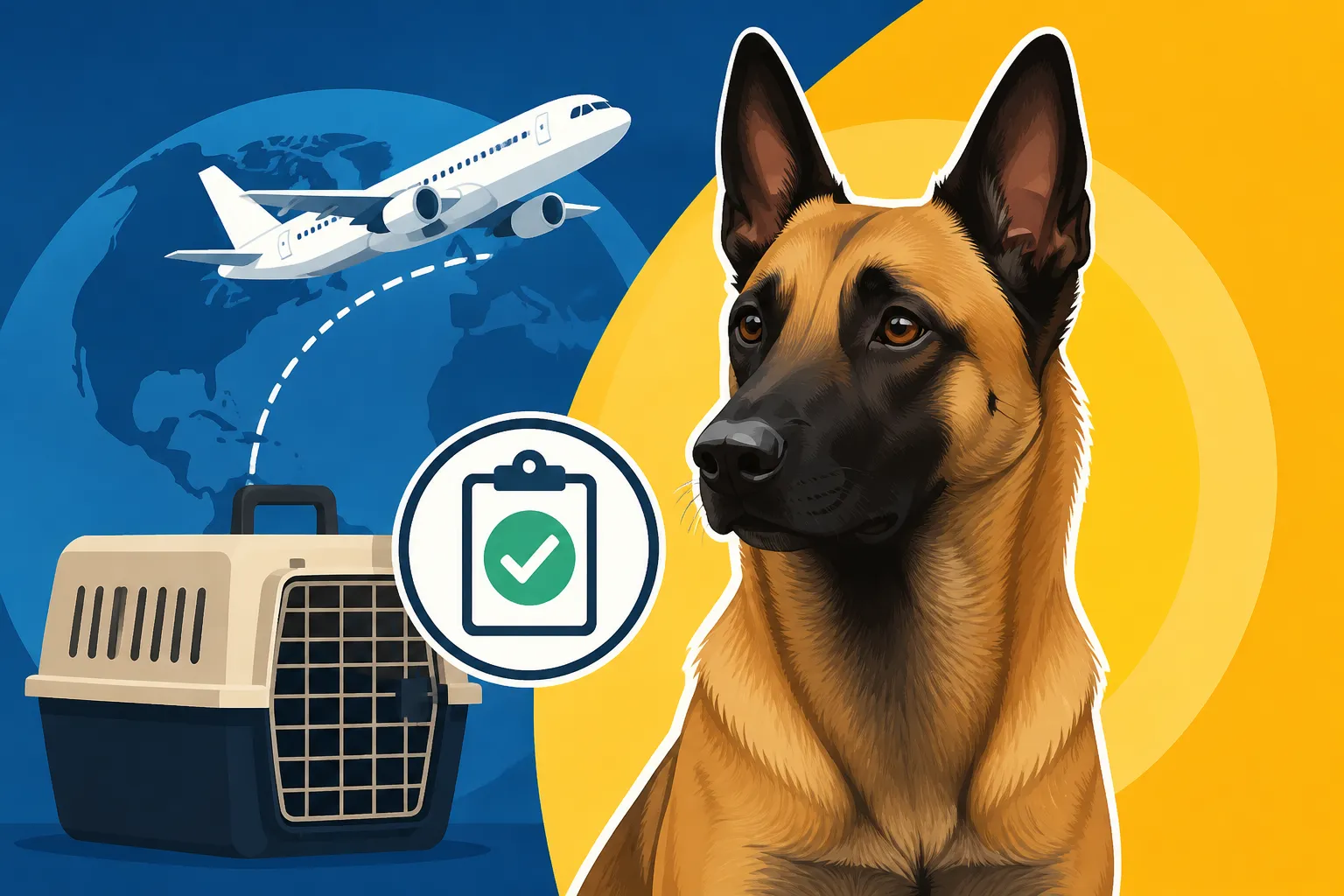
Whether a Belgian Malinois Can Be Imported Privately
Importing a Belgian Malinois privately is possible, but arranging the flight is only one part of the job. Buyers also have to sort out export paperwork, destination-country entry rules, airline restrictions, and the dog’s health and travel readiness. This guide explains what private import involves, what to check before sending a deposit, and how to plan a safer arrival.
Can you import a Belgian Malinois privately
In many cases, yes. A private buyer can purchase a Belgian Malinois from a breeder in another country and arrange for the dog to travel to them. The important distinction is that “private import” does not mean “no paperwork”: a dog crossing a border is still subject to the rules of the countries it enters, and possibly the rules of any country where it changes planes.
The answer depends on the dog’s age, country of origin, destination, route, and purpose of travel. Requirements for a pet moving to live with its owner may differ from requirements for a dog being imported for resale or breeding. Before committing to a puppy, confirm the rules with the destination country’s official animal-health authority and the relevant airline.
Private import is different from buying locally
A local purchase usually keeps the buyer and breeder within one country’s legal and transport systems. With a private import, you take responsibility for coordinating details across borders. The breeder may handle export documents or book transport, but you should establish exactly what they will do in writing rather than assuming that “shipping included” means the dog will arrive with every requirement satisfied.
The dog’s intended use can matter, too. A Malinois imported as a household pet may be treated differently from a commercial shipment or a dog being brought in for resale. Definitions vary by jurisdiction, so ask the relevant authorities how your specific situation is classified. Be ready to explain who owns the dog, whether it is traveling with you or separately, and whether the arrangement involves payment or onward sale.
Private import also does not guarantee that a particular puppy will be a good fit. An impressive pedigree, working titles, or a breeder’s claims do not substitute for an honest discussion about temperament, health, early socialization, and the demands of living with the breed. If you are still weighing whether this dog suits your home, Whether a Belgian Malinois Belongs in a Pet Home and The Kind of Owner a Belgian Malinois Requires are useful starting points.
Rules depend on the destination and route
There is no single international checklist that applies to every Malinois import. Destination authorities may require identification, health records, veterinary certificates, specific vaccinations, parasite treatments, permits, or other steps. Timing matters: some documents or treatments must be completed within a defined period before travel, while other requirements may need to be arranged well in advance.
The flight route can add another layer. A dog might be subject to transit-country rules even if it does not leave the airport, depending on the route and how the shipment is handled. Airlines also set their own acceptance conditions, which may include restrictions on the dog’s age, carrier, temperature conditions, route, or travel method. A breeder’s experience with one airline or route is not proof that the same arrangement will work for yours.
If the destination is the United States, check the federal dog-entry rules as well as any state or local requirements. If you are importing into another country, start with that country’s official guidance. Then confirm any additional requirements with the export authority in the dog’s country of origin, the airline, and any transit country. Keep written confirmations and copies of every document.
What to verify before you pay a breeder
International puppy purchases can feel exciting and urgent, especially when a breeder says a litter is nearly spoken for. That is exactly when it pays to slow down. Verify the breeder, the dog, and the travel plan before sending a deposit. A legitimate-looking website or a polished video call cannot by itself confirm that the puppy exists, is healthy, or is legally ready to travel.
Check the breeder and the individual dog
Ask for the breeder’s full name, physical location, and a live conversation that lets you see the puppy with its mother and littermates when possible. Ask for recent, unedited video and clear answers about where the puppies are raised, how they are handled, and what the breeder observes about each puppy’s confidence, recovery, sociability, and response to new experiences.
Request the dog’s identification details and the original records that will accompany it. Depending on the country and the dog’s age, those may include identification, veterinary records, pedigree documents, and health-testing information. Make sure names, dates, identification numbers, and ownership details match across the records. If the breeder says documentation will be supplied later, find out precisely what it is, who issues it, and when you will receive it.
Ask about the parents’ health evaluations and relevant genetic testing, and request the actual results rather than relying on a general statement such as “fully health tested.” For Malinois, it may help to review The Hip and Elbow Numbers Behind a Malinois Clearance and The Two Ataxia Genes Belgian Malinois Are Tested For. Health tests are only part of the picture, but they give you better questions to ask and help you judge how transparent the breeder is.
Put the sale and transport responsibilities in writing
A written agreement should identify the puppy, the breeder, the buyer, the payment terms, and what happens if the dog cannot travel as planned. It should spell out who arranges export paperwork, who books the transport, who pays each expense, and who is responsible if a document is rejected or the flight is delayed. It should also explain what happens if the puppy becomes ill before departure or is found to have a condition after arrival.
Do not rely on a vague promise that the breeder will “take care of everything.” Ask for a list of documents you will receive and the name of the veterinarian or authority responsible for issuing each one. Confirm whether the puppy will travel with you, as checked baggage where permitted, or through a separate cargo arrangement. These options have different requirements, and availability can vary by airline and route.
Be cautious if someone pressures you to pay quickly through an irreversible method, refuses a live conversation, offers an implausibly simple delivery arrangement, or asks for extra money repeatedly after the initial payment. An unexpected request for a new fee should prompt you to pause and independently verify the details with the airline or relevant authority. For guidance on pedigree documents and purchase terms, see Reading a European Belgian Malinois Pedigree and The Guarantees in a Malinois Sale Agreement.
Plan paperwork and transport step by step
The smoothest imports are planned backward from the proposed arrival date. Start by identifying the destination requirements, then work out which veterinary appointments, documents, airline bookings, and export steps must happen first. Do not book a nonrefundable trip based only on a breeder’s estimate of when the puppy will be ready.
| What to verify | Questions to ask | Why it matters |
|---|---|---|
| Destination entry rules | What identification, health documents, permits, or treatments are required? | Missing a requirement can delay entry or prevent travel. |
| Export documents | Which authority or veterinarian issues the export paperwork, and when? | Documents may need official endorsement or careful timing. |
| Transit route | Does each stop create an additional rule or handling requirement? | A connecting country or airport can affect the itinerary. |
| Airline acceptance | What carrier, travel method, age, and booking conditions apply? | Airline approval is separate from government entry approval. |
| Breeder responsibilities | Who arranges documents, transport, and contingency plans? | Clear roles reduce last-minute confusion and disputes. |
| Arrival arrangements | Who meets the dog, and where will the first veterinary visit happen? | A calm arrival and prompt health check help you respond to problems. |
Build a document and deadline checklist
Once you know the destination requirements, write down each required action, who is responsible, the issuing party, and the deadline. Keep a digital copy and a printed copy of the final documents, but follow the authority’s instructions about which originals must accompany the dog. Check that the dog’s identification details are consistent everywhere they appear.
Ask the issuing veterinarian or official authority what the documents need to say and whether any endorsement is required. A general health note may not replace a specific certificate. Likewise, a vaccination record does not automatically satisfy every country’s entry rules. If the paperwork is unclear, ask the authority that will review it rather than relying on a breeder’s interpretation.
Reconfirm the rules before travel, especially if the puppy’s age, route, or arrival date changes. A small schedule shift can affect whether a document remains valid or whether a required step happens in the right order. Keep contact details for the breeder, airline, veterinarian, and destination authority together so you are not searching for them during a travel disruption.
Choose a travel plan that suits the puppy
Ask the airline how the dog will travel, what carrier is permitted, how the booking is confirmed, and what happens if the flight is delayed or canceled. Find out whether the dog will be handled as a pet traveling with a passenger or through a separate cargo process. Do not assume a route is suitable just because another dog has traveled it successfully.
The carrier should be selected and introduced well before departure. The puppy needs time to enter it willingly, rest inside it, and become comfortable with the door closing. A rushed introduction on travel day adds avoidable stress. Confirm the carrier’s permitted dimensions and construction with the airline rather than relying on a product description alone. Retailers such as Chewy may carry travel and containment supplies, but verify that any item meets the exact airline and route requirements before purchasing.
A young Malinois may already find unfamiliar handling, noise, and separation difficult. Ask the veterinarian about travel readiness and what signs of illness or stress would warrant delaying the trip. Do not sedate a dog for air travel unless a veterinarian and the airline have specifically addressed the plan; medication can affect an animal’s response to travel conditions. If your Malinois is uncomfortable with restraint or unfamiliar people, Teaching a Belgian Malinois to Accept a Stranger's Hands offers useful preparation ideas for everyday handling.
Prepare for arrival and the first weeks at home
Arrival is not the finish line. Your puppy may be tired, thirsty, unsettled, or overwhelmed after a long journey. Keep the first days quiet and predictable rather than trying to make up for lost time with visitors, outings, and introductions. A simple routine gives the puppy space to recover and helps you notice changes in appetite, energy, and behavior.
Arrange a veterinary check and a calm routine
Book a veterinary appointment soon after arrival and bring every document you received. The veterinarian can review the records, examine the puppy, discuss preventive care, and help you plan any follow-up testing or vaccination steps. If records are incomplete or there is a gap in the history, ask what should be repeated or verified rather than guessing.
For the first few days, offer familiar food if you can obtain it, provide fresh water, and give the puppy a quiet sleeping area. Keep handling gentle and routine. A puppy that has just traveled internationally may not be ready for a busy household, dog park, long car ride, or parade of well-meaning visitors. If appetite, vomiting, diarrhea, coughing, marked lethargy, or other concerning signs appear, contact your veterinarian for advice.
When planning supplies, focus on practical items you can use immediately: a secure carrier or crate, leash and collar, food and water bowls, cleaning supplies, and a bed or washable resting surface. Chewy can be one place to look for routine pet supplies, but select products based on fit, durability, and your veterinarian’s recommendations rather than buying a large collection before you know what works for your puppy.
Give the puppy time to adjust to your household
An imported puppy has to adjust to a new person, home, climate, sounds, surfaces, and daily rhythm. Even a confident puppy may need time to learn where to sleep, how to ask to go outside, and what behavior earns attention. Start with short, positive experiences and build gradually. Avoid testing the puppy’s limits simply because the breed is known for energy or confidence.
Set predictable boundaries from the beginning. Use a secure area when you cannot supervise, reward calm behavior, and provide brief training sessions that end while the puppy is still engaged. Socialization means helping the puppy experience people, places, objects, and everyday sounds safely; it does not mean forcing close contact with every dog or stranger. A thoughtful first-week plan is more helpful than trying to expose the puppy to everything at once. See The First Week With a Belgian Malinois Puppy and Socializing a Belgian Malinois Puppy Safely for practical ideas.
Keep all travel and purchase records organized after the dog is home. You may need them for veterinary care, registration, future travel, or questions about the dog’s origin. If the puppy’s pedigree or export documents arrive later, check them promptly and contact the breeder in writing if anything is missing or inconsistent. A careful paper trail will not eliminate every problem, but it makes it much easier to address one.
Disclaimer
This article is for general informational purposes only and does not constitute professional advice. Laws, prices and regulations vary by location and change over time. Consult a qualified professional for guidance on your specific situation.