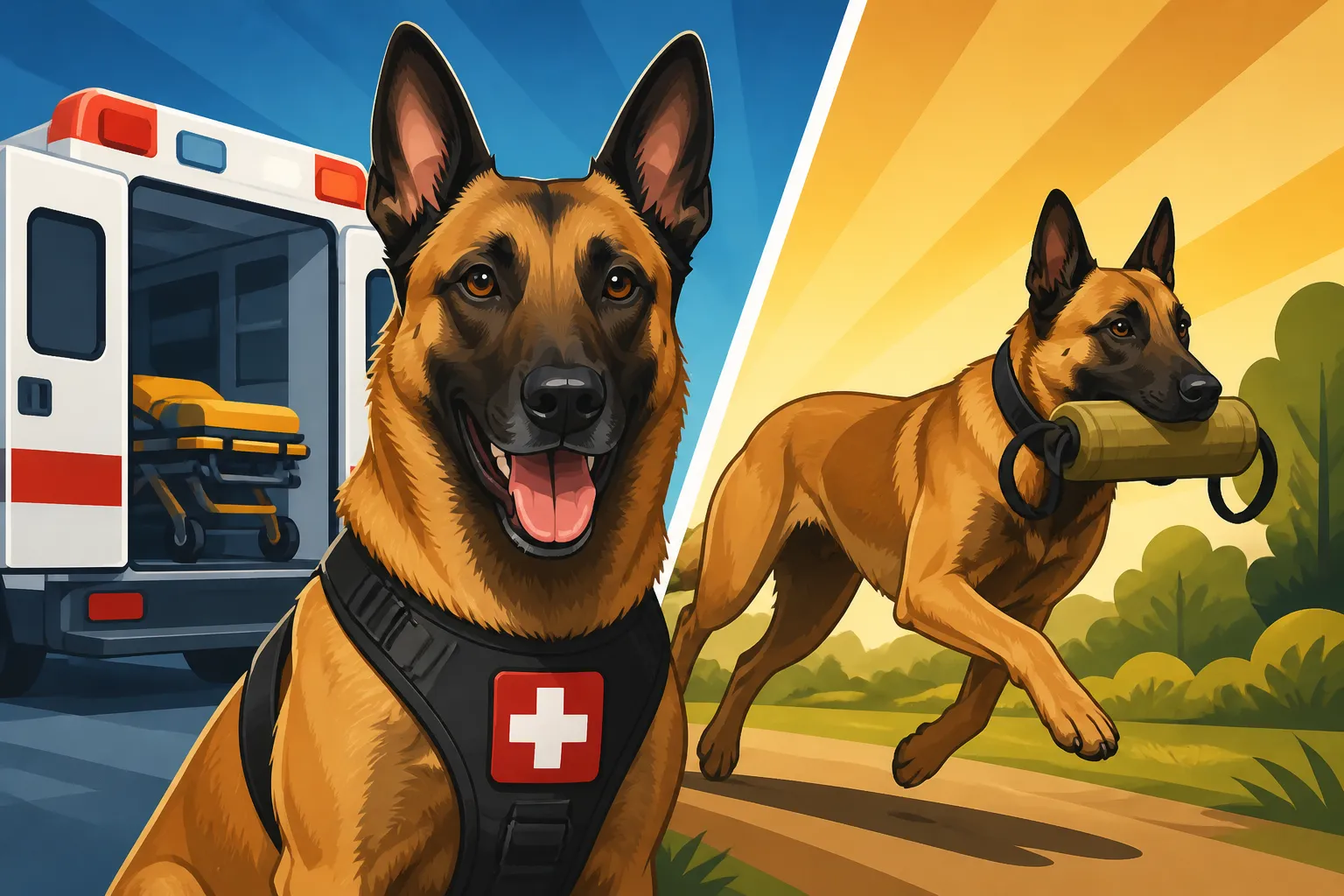
Belgian Malinois Used as Ambulance and Message Dogs
Belgian Malinois are often described as modern police and military dogs, but their story reaches back to the working dogs of Belgium and the upheaval of the First World War. Accounts of ambulance and message dogs can blur breeds, duties, and eras. This guide explains what these dogs did, what “ambulance dog” meant, and how carefully to connect those wartime roles to today’s Malinois.
What Belgian dogs did in wartime
From farm work to military service
The Belgian dogs later associated with the Malinois came from a practical working tradition. They were expected to move confidently across farms and open country, pay attention to a handler, and respond to changing conditions. Herding was central to their heritage, but the useful traits behind that work—alertness, stamina, and trainability—could also make a dog valuable in other settings.
Belgian authorities and handlers saw potential in dogs as more than companions. Before and during the First World War, dogs in several European countries were trained for military and support tasks. Depending on the setting, that could mean carrying messages, helping locate wounded soldiers, guarding positions, or moving supplies. These were dangerous jobs, and dogs were not a replacement for people or equipment. They were trained animals working alongside human handlers.
It is helpful to keep the breed’s origins in view rather than imagining that every early wartime dog had exactly the appearance and identity of a modern Malinois. The Belgian shepherd population was still being defined and organized. The history of those dogs is closely connected to The Belgian Farm Dogs the Malinois Came From and The Herding Job the Belgian Malinois Was Built For, where the practical roots of the breed become clearer.
Why older accounts may use different breed names
Historical descriptions can be confusing because terminology changed over time. A report might refer to a Belgian sheepdog, a Belgian shepherd, or a local type rather than use “Malinois” in the way a present-day breed enthusiast would. Even when a dog was of the Malinois type, records may not consistently distinguish it from other Belgian shepherd varieties.
The Malinois is associated with the Belgian town of Mechelen, known in French as Malines. Breed identity and classification developed through organized breeding and standards, rather than appearing fully formed in a single year. That makes it risky to read an old reference to a “Belgian dog” and assume it identifies a modern Malinois with certainty. The context, date, description, and intended role all matter. The Years the Belgian Malinois Was Standardized offers more background on how those distinctions took shape.
A useful way to read wartime accounts is to separate three questions: Was the dog described as Belgian? Was it identified specifically as a Malinois or a close type? And is the account describing a documented individual or a general practice involving military dogs? Those questions prevent a broad history of working dogs from being mistakenly presented as a precise breed record.
What an ambulance dog actually did
Finding and assisting wounded people
The phrase “ambulance dog” can sound as if a dog carried injured soldiers away from the battlefield. In many historical descriptions, the role was more limited and practical: a trained dog searched an area, located a wounded person, or helped a medical team find someone who might otherwise be missed. The dog’s work could support rescue efforts, but it did not mean the animal functioned as a miniature ambulance.
Searching in a damaged or noisy landscape required a dog to keep working amid unfamiliar scents, debris, and commotion. A dog might need to follow a handler’s direction, investigate an area, and remain focused despite gunfire or other distractions. The human team still had to reach the casualty, assess their condition, and carry out any treatment or evacuation. The dog’s value was in helping direct attention toward a person who needed help.
Accounts of this work sometimes describe dogs carrying small medical supplies or equipment. That should not be confused with carrying a person or independently treating injuries. A dog could be a useful part of a search or support team, but the work depended on trained handlers and people with medical responsibilities. As with many stories about wartime animals, the broad idea is easier to establish than the exact task performed by every individual dog.
The limits and risks of the work
Searching for wounded people in a conflict zone exposed dogs and handlers to serious danger. The dog had to enter or approach places where conditions could change quickly, while the handler needed to manage the animal and interpret what it was communicating. A dog’s alert might help guide a search, but it was not a guarantee that every person would be found or that the route was safe.
It is also worth distinguishing an organized role from a romanticized image. Dogs did not simply roam a battlefield, reliably identify every casualty, and return unharmed. Training, communication with a handler, and the circumstances of each search affected what could be accomplished. Some animals may have succeeded in difficult tasks; others could be injured, lost, or unable to work in a particular environment.
For readers interested in how Belgian dogs’ broader work changed over time, How the Malinois Went From Herding to Police Work traces the transition from traditional working roles to later forms of service. That history helps explain why the breed’s modern reputation can make its wartime past seem more uniform than it really was.
How message dogs carried information
When a dog was useful for communication
A message dog carried a written or otherwise prepared communication between people or positions. The basic advantage was mobility: a dog could travel across a route where sending a person might be difficult or dangerous. But the task was not as simple as attaching a note and hoping the dog knew where to go. The animal needed training, a clear destination or route, and a handler who understood how to prepare and deploy it.
Dogs could be useful when ordinary communication was interrupted or when a message needed to move between separated units. Their speed and ability to travel over uneven ground could help in some circumstances. But a dog was not a dependable substitute for every communication system. The route, visibility, noise, terrain, and risk of interception or injury all affected whether the message arrived.
Training mattered as much as physical ability. A dog had to learn to travel away from its handler, recognize a destination or familiar person, and continue despite distractions. In real conditions, those skills could be tested by unfamiliar places and danger. A successful message run was a trained working task, not proof that every Malinois has an instinctive ability to deliver messages.
Why breed labels require care
Belgian shepherd dogs are often included in discussions of wartime messenger and ambulance work, but a particular story may not identify the dog’s variety clearly. Descriptions such as “Belgian sheepdog” can refer to a broader population, while the modern Malinois is one recognized Belgian variety. So it is fair to discuss the Malinois within Belgium’s working-dog history, but a specific claim about a named Malinois should rest on a specific record.
This is especially important because later generations often remember a breed through its best-known roles. Police, military, and detection work have made the Malinois familiar as a contemporary service dog. That modern visibility can lead people to project today’s breed identity and tasks backward onto every older account. The more careful approach is to say that Belgian working dogs were used in support roles, while noting when the source does not establish an individual dog’s exact variety.
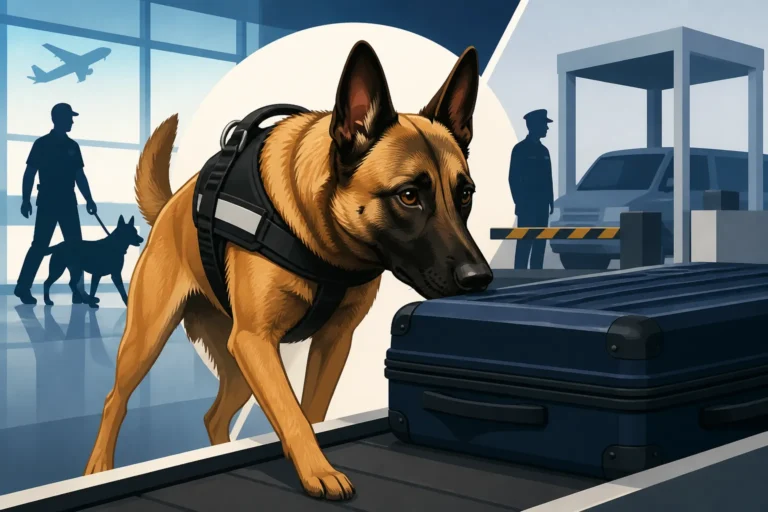
The broader story of service also extends well beyond wartime communications. For comparison, Belgian Malinois in Airport and Border Detection looks at a later working context, while What Belgian Breeders Originally Selected the Malinois For helps separate the breed’s original selection goals from the specialized work developed afterward.
| Role | What the dog could contribute | What the role did not mean |
|---|---|---|
| Message work | Carry a prepared message between people or positions | Guarantee that every message arrived or replace all communication systems |
| Wounded-person search | Help locate or draw attention to an injured person | Treat the person or transport them as an ambulance would |
| Guarding or support | Alert a handler or assist with duties around a position | Work safely or effectively without training and human direction |
| Supply assistance | Carry limited items where appropriate | Move heavy loads or replace organized transport |
How to understand the Malinois connection today
A real history, with reasonable limits
The connection between Belgian working dogs and wartime support roles is part of a larger European history of dogs used for communication, searching, guarding, and practical assistance. The Malinois belongs in that working tradition. Still, breed-specific claims should be phrased with care when records use broad labels or do not identify an individual dog’s variety.
It is also important not to treat “ambulance dog” and “message dog” as interchangeable terms. One describes a search or medical-support function; the other describes carrying communication. A dog might have been trained for one task, several tasks, or a role that changed according to the situation. A short historical reference may not tell us enough to know exactly how a particular dog worked.
Readers comparing accounts from different conflicts should keep dates and national contexts in mind. Military dog programs were not identical everywhere, and roles evolved as communication and medical practices changed. For an overview of the breed’s possible wartime experience, Whether Belgian Malinois Served in Both World Wars and The Countries That Breed the Most Belgian Malinois can help place the breed’s history in a wider setting. It is equally useful to ask what evidence supports a specific claim, rather than relying only on a repeated anecdote.
What the history says about the breed, and what it does not
Wartime service helps illustrate the qualities people have valued in Belgian working dogs: alertness, stamina, responsiveness, and a close working relationship with a handler. Those traits did not make the dogs invulnerable, automatically suited to every task, or interchangeable with trained human specialists. Their work was shaped by preparation and by the people responsible for them.
The history also does not mean that a modern Malinois needs military-style work to have a satisfying life. A household dog still needs thoughtful training, appropriate exercise, rest, and safe ways to use its attention and energy. Owners looking for practical enrichment may compare food puzzles, durable play items, or training rewards through retailers such as Chewy, while choosing items that suit the individual dog and supervising use. The historical role is interesting context, not a care plan.
Likewise, being descended from working dogs does not guarantee that every individual Malinois will enjoy or excel at the same activity. Temperament, health, experience, and training all matter. A dog interested in scent games may not be a candidate for protection sport; another may need help learning to settle after exciting work. If a Malinois seems restless or difficult to engage, carefully structured activities and guidance from a qualified trainer are more useful than trying to recreate a dramatic historical job. Owners can use Chewy to browse basic enrichment options, but the activity itself should be selected for the dog’s needs rather than for the breed’s reputation.
The lasting lesson is less about imagining a dog carrying a message through a battlefield and more about recognizing the partnership behind the task. In every role—farm work, search, communication, or modern detection—the dog’s contribution depended on training, clear handling, and conditions that made the work possible. For everyday care, practical supplies such as grooming tools and suitable chews can be compared at Chewy, but equipment cannot replace supervision, thoughtful training, or attention to the dog’s comfort.
Disclaimer
This article is for general informational purposes only and does not constitute professional advice. Laws, prices and regulations vary by location and change over time. Consult a qualified professional for guidance on your specific situation.