Whether the Malinois Survived the Wars in Numbers
The Belgian Malinois did survive both world wars, but there is no dependable figure for how many dogs were lost or how many remained afterward. War disrupted breeding, destroyed homes and kennels, and put working dogs at risk. The surviving population was rebuilt through breeding, though records do not support a precise before-and-after count for the Malinois alone.
Did the Belgian Malinois survive the First World War?
A young breed entered a period of upheaval
The Belgian Malinois was taking shape as a recognized type in the decades before the First World War. Belgian shepherd dogs were being classified and standardized, but the modern breed categories and record-keeping systems should not be confused with a complete count of every dog alive in Belgium. That distinction matters when asking how many Malinois survived: the war arrived while breed identity and registration practices were still developing.
Belgium was invaded in 1914, and fighting devastated parts of the country. People were displaced, farms and homes were damaged, and the ordinary conditions needed to breed and raise dogs were badly disrupted. A herding dog might lose its home, be separated from its owner, or face shortages of food and care. Even dogs that survived physically could disappear from breeding records when their families moved or their kennels were lost.
The story of the breed’s early development is covered in The Years the Belgian Malinois Was Standardized and The Belgian Farm Dogs the Malinois Came From. Those histories help explain why wartime losses cannot be neatly counted as losses from a fully defined, separately tracked Malinois population.
Working dogs served, but that does not give us a census
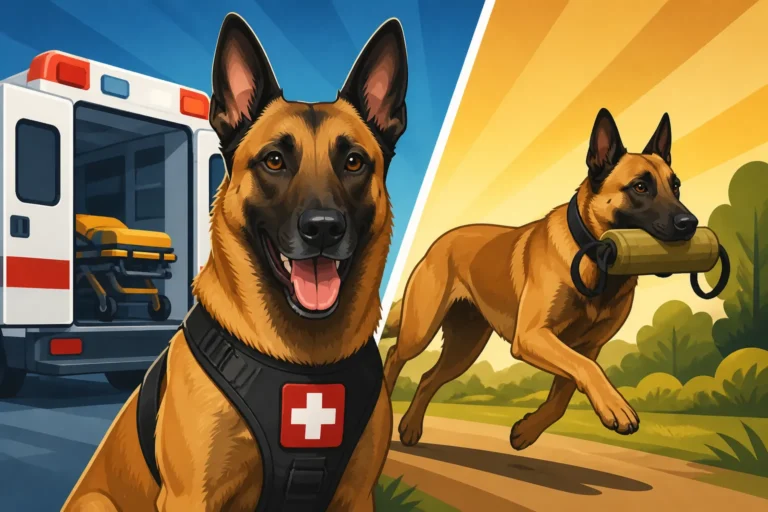
Belgian shepherd dogs were used for work during wartime, including carrying messages and supporting military or medical efforts. But accounts of dogs in service do not tell us how many Malinois existed across Belgium, how many were deployed, or how many returned. Dogs used in the field were only one part of the population; many others stayed with civilian owners or were never entered into official records.
There is another complication: historical accounts may use “Belgian shepherd” broadly, rather than consistently identifying the specific coat variety or type of each dog. The Malinois is one of four Belgian varieties, and the way those varieties were distinguished has changed over time. Without a clear, individual record for each dog, it is easy to mistake a general account of Belgian working dogs for a count of Malinois specifically. For more on that distinction, see The Four Belgian Varieties the Malinois Belongs To.
So the responsible answer is not that a known number of Malinois were killed or that a certain percentage survived. It is that the breed’s early population endured severe disruption, while surviving dogs and postwar breeding helped carry the type forward.
What happened to Malinois and Belgian shepherd dogs during the Second World War?
Occupation and disruption affected breeding again
The Second World War brought another period of occupation, upheaval, and hardship to Belgium. Families faced displacement and shortages, and the daily routines that support animal care and planned breeding could be interrupted. For a farm dog, survival depended on practical circumstances: whether its household could keep it, whether it could find food, and whether its surroundings remained safe.
The impact on a breed is not limited to dogs killed directly by fighting. When breeding stops or becomes difficult, a population can shrink in ways that are less visible. Fewer litters may be raised, some bloodlines may vanish, and surviving dogs may not be registered or bred. The result can be a narrower pool of dogs available for future breeding even when the breed never disappears altogether.
That general pattern is relevant to the Malinois, but it does not establish a precise number of surviving dogs. Records that could support such a count would need to consistently identify each dog as a Malinois, distinguish registered dogs from unregistered ones, and track deaths, births, and transfers through wartime conditions. A complete dataset of that kind is not available in the commonly discussed breed history.
Broad wartime accounts are not Malinois-only figures
Stories about Belgian dogs serving as messengers or helping medical personnel are part of the wider history of working dogs. They show that dogs were valued for practical tasks, but they do not prove that every dog described was a Malinois. The same caution applies to claims that the breed was nearly wiped out or, at the other extreme, that it came through the war with little harm. Either statement would require population evidence that is not established by anecdotal service accounts.
Belgian shepherd dogs were bred for useful work, including herding and farm duties. Wartime service was one part of a broader working history, not a complete record of breed numbers. The Herding Job the Belgian Malinois Was Built For offers context on the breed’s earlier role, while Belgian Malinois Used as Ambulance and Message Dogs focuses on the service stories that are often associated with wartime accounts.
When you encounter an exact-sounding claim online, check what population it describes. Is it referring to all Belgian shepherd varieties, dogs registered with a particular organization, or a specific group of military dogs? If the claim does not identify its records or explain its definition of “Malinois,” treat the number cautiously.
Why is there no reliable number for how many Malinois survived?
The records were not designed as a wartime population count
A registry records dogs that are submitted and documented under its rules. It does not automatically count every dog in a country, and it cannot account for dogs whose papers were lost or who were never registered. Wartime conditions make those gaps more likely: owners may be displaced, kennels may close, and normal administrative routines may stop.
Historical records also need consistent breed labels. If an older document describes a dog simply as a Belgian sheepdog, it may not be possible to identify its variety from the name alone. A dog’s coat and type may help, but not every record includes those details. That makes it difficult to compare prewar and postwar figures as if they were measurements of the same clearly defined population.
| Question | What can be said responsibly |
|---|---|
| Did the Malinois survive the wars? | Yes. The breed continued after both world wars. |
| Is there a reliable total of Malinois killed? | No complete, Malinois-specific wartime count is established. |
| Do military service stories provide the total? | No. They describe some working dogs, not the entire population. |
| Did the wars disrupt breeding? | Yes. Conflict, displacement, and shortages made ordinary breeding and care more difficult. |
| Was the breed rebuilt afterward? | Postwar breeding carried the population forward, but that does not reveal an exact survivor total. |
The table’s distinction between survival and headcount is the heart of the answer. A breed can survive a major crisis without leaving behind a trustworthy census of its losses. The Malinois did not vanish, but that fact alone cannot tell us how many individual dogs lived through either war.
Population recovery does not mean every bloodline survived
After a crisis, breeders can rebuild numbers from dogs that remain, but a larger population later does not necessarily mean the original population was preserved intact. Some lines may have ended, and others may have contributed more heavily to later generations. That is true of many breeds affected by war and social upheaval, and it is a useful way to think about Malinois history without turning uncertainty into a dramatic extinction claim.
The breed’s later development also occurred alongside changing standards and expanding working roles. The distinctions between Belgian varieties were shaped by coat and type, while the Malinois became especially prominent in modern police and military work. Why Belgium Sorted the Malinois Out by Coat and How the Belgian Malinois Took Over Police Work provide context for those later developments. They should not be read as evidence of an exact wartime recovery count.
A careful account therefore separates three things: survival of the breed, continuity of particular family lines, and the number of dogs alive at a specific date. The first is clear. The second may be traced in some pedigrees and records, but not as a complete account of every dog. The third cannot be answered with a reliable Malinois-wide number.
What is the clearest answer about the Malinois and the wars?
The breed survived, but not with a documented headcount
The Belgian Malinois survived both world wars. The dogs and people connected to the breed endured periods of danger and disruption, and breeding continued afterward. But no dependable figure tells us exactly how many Malinois were alive before each war, how many were lost, or how many remained immediately afterward.
That answer may feel less satisfying than a precise number, especially when a headline promises one. But a number without a clearly described source and population can create false certainty. If it refers to dogs in military service, it does not represent all Malinois. If it refers to registered dogs, it may exclude unregistered animals and dogs missing from the records. If it refers to Belgian shepherds broadly, it may include varieties beyond the Malinois.
The most accurate takeaway is simple: war put the breed’s dogs and breeding networks under pressure, yet the Malinois continued beyond both conflicts. Its history is one of survival and rebuilding, not a documented numerical tally of losses.
How to read claims about wartime survival
When you see a claim that the Malinois was nearly extinct, ask whether it refers to the Malinois specifically or Belgian shepherd dogs as a wider group. Also ask whether the writer is talking about a decline in breeding, a lost bloodline, or the death of most individual dogs. Those are different claims and require different evidence.
Likewise, treat claims that give a precise survivor count with care unless they explain the source and what was counted. A record of military dogs, a kennel’s breeding books, and a national population estimate are not interchangeable. The historical record supports the broad conclusion that the breed survived and was carried forward; it does not support a confident, breed-wide wartime headcount.
For readers interested in the broader chronology, When the First Malinois Landed in the States adds context on how the breed’s history continued beyond Belgium, while Whether Belgian Malinois Served in Both World Wars addresses the service question directly. The key is to keep military use, breed development, and population size separate rather than treating one as proof of the others.
Disclaimer
This article is for general informational purposes only and does not constitute professional advice. Laws, prices and regulations vary by location and change over time. Consult a qualified professional for guidance on your specific situation.