Telling a Belgian Malinois From a German Shepherd
A fawn dog with a black mask and upright ears can look unmistakably like a Belgian Malinois—until you meet a lean German Shepherd or a mixed-breed dog with the same coloring. Coat color and a quick glance can mislead. This guide compares the breeds’ build, head, movement, and behavior, and explains when appearance alone cannot give you a reliable answer.
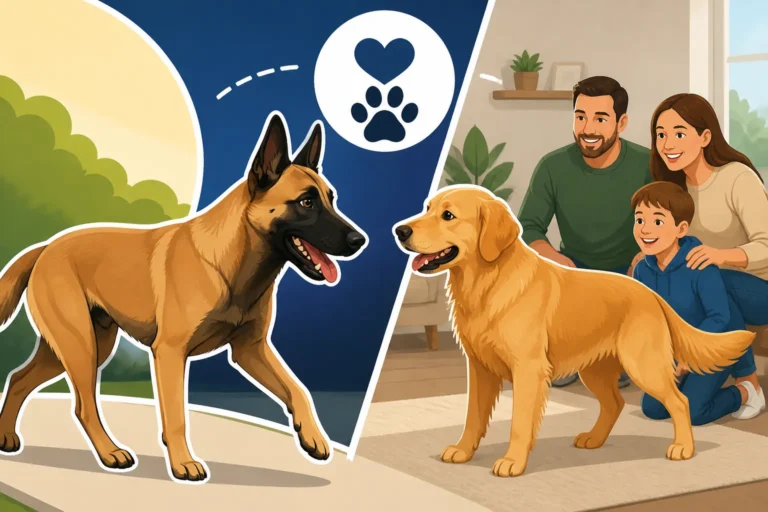
Belgian Malinois vs German Shepherd at a glance
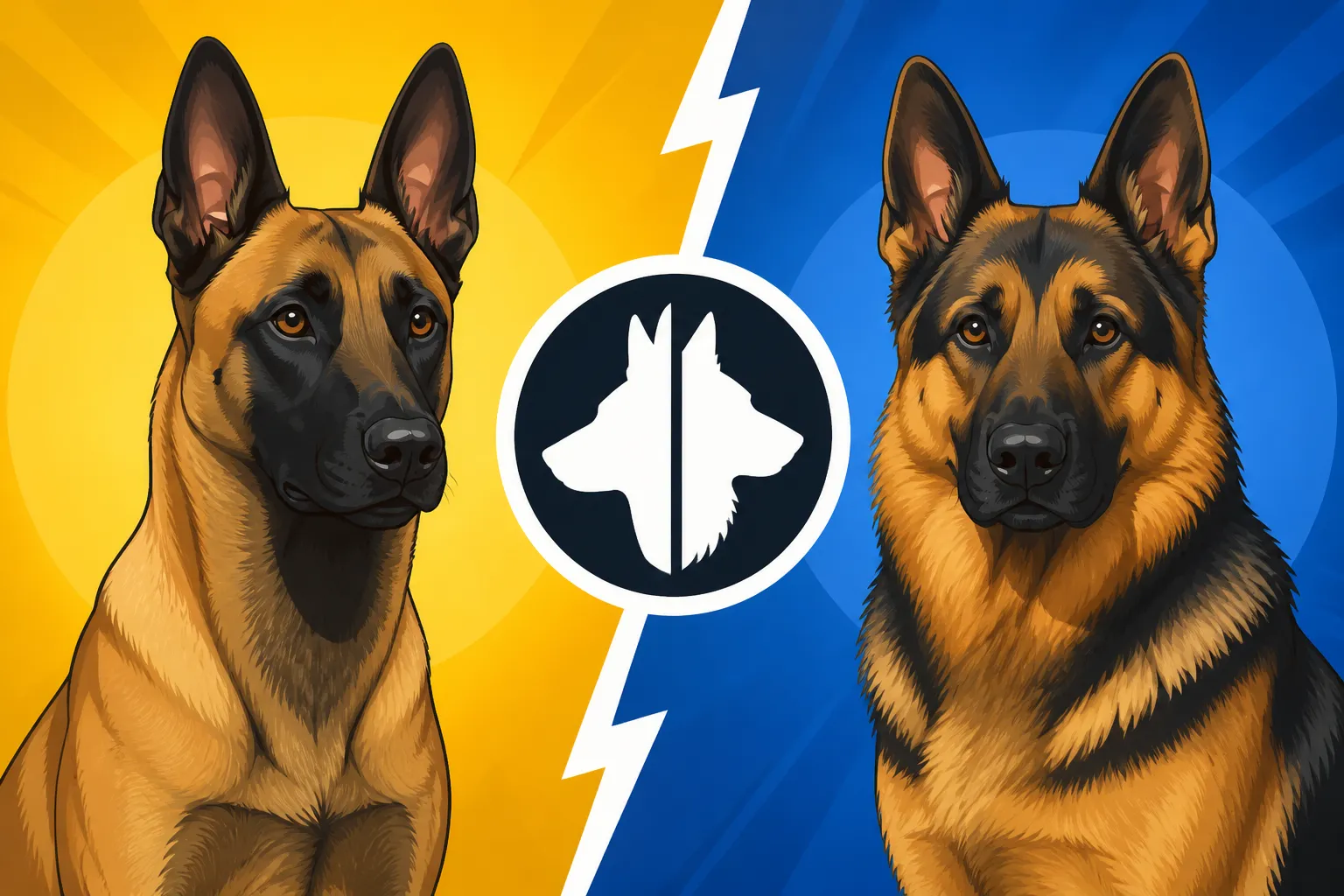
Both breeds are alert, athletic shepherds with erect ears, double coats, and a strong working heritage. From a distance, especially when they are young or moving, it’s easy to confuse them. The most useful clues are usually the dog’s overall proportions and movement—not one isolated feature such as coat color or ear shape.
| Feature | Belgian Malinois | German Shepherd |
|---|---|---|
| Overall build | Usually lighter-framed and more square in outline | Usually heavier-boned, with a longer-looking outline |
| Common coat appearance | Often fawn to mahogany with a black mask and overlay | Commonly black and tan, sable, or solid black, among other colors |
| Head and expression | Tends to look finer and more sharply defined | Often appears broader and more substantial |
| Movement | Quick, agile, and springy | Powerful and athletic, with a longer-reaching stride |
| What appearance can tell you | May suggest Malinois type | May suggest German Shepherd type |
| Most reliable confirmation | Breed records or appropriate DNA testing | Breed records or appropriate DNA testing |
These are tendencies, not guarantees. Individual dogs vary, and a mixed-breed dog may combine features of both. A photo can offer clues, but it rarely proves a dog’s ancestry.
Start with the dog’s overall outline
A Belgian Malinois often looks compact and light on its feet, with a balanced, square-ish outline. Its body tends to appear lean and tightly muscled rather than bulky. Even a fit Malinois can give the impression of being built for quick changes of direction: the dog looks ready to turn, accelerate, or spring into action.
A German Shepherd often appears longer through the body and more substantial in bone. That does not mean every German Shepherd is large or every Malinois is small. Rather, compare the dog’s proportions from the side. Does it look relatively compact and square, or longer and heavier through the frame? That visual impression is more helpful than asking only how tall the dog seems.
The comparison gets harder when a Malinois has a broad chest or a German Shepherd is exceptionally lean. Working dogs can also look different from show-line dogs of the same breed. Conditioning, age, grooming, and camera angle all affect what you see. A low-angle photo can make a dog look taller and heavier, while a thick coat can make its frame seem broader.
Use size carefully
Height alone is not a dependable way to distinguish these breeds. Adult males and females in both breeds can overlap in height, and a young dog may not have reached its mature size. Weight can offer another clue: German Shepherds often carry more overall mass, while Malinois are frequently lighter and more finely built. But diet, muscle, and individual genetics can shift that comparison.
If you’re looking at a puppy, don’t treat its current proportions as a final breed verdict. Puppies can go through lanky, awkward growth stages; their ears may not be fully upright yet, and their adult coat and body shape are still developing. For general size context, The Weight Range a Belgian Malinois Falls In can help explain why a number on the scale is only one part of the picture.
A dog’s weight also doesn’t tell you what it should eat or how much exercise it needs. If you’re browsing food or supplies at Chewy, use your dog’s actual age, body condition, health, and activity level rather than guessing from a possible breed label. A veterinarian can help you assess whether the dog is growing or maintaining weight appropriately.
Comparing the head, ears, and coat
The head and coat offer useful clues, but neither is a single-feature test. The two breeds share traits that can make them look alike, and both can vary in color and build. Look for a cluster of features that fit together instead of deciding based on a black mask, upright ears, or one striking photo.
Head shape and expression
A Malinois often has a more finely cut, somewhat narrower-looking head, with a pronounced but not exaggerated muzzle and an alert expression. The overall impression is often sharp and clean. A German Shepherd’s head may look broader and more substantial, especially in dogs with a heavier frame. These differences can be subtle, and head shape varies widely within both breeds.
The ears are not a guaranteed giveaway. Both breeds typically have upright ears as adults, but puppies may have ears that fold, tilt, or rise at different times. One ear standing before the other is not enough to identify a puppy’s breed. Injuries, ear development, and mixed ancestry can also affect the appearance of the ears.
Expressions are especially easy to misread. A dog’s focus, fatigue, or excitement can change how its eyes and ears appear in a picture. Instead of relying on a “look,” compare the head with the dog’s body proportions and coat pattern. The more traits that point in the same direction, the more useful your visual estimate becomes—but it remains an estimate.
Coat color and markings
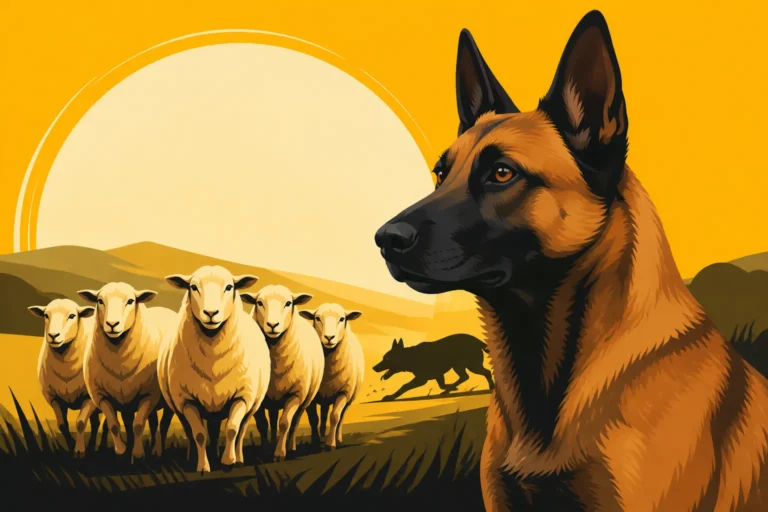
Many Malinois have a fawn-to-mahogany coat with a black mask and some black overlay. That familiar look is one reason people often identify a dog as a Malinois at a glance. German Shepherds, however, come in several recognized color patterns, including black and tan, sable, and solid black. Some coat patterns can create a similar overall impression, especially in a lean German Shepherd.
Color is not enough to confirm breed. A black mask does not prove a dog is a Malinois, and a sable coat does not automatically mean German Shepherd. The black overlay can also vary in intensity, while lighting and seasonal coat changes affect how a dog’s color appears. Fawn to Mahogany and the Black Malinois Mask offers more detail on the range of Malinois coat appearance.
Both breeds have double coats, though the length and texture can differ between individual dogs and lines. A German Shepherd may have a coat that looks fuller or longer, but coat appearance can be affected by season, grooming, age, and genetics. If you’re choosing a brush or shedding tool through Chewy, consider the dog’s actual coat length and shedding pattern, not just what breed someone suspects it is.
Look at the dog in motion
Movement can help you compare build. A Malinois often appears quick and nimble, with an athletic, springy way of changing direction. A German Shepherd may give a more powerful, ground-covering impression, with a longer-looking stride. These are broad patterns, not a test: both breeds can move fluidly, and a dog that is tired, injured, overweight, or excited may move in a way that obscures its usual style.
If possible, observe the dog walking and trotting on level ground rather than judging a still image. Watch the whole body: how the back, legs, and shoulders work together; whether the dog looks compact or elongated; and whether its movement appears light or more substantial. Don’t ask a dog to run or jump just to make an identification. Normal, comfortable movement is enough to notice general proportions.
Movement can also reveal a health concern rather than a breed clue. A limp, stiffness, reluctance to rise, or unusual gait deserves attention instead of being explained away as “how that breed moves.” For one issue that can affect active dogs, see Elbow Problems in a Jumping Belgian Malinois.
Behavior and working history are clues, not proof
People often try to identify these breeds by personality: “That dog is intense, so it must be a Malinois,” or “It’s calm, so it must be a German Shepherd.” These shortcuts are unreliable. Both breeds can be energetic, intelligent, trainable, and strongly attached to their people. A dog’s behavior reflects its individual temperament and experiences as well as its ancestry.
Avoid the stereotype test
Malinois are often associated with speed, intensity, and demanding working roles. German Shepherds also work in police, military, service, herding, sport, and companion settings. Either breed can be lively or reserved, and either can struggle if its needs are not met. A dog’s training history, daily routine, health, and environment all shape what you see.
A Malinois that has had a quiet morning may look relaxed. A German Shepherd that is excited about a ball may seem relentlessly driven. Conversely, a dog that has experienced poor socialization or stress may appear wary or reactive, regardless of breed. Behavior in a shelter, busy park, or unfamiliar home may not reflect how the dog acts once settled.
It’s more useful to ask what support the individual dog needs than to use behavior as a breed label. If you’re considering a dog whose background is uncertain, assess its exercise needs, ability to settle, comfort around people and animals, and response to everyday handling. The guide The Kind of Owner a Belgian Malinois Requires discusses the demands often associated with the breed, but it should not replace an individual temperament assessment.
Working lines and show lines add variation
Within each breed, breeding goals can influence appearance and behavior. Dogs bred for particular working tasks may be selected for athleticism, focus, or other traits valued in that work. Dogs bred with an emphasis on conformation may show a different build or style. These broad differences don’t divide neatly into “one breed is always like this” and “the other is always like that.”
That variation can complicate visual identification. A lean German Shepherd from a working background may look more compact than people expect. A larger or heavier-built Malinois may not match the familiar image of a narrow, lightweight dog. Working Malinois Against Show Malinois explains one source of variation within the Malinois breed, while The Malinois Against the Dutch Shepherd shows how visual comparisons can extend beyond these two breeds.
When a breeder, seller, or shelter describes a dog as a particular type, ask what supports that description. Registration papers and documented parentage are more informative than a confident guess based on appearance. If the dog is being sold as a specific purebred, ask to see records that connect the dog to its claimed lineage.
When appearance is not enough
Some dogs are easy to recognize, but many are not. A mixed-breed dog might inherit a Malinois-like mask and a German Shepherd-like frame, or carry traits from breeds that look quite different. If the answer matters for health records, housing rules, adoption planning, or breeding decisions, a visual guess is not a substitute for documentation.
Confirming breed with records or DNA testing
For a registered purebred dog, reliable pedigree and registration records are the clearest starting point. Ask for documents that identify the dog and its parents, and check that the names and identifying details match. A verbal claim or a photo of a dog that supposedly appears in the pedigree is not the same as records that establish parentage.
A canine DNA test may provide additional information, particularly for a mixed-breed dog with an unknown history. Results should be interpreted as an estimate based on the test’s methods and reference data—not as a replacement for a pedigree or a guarantee of appearance and temperament. Testing is generally most useful when your reason for asking is clear, such as learning about ancestry or discussing possible inherited health concerns with a veterinarian.
If the dog came from a shelter or rescue, ask what staff know about its background and what is recorded in its file. A shelter’s breed label may be a practical visual description rather than a verified ancestry claim. You can read more about that distinction in Whether Shelter Malinois Mixes Are Correctly Identified.
Use the label as a starting point for care
Knowing a likely breed can help you anticipate broad tendencies, but it does not tell you exactly how to feed, train, or care for a particular dog. A Malinois and a German Shepherd both need thoughtful exercise, training, preventive veterinary care, and a safe home. Their needs also vary with age, health, temperament, and lifestyle.
If you’ve been shopping at Chewy based on an assumed breed, pause before choosing products solely because they’re labeled for a Malinois or a German Shepherd. Measure the dog for a harness, check its real coat and chewing habits, and ask your veterinarian about nutrition. A breed guess is especially weak evidence for deciding how much food to provide or whether a dog needs special health screening.
Most importantly, don’t make a big decision from one visual detail. A black mask, upright ears, a lean body, or a confident working manner may suggest a Malinois, but no single trait settles the question. Consider the whole dog, check available records, and seek qualified guidance when breed identification has practical consequences. Chewy can be one place to browse routine supplies, but product selection should follow the dog’s individual measurements and needs—not an uncertain label.
Disclaimer
This article is for general informational purposes only and does not constitute professional advice. Laws, prices and regulations vary by location and change over time. Consult a qualified professional for guidance on your specific situation.