Whether the Belgian Malinois Was Always This Driven
A Belgian Malinois can look as if it arrived in the world already sprinting, grabbing, and scanning for its next task. That impression is understandable, especially when most people see the breed in police or sport videos. But the Malinois was not always shaped like today’s most intense working dogs. Its drive grew from useful herding traits—and from generations of selection for particular kinds of work.
What the Belgian Malinois was originally bred to do
The Malinois began as a practical Belgian farm dog
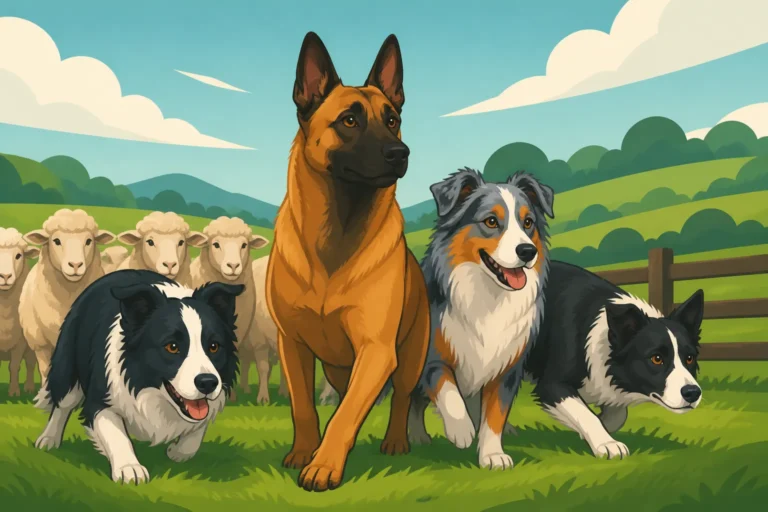
The Belgian Malinois takes its name from the city of Malines, also known as Mechelen. It developed among Belgian shepherd dogs kept for practical work, especially managing livestock. A farmer needed a dog that could move sheep, respond to direction, stay alert, and work through a full day—not a dog whose only purpose was to produce dramatic bursts of speed or bite.
Those tasks rewarded energy, but energy had a job. A herding dog might need to cover ground, notice when an animal drifted away, and change direction quickly when the handler gave a cue. It also needed enough steadiness to work near people and livestock without turning every movement into an uncontrolled chase. The breed’s famous responsiveness and athleticism make more sense when you picture that everyday farm setting.
Belgian shepherd dogs were later organized and classified by coat type. The Malinois is the short-coated variety; the Tervuren, Groenendael, and Laekenois are the other Belgian varieties. Their shared history helps explain why the Malinois was not originally a completely separate kind of dog with a single, modern job. For more on that background, see The Four Belgian Varieties the Malinois Belongs To and The Belgian Farm Dogs the Malinois Came From.
Early selection valued useful ability, not nonstop intensity
When people describe a dog as “driven,” they can mean several different things: a strong interest in chasing, a willingness to keep working, quick responses to a handler, or difficulty settling. Those qualities overlap, but they are not interchangeable. A farm dog that worked eagerly and stayed attentive was useful; a dog that could never disengage or rest would have been harder to live and work with.
Early Belgian shepherds were not all identical in temperament or working style. The dogs were shaped by the demands of their homes and the choices of the people breeding them. A household that needed a reliable livestock dog might value steadiness and control alongside energy. A breeder selecting for speed, intensity, or a particular kind of engagement could gradually produce a different balance of traits.
That distinction matters because modern images can make the breed’s history look inevitable: as if every Malinois was always destined to be a high-octane police dog. The historical picture is broader. The Malinois inherited qualities that could support demanding work, but the kind of work—and the particular traits emphasized—changed over time. The breed’s herding roots are explored further in The Herding Job the Belgian Malinois Was Built For.
How the Malinois’s working role changed
Police and service work put new value on familiar traits
As people looked for dogs capable of working closely with handlers in public settings, traits that had already helped a shepherd dog could be useful in new ways. Alertness, physical agility, quick learning, and willingness to stay engaged could support tasks such as tracking, searching, and responding to trained cues. The dog’s usefulness was no longer limited to moving livestock.
That shift did not mean every Malinois instantly became a police dog, or that police work created the breed’s energy from scratch. Rather, people began choosing and developing dogs whose existing abilities fitted the work they wanted. A dog that could focus intensely, move efficiently, and respond rapidly had an advantage in demanding working roles. Over generations, selection for those qualities could make them more pronounced in some families and lines.
The public often sees the most compelling examples: a dog leaping from a vehicle, searching a building, or working through a protection-sport routine. Those clips show a dog performing a selected and trained task, not a neutral sample of every Malinois. A broader history of that change appears in How the Belgian Malinois Took Over Police Work and How the Malinois Went From Herding to Police Work.
Different breeding goals created different kinds of intensity
There is no single “Malinois drive” that looks exactly the same in every dog. Some dogs are strongly motivated by toys or moving objects; others are more interested in scent, food, environmental exploration, or working in close partnership with a handler. Two dogs can both be energetic while differing greatly in how easily they settle, how they respond to frustration, and what kinds of work hold their attention.
Breeding goals influence that mix. A program focused on a specific sport or working task may prioritize traits useful for that task. A different program may put more weight on structure, temperament, or versatility. Even within one broad purpose, breeders and handlers do not all seek the same balance. That is one reason the labels “working line” and “show line” can be informative but cannot tell you everything about an individual dog. Working Malinois Against Show Malinois offers more context on those differences.
It is also why online footage can create a misleading expectation. A short clip captures peak action, not the ordinary hours around it: waiting in a crate, riding calmly in a vehicle, resting between training sessions, and responding to familiar household routines. The dog’s ability to settle is not a trivial extra. It is part of whether the dog can function safely and comfortably in daily life.
| Trait people may call drive | What it can look like | Why it matters in daily life |
|---|---|---|
| Chase or prey interest | Fixating on balls, toys, wildlife, or fast movement | Needs thoughtful management around roads, bicycles, pets, and children |
| Work motivation | Persisting with a task or seeking another activity | Can make training rewarding, but also requires planned rest |
| Handler engagement | Quickly noticing and responding to a person | Useful for learning, though it does not replace reliable training |
| Arousal or intensity | Becoming highly excited by activity or anticipation | Needs practice with calm transitions and recovery |
| Stamina | Continuing physical or mental work for a long time | Makes exercise planning important, but does not mean more exercise is always better |
Why some Malinois seem more intense today
Selection can amplify traits without making every dog alike
When breeders repeatedly choose dogs with certain qualities, those qualities can become more common in the dogs they produce. If a program rewards persistence, speed, physical confidence, or strong engagement in a particular task, puppies from that program may be more likely to show those tendencies. That is a gradual change in emphasis, not a sudden transformation of the breed as a whole.
The traits are also not separate switches. A dog may have tremendous enthusiasm for a tug but be cautious in unfamiliar places. Another may be highly alert but less interested in retrieving. A third may learn quickly yet struggle to relax after excitement. Genetics, early experiences, health, training, and the dog’s surroundings all influence what an owner sees.
So, when someone asks whether the Malinois was always this driven, the fairest answer is: the breed has long had qualities that support energetic work, but people have emphasized different versions of those qualities over time. Some modern working dogs are bred for exceptionally demanding roles. Other Malinois are less intense, though even a moderate individual may need more structure and purposeful activity than an inexperienced owner expects.
Popular images show performance more than ordinary life
Police, military, and sport settings tend to showcase dogs doing high-energy work. They are not designed to show the quieter parts of the dog’s day. That can leave prospective owners with an incomplete impression: the dog seems to be either performing at full throttle or causing trouble, with no middle ground.
In a real home, the middle ground is something people deliberately build. A dog may need clear routines, short training sessions, decompression, and a practiced “off switch.” A yard alone does not necessarily teach calm behavior, and endless ball throwing may increase arousal rather than leave the dog pleasantly tired. For an in-depth look at that everyday challenge, see Building an Off Switch Into a Belgian Malinois.
Enrichment can help when it is chosen for the individual dog and used as part of a balanced routine. Food puzzles, scent games, and appropriate chew or tug activities may give a dog a constructive outlet indoors. Owners sometimes browse options through retailers such as Chewy, but a toy is not a substitute for supervision, training, or rest. A dog that becomes frantic around a particular toy may need a different activity, not more access to the same trigger.
What the breed’s history means for a prospective owner
Evaluate the individual dog, not the reputation
A breed’s history can explain tendencies, but it cannot predict every detail of a dog’s behavior. Before bringing home a Malinois, ask about the parents’ temperaments, the purpose of the breeding program, the puppy’s early environment, and the support available after placement. If considering a rescue or adult dog, ask what the dog has actually experienced and how it behaves during ordinary routines—not only during a high-energy activity.
It is worth seeing Malinois in person before deciding. Watch how they transition from excitement to rest, how they respond to handling, and how their handlers manage them in everyday settings. If possible, talk with people who live with the breed outside a highlight reel. Questions about training time, exercise, household management, and recovery after activity will reveal more than asking whether the dog is “high drive.” The guide Where to See Malinois Working Before You Buy can help frame that research.
Think about your own schedule as honestly as you would think about the dog’s potential. A person who enjoys structured training and can provide consistent supervision may find the breed rewarding. Someone hoping that a large yard, occasional long walk, or a new toy will meet the dog’s needs may find the reality frustrating. For a wider discussion of fit, see The Kind of Owner a Belgian Malinois Requires.
Provide purposeful activity and teach calm as a skill
A Malinois does not need to spend every waking hour working. In fact, continually adding exercise can create a dog that expects more and more stimulation without learning how to settle. A better routine usually balances movement, training, sniffing, rest, and predictable downtime. The right mix depends on the dog’s age, health, temperament, and training.
For example, a young dog might practice a few minutes of basic cues, take a controlled sniffing walk, rest in a quiet space, and later work on a simple search game. Another dog might enjoy tracking or a structured sport session but need a calm transition afterward. Food-based enrichment can be useful for some dogs; Chewy is one place owners may look for puzzle feeders or other supplies, but the activity should match the dog’s safety needs and temperament. Keep small parts, chewing habits, and supervision in mind.
The historical point is not that every Malinois requires police work, bite sport, or an elaborate training program. It is that the breed’s energy and responsiveness have a background in purposeful work, and those traits still need thoughtful outlets. A realistic plan should include not only what the dog will do, but how the dog will learn to stop. That everyday structure is discussed in The Structure a Belgian Malinois Needs Every Day. If selecting toys or enrichment items, Chewy may offer options to compare, but the most useful choice is the one that supports calm, safe engagement rather than simply making the dog more excited.
Disclaimer
This article is for general informational purposes only and does not constitute professional advice. Laws, prices and regulations vary by location and change over time. Consult a qualified professional for guidance on your specific situation.