Dropping a Malinois at Thirty Yards
It's incredibly frustrating when you've got a brilliant, high-drive Belgian Malinois who performs perfectly at your side, but the moment you try to ask for a "down" from a distance, they either hesitate, wander off, or simply ignore you as if you've never spoken the command before. This guide is going to walk you through exactly how to bridge that gap, building a rock-solid, instant "down" command for your Malinois, even when they're thirty yards away and buzzing with energy.
The Art of the Remote Down: Why Distance Control Matters
For anyone living with or working a Belgian Malinois, the "down" command isn't just a polite request; it's often a critical safety cue and a cornerstone of advanced obedience and sport work. When your Malinois is locked onto a distant rabbit, heading toward a busy street, or about to launch themselves into an unexpected situation, having them drop instantly, no matter the distance, is invaluable. This isn't just about looking good in a trial; it's about real-world control over a powerful, intelligent, and often impulsive animal.
More Than Just a Trick: Safety and Performance
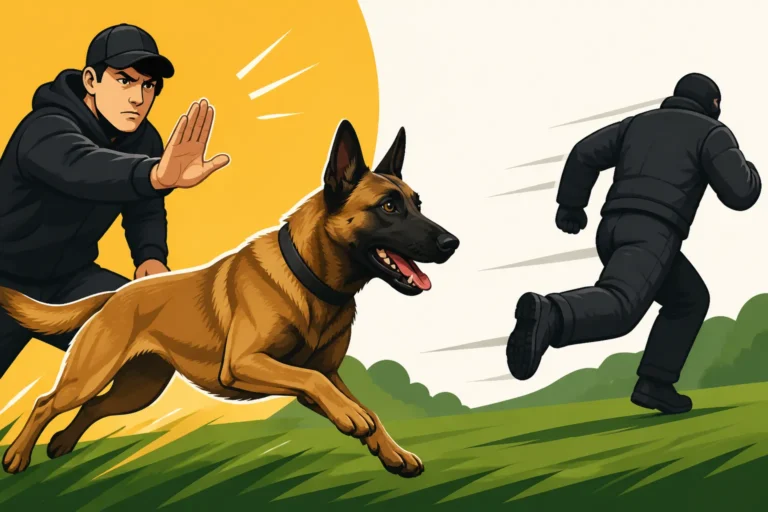
Imagine you're at the park, and your Malinois spots a squirrel on the other side, darting towards it with incredible speed. A reliable remote down means you can halt that chase before they run into traffic or bother another park-goer. Or, in the context of dog sports like IGP, a solid long-distance down is a non-negotiable part of the obedience routine, directly impacting your score and demonstrating your handler skills. It shows that your dog isn't just responding to your immediate presence but has truly generalized the command to any context and distance. It's a testament to the depth of your communication and the strength of your training.
This level of control also speaks volumes about the relationship you've built with your Malinois. It signifies that your verbal command or hand signal carries immense weight, overriding even the most compelling environmental distractions. For a breed known for its intensity and independence, achieving this kind of reliable remote control is a significant accomplishment and a crucial step in responsible ownership, ensuring both your dog's safety and the peace of mind of those around them.
Building the Bedrock: Close-Range Reliability
You can't expect your Malinois to perform a flawless thirty-yard down if they don't have a perfectly consistent down right at your feet. This is where the foundational work comes in, and it cannot be rushed. Before you even think about adding distance, your Malinois needs to understand that "down" means hitting the deck instantly, every single time, without question or hesitation. This means practicing in various environments, starting in low-distraction areas, and slowly building up to more complex settings. Think of it as drilling the basics until they're ingrained.
Focus on getting a fast, clean down when your Malinois is right next to you, then in front of you, and then slightly off to your side. Use high-value rewards to mark the desired behavior immediately. Your timing with the reward is critical; the treat or praise should come the instant their elbows hit the ground, not a second later. If you're struggling with these basics, resources like BAXTER & Bella's online puppy school can provide excellent structured programs to lay down these early obedience foundations, helping you establish clear communication and reliable close-range commands before tackling advanced concepts. Mastering this close-range reliability also involves teaching your Malinois Teaching a Belgian Malinois to Lie Down and Do Nothing, a crucial aspect for dogs with high drive. It's not just about the action of lying down, but the duration and calmness in that position.
We also want to ensure that your Malinois understands the "down" in conjunction with a stay, making sure they hold the position until released. This ties directly into commands like Building a Malinois's Place Command, where the dog learns to stay put in a designated spot for extended periods, regardless of what's happening around them. This level of confidence in holding a static position, even when you move away, is what truly sets the stage for a successful remote down. Without this rock-solid foundation, extending the distance will only highlight and amplify any existing inconsistencies in the command.
Progressive Training Steps for the Thirty-Yard Drop
Training a remote down isn't a quick fix; it's a systematic progression that builds confidence and understanding over time. You'll move in small, manageable steps, ensuring your Malinois is successful at each stage before moving on to the next. Patience and consistency are your greatest allies here. Remember, your Malinois wants to succeed, but they need clear communication and repetition to understand exactly what you're asking.
Phase One: Gradual Distance and Leash Control
Start by asking for your close-range down, then take one small step backward and repeat the command. If they perform it instantly, step back to them and reward. If there's any hesitation, immediately step back into their space, give the command again, and guide them into the down with a leash or hand motion. The goal is to make the correct response easy and highly rewarding. Slowly increase the distance, literally one step at a time, keeping your long line attached. This gives you the control to enforce the down if they ignore or break it.
Using a long line during this phase is absolutely critical. A 15-foot or 30-foot long line, easily found on a platform like Amazon, allows you to maintain a physical connection to your Malinois even as you increase distance. If your Malinois attempts to stand up or ignore the command, a quick, consistent pop on the long line, immediately followed by the verbal "down" command, can serve as a correction, quickly followed by praise the moment they comply. This teaches them that the command is non-negotiable, regardless of how far away you are. This type of Long Line Work With a Malinois in Open Ground is an excellent way to practice control at increasing distances without fully releasing them.
It's vital to ensure that your Malinois is still highly motivated by your rewards at these slightly increased distances. Don't let the distance dilute the value of the reward. Continue to use their favorite high-value treats or a quick game of tug as a reward upon successful completion, ensuring you walk back to them to deliver it, reinforcing that you are the source of good things, no matter the gap between you. This builds a strong desire for them to engage with you across the space.
Phase Two: Introducing Motion and Distraction
Once your Malinois is reliably dropping from a standing position at a distance on the long line, it's time to introduce motion. Start by having your dog walk a short distance away from you on the long line, then stop, give the "down" command, and reward. Gradually increase the distance and the speed of their movement. You might have them trot a few steps, then down. Then a full run, then down. This mimics real-world scenarios where they might be moving when you need them to drop. Building strong Building Engagement With a Belgian Malinois will be crucial here, as you need their attention to remain on you despite their movement.
Next comes the distraction. Start with very mild distractions, like having another person quietly walk by in the distance, or a light breeze rustling leaves. Again, use your long line to enforce the command if needed, and reward heavily for success. As they become more proficient, slowly introduce more significant distractions: another dog playing far away, a ball bouncing, or a person jogging. The key is to introduce these distractions gradually, always setting your Malinois up for success and never asking for more than they can handle. This step is also a good opportunity to practice control for situations like Recalling a Belgian Malinois Off a Moving Target, as it requires similar focus and responsiveness.
Remember that for a Malinois, drive is everything. You can use their drive to your advantage by having them move towards a thrown toy or a decoy (if training for sport) and then dropping them midway. This teaches them to break drive on command, a crucial skill. The immediate reward for the down then becomes the continuation of the game or the retrieval of the toy, reinforcing that dropping instantly leads to what they want, rather than stopping it. This careful management of drive and reward ensures your Malinois remains enthusiastic about the exercise.
Phase Three: Proofing for Precision and Speed
This is where the magic happens and you solidify that thirty-yard drop. At this stage, your Malinois should be performing reliable downs from a distance with motion and moderate distractions. Now, we want to make it instant and impeccable, even under high-level distractions and without a physical tether. This is often where an e-collar, used correctly, can become an invaluable tool. It allows you to communicate with your dog instantly and consistently, even when they are far away and highly distracted.
When introducing an e-collar, it's paramount to ensure your Malinois already understands the "down" command thoroughly. The e-collar is not for teaching the command but for reinforcing it at a distance, making it a reliable remote communication tool. Start with very low levels, pairing the e-collar stimulation with your verbal command. The moment your dog performs the down, release the stimulation and reward. Your timing is everything. For detailed guidance on this, understanding E-Collar Timing on a Belgian Malinois is absolutely essential to avoid confusion or negative associations.
Gradually, you'll work towards using the e-collar as a subtle cue, a "tap" on the shoulder at a distance, to remind them of the command. Practice in increasingly distracting environments – a busy park, near other dogs, or even in a light training session with other people. The goal is a lightning-fast, silent drop, no matter the context. Some owners worry about Whether an E-Collar Damages a Soft Malinois, but when introduced properly and used humanely, it becomes a clear line of communication, not a punishment. The consistency and clarity it provides can actually reduce frustration for both dog and handler.
Navigating Common Pitfalls and Strengthening the Command
Training a high-drive breed like a Malinois will inevitably present unique challenges. They are intelligent, tenacious, and can be easily distracted if not properly engaged. Understanding these common pitfalls and having strategies to overcome them is key to successfully achieving a reliable thirty-yard drop.
Overcoming Drive and Resistance
A Malinois's natural drive is both their greatest asset and their biggest hurdle in advanced obedience. When they're locked onto a scent, a moving object, or another dog, that drive can make them "drive through" your command, seemingly deaf to your requests. This isn't defiance; it's often an overwhelmed brain struggling to switch gears. The trick here is to teach them that responding to your command is the most rewarding choice, even more so than indulging their natural instincts. This involves careful reward management and building a powerful "off switch."
To counter this, consistently practice breaking their drive with the down command in various scenarios, starting with lower-intensity triggers. For example, if they're playing with a toy, ask for a down, reward, then immediately give the toy back. This teaches them that compliance doesn't mean the end of fun, but rather a brief pause that leads to more fun. If you're struggling with a dog that constantly wants to be "on," exploring strategies for Building an Off Switch Into a Belgian Malinois can be incredibly beneficial. It's about teaching them mental calmness and flexibility, rather than just physical stillness.
It's also about building the perceived value of your command. If your Malinois anticipates a high-value reward every time they execute a remote down, that command becomes a powerful magnet that can pull them away from other distractions. This requires being prepared with truly irresistible treats or the opportunity to re-engage in an activity they love immediately after a successful down. The consistency of this reinforcement loop is what ultimately reshapes their default response to immediate compliance.
Consistency, Timing, and Reward Strategies
In training, consistency isn't just about repeating the command; it's about being consistent in your expectations, your body language, your voice, and your follow-through. Every time you ask for a "down" at a distance, you must be prepared to get that down, even if it means walking out to them on the long line to enforce it. Inconsistency teaches your Malinois that sometimes they can get away with ignoring you, which undermines all your hard work. Your timing for both commands and rewards needs to be precise. The clearer and more immediate your feedback, the faster your Malinois will learn.
When it comes to rewards, variety and high value are essential. For a Malinois, generic kibble probably won't cut it when they're thirty yards away and a squirrel just ran by. Think about what truly motivates your dog. Small pieces of cooked meat, cheese, or specialized high-value training treats work wonders. The intensity of the reward should match the difficulty of the task. A perfect thirty-yard down in a distracting environment deserves a jackpot – multiple treats, enthusiastic praise, and maybe even a quick game with a favorite tug toy. For ideas on what really hits the mark, look into Training Treats a Belgian Malinois Burns Through.
Don't forget the power of "life rewards." Sometimes, the best reward isn't food but access to something they want. For example, a reliable remote down could earn them the privilege of being released to greet a friend, go for a swim, or chase a ball. This makes the down command a gateway to desirable activities, further cementing its value in their minds. The more ways you can make compliance incredibly rewarding, the stronger and more reliable the behavior will become.
When to Introduce Advanced Tools
For many handlers, especially those working in sport or professional capacities, advanced tools like e-collars become essential for achieving the level of precision and reliability needed for a thirty-yard drop. However, the decision to use an e-collar should never be taken lightly, and it should always be introduced properly. An e-collar is a communication tool, not a punishment device, and it’s meant to clarify, not coerce. It provides a consistent, unbiased signal that can be felt regardless of distance or distraction.
The ideal time to introduce an e-collar for a remote down is after your Malinois already understands the command clearly through traditional leash and lure methods. The e-collar then serves as a way to "layer" that known command onto a new communication channel. Start at very low, "working" levels where your dog barely perceives the stimulation, and pair it with your verbal command. The moment they initiate the down, the stimulation stops, and they receive praise and reward. This creates a positive association with the cessation of the e-collar signal. For a comprehensive overview of costs, consider researching What a Quality E-Collar Costs for a Belgian Malinois.
It's crucial to understand that an e-collar won't fix poor training; it amplifies good training. If your Malinois doesn't understand "down" reliably at close range, an e-collar will only confuse and potentially stress them. Seek guidance from experienced e-collar trainers who can teach you proper timing, levels, and application techniques. When used correctly, an e-collars can be incredibly effective for proofing commands at extreme distances and in high-distraction environments, giving you the confidence that your Malinois will respond every time, even when thirty yards away.
Essential Equipment for Distance Down Success
Having the right tools can make a significant difference in your training journey. While no piece of equipment can replace solid training and a strong handler-dog bond, certain aids are invaluable when working on a remote thirty-yard drop with a Belgian Malinois.
The Right Long Line for Practice
A long line is your lifeline during the early and intermediate stages of distance training. It provides a physical connection to your Malinois, allowing you to guide or correct them gently without breaking the flow of the exercise or losing control. For Malinois, you'll want a durable, lightweight long line that's easy to handle and won't get tangled easily. Nylon or biothane lines are popular choices. A 15-foot line is a good starting point, and as your confidence grows and your dog's reliability improves, you might move up to a 30-foot or even 50-foot line for maximum practice distance. These are readily available on platforms like Amazon.
When choosing a long line, consider the material. Nylon lines are generally softer on the hands but can absorb water and get muddy. Biothane lines are more expensive but are waterproof, easy to clean, and extremely durable, making them excellent for all-weather training. Regardless of material, ensure the hardware (clips) is strong enough to withstand a Malinois's sudden bursts of speed and power. A lightweight but sturdy snap hook is ideal, as anything too heavy will drag down your dog's collar and potentially distract them. Think about how the line feels in your hand – you'll be holding it a lot! For more information on starting with these tools, look up The Tracking Line a Malinois Handler Starts With.
Practicing with a long line teaches your Malinois that even when you're far away, the command is still real, and there are consequences for not obeying. It also helps them generalize the command, understanding that "down" means down, whether you're right next to them or a football field away. The tactile connection reinforces your verbal or hand signals, building a deeper understanding of the expectation.
Understanding E-Collar Usage in Advanced Obedience
As discussed, an e-collar is a powerful tool for advanced obedience, particularly for distance work like a thirty-yard drop. It offers a clear, consistent, and instant way to communicate with your Malinois across significant distances and through high levels of distraction. However, responsible e-collar usage is absolutely paramount. It requires education, practice, and a commitment to humane and effective training principles. Never use an e-collar out of frustration or as a primary teaching tool for new commands.
Modern e-collars offer a wide range of stimulation levels, from very gentle vibrations or tones to static stimulation that can be finely adjusted. The goal is always to find the lowest effective level that your dog perceives and responds to, often referred to as their "working level." This level is unique to each dog and can vary with their arousal state or environmental distractions. Proper introduction involves pairing known commands with the e-collar stimulation at the working level, so the dog learns that the stimulation precedes a command they already understand. The stimulation then becomes a subtle cue, not a deterrent.
The benefit of an e-collar in perfecting a thirty-yard drop is its immediate feedback. If your Malinois is thirty yards away, focused on a bird, and your verbal "down" is lost in the wind, a precisely timed, low-level e-collar stimulation can serve as an undeniable reminder. This allows you to maintain your standards and ensure compliance, even when your physical presence or voice can't reach them effectively. Always invest in a high-quality e-collar from a reputable brand, as cheap models can be unreliable and potentially unsafe.
Training Stages for Remote Down Mastery
| Stage | Focus | Key Tools | Goal |
|---|---|---|---|
| Foundation | Instant, reliable close-range down | Flat collar, 6-foot leash, high-value treats | Dog downs quickly at heel and directly in front |
| Phase One | Gradual distance increase | Long line (15-30 ft), treats | Reliable down from standing at 15-20 yards |
| Phase Two | Introducing motion and mild distraction | Long line, higher-value treats, environmental distractions | Reliable down from motion at 20-25 yards |
| Phase Three | Proofing for precision and speed | E-collar (optional, properly introduced), various distractions, environmental proofing | Instant, silent down from 30+ yards in any scenario |
| Maintenance | Consistency and reinforcement | Regular practice, varied rewards | Command remains rock-solid for life |
Disclaimer
This article is for general informational purposes only and does not constitute professional advice. Laws, prices and regulations vary by location and change over time. Consult a qualified professional for guidance on your specific situation.