E-Collar Timing on a Belgian Malinois
There's a moment in every Belgian Malinois owner's journey where you realize that conventional training methods, while good for other breeds, just might not cut it for the sheer intensity and drive your Malinois brings to the table. You're constantly battling that laser-focus on a squirrel, a passing car, or another dog, and it feels like your voice just vanishes into the ether. This guide isn't about whether to use an e-collar, but about the absolutely critical "when" and "how" to use it effectively, turning it into a clear communication tool rather than a source of confusion or conflict for your powerhouse of a dog.
Understanding the "Why" Behind E-Collar Timing with a Malinois
Let's face it, a Belgian Malinois isn't your average dog. They're bred for intense work, often in high-stakes environments, which means their brains are wired differently. They process information at lightning speed, and their drive to pursue a perceived "job" can completely override everything else. This incredible focus is what makes them exceptional partners in so many fields, but it's also why precise e-collar timing becomes not just helpful, but truly essential for effective communication.
The Malinois Drive and Its Impact on Learning
Your Malinois has a drive like no other. Whether it's prey drive, toy drive, or just the inherent need to do something, it's a force to be reckoned with. When that drive kicks in, especially something primal like chasing a fleeing object, their selective hearing gets amplified to an Olympic level. You can shout "come!" until you're blue in the face, but if your dog is locked onto that rabbit at the edge of the park, your voice might as well be the wind. This isn't stubbornness, it's genetic programming.
Because of this intense focus, a Malinois needs immediate, clear feedback. If the correction (or communication, as we prefer to call it with an e-collar) comes too late, they won't associate it with the action they were just performing. Imagine your Malinois spots a jogger and starts to lunge at the end of the leash, barking his head off. If you hit the e-collar button after he's already in a full lunge, pulling you off your feet, his brain struggles to connect the stimulation with the initial thought or movement that started the lunge. He might think it's the jogger, the leash, or even you causing the discomfort, rather than his own choice to react. This is where the magic (or disaster) of timing comes in. They need to understand, almost instinctively, "I thought about doing X, I started to do X, and that sensation happened. When I stopped X, the sensation stopped." It's a very clear, black-and-white consequence for a dog that thrives on clarity.
Avoiding Aversion and Building Association
The ultimate goal with an e-collar, especially with a sensitive and intelligent breed like the Malinois, is not to punish them into submission. It's to open a new line of communication – a tap on the shoulder, a subtle cue that says, "Hey, I need your attention, or that choice you're about to make isn't the one we want." If the timing is off, you risk creating aversion, fear, or confusion instead of clear understanding. This is particularly true for a breed that can sometimes be a bit "soft" emotionally, despite their tough exterior. You don't want your Malinois to associate the e-collar with pain or unfairness.
Think about it: if you're trying to recall your Malinois from sniffing an interesting bush, and the stimulation comes when he's already halfway back to you, or when he's just looked at you, he might associate the stimulation with coming to you, not with staying at the bush. This can quickly unravel months of training and erode trust. We want him to understand that the e-collar tells him, "Hey, disengage from that distraction," not "Coming to me is unpleasant." The subtlety and precision are everything. A poorly timed correction can make your Malinois become wary of the e-collar itself, or worse, make him generalize the negative feeling to the environment he was in, or even the person handling him. You're aiming for a reliable, predictable signal that helps your dog make the right choice, not one that leaves him guessing or feeling anxious. This careful approach also factors into discussions about Whether an E-Collar Damages a Soft Malinois.
Pre-Collar Foundations: When Not to Use an E-Collar
Before you even think about clipping that e-collar onto your Malinois, there are crucial foundational steps you absolutely cannot skip. Rushing into e-collar training without a solid base is like trying to build a house on quicksand – it's doomed to fail and can cause more problems than it solves. The e-collar is a finishing tool, an enhancement to communication, not a magic wand for untrained dogs.
Establishing Basic Obedience First
This is perhaps the most critical point: an e-collar is primarily a communication tool to reinforce commands your dog already understands, not to teach new ones from scratch. Your Malinois needs to have a solid grasp of basic obedience cues like "sit," "stay," "come," and "place" using traditional methods first, like leash pressure, lures, and positive reinforcement. They need to know what the words mean and what the desired action is before you layer on the e-collar.
Imagine trying to teach your Malinois "sit" for the very first time using an e-collar. He has no idea what "sit" means. When you give the command and then apply stimulation, he's just going to be confused and potentially stressed. He might try a dozen different behaviors, desperately trying to figure out what you want, and none of them will truly be tied to the word "sit" in his mind. Now, if your Malinois already knows "sit" on a verbal cue and leash pressure, the e-collar can be introduced as a way to reinforce that command, especially at a distance or with distractions. It becomes another way of saying, "Remember 'sit'? Do that now." This helps in Building a Marker System With a Malinois where the e-collar stimulus functions as a clear signal. For truly solid foundational work, focusing on Obedience a Malinois Needs Before Protection Work is key before introducing advanced tools.
Proofing in Low-Distraction Environments
Once your Malinois understands the basic commands, you need to "proof" them in various environments, gradually increasing distractions. This means practicing "come" in your living room, then the backyard, then a quiet park, all on a long line, before you even consider using an e-collar to enforce it in a busy setting. The e-collar comes in when your dog knows the command but chooses to ignore it due to overwhelming distractions or high drive.
If you introduce the e-collar in a highly stimulating environment right away, your Malinois might not be able to differentiate the e-collar sensation from the chaos around him. He might associate the stimulation with the other dogs, the loud noises, or the excited children, leading to negative emotional responses toward those things, rather than connecting it to his own choice to disregard your command. Start small, in predictable, low-distraction areas where you can set your dog up for success. This slow, deliberate process ensures that the e-collar becomes a tool for clarity, not confusion. Using a long line in open ground, as discussed in Long Line Work With a Malinois in Open Ground, is an excellent interim step before moving to e-collar work in more complex scenarios.
The Art of Precise E-Collar Timing
This is where the rubber meets the road, especially with a Belgian Malinois. Their intelligence and intensity demand precision that would be overkill for many other breeds. When you're working with an e-collar, the timing of your interaction is far more crucial than the level of stimulation you use. It's about a conversation, not a correction.
The "Moment of Disobedience" and the Quarter-Second Rule
For a Malinois to truly understand what the e-collar is communicating, the stimulation needs to be delivered at the exact "moment of disobedience" – which often means before the full behavior unfolds. We're talking about a quarter-second rule here, folks. This isn't about punishing your dog after he's already bolted across the park; it's about interrupting the thought or the initiation of that unwanted behavior.
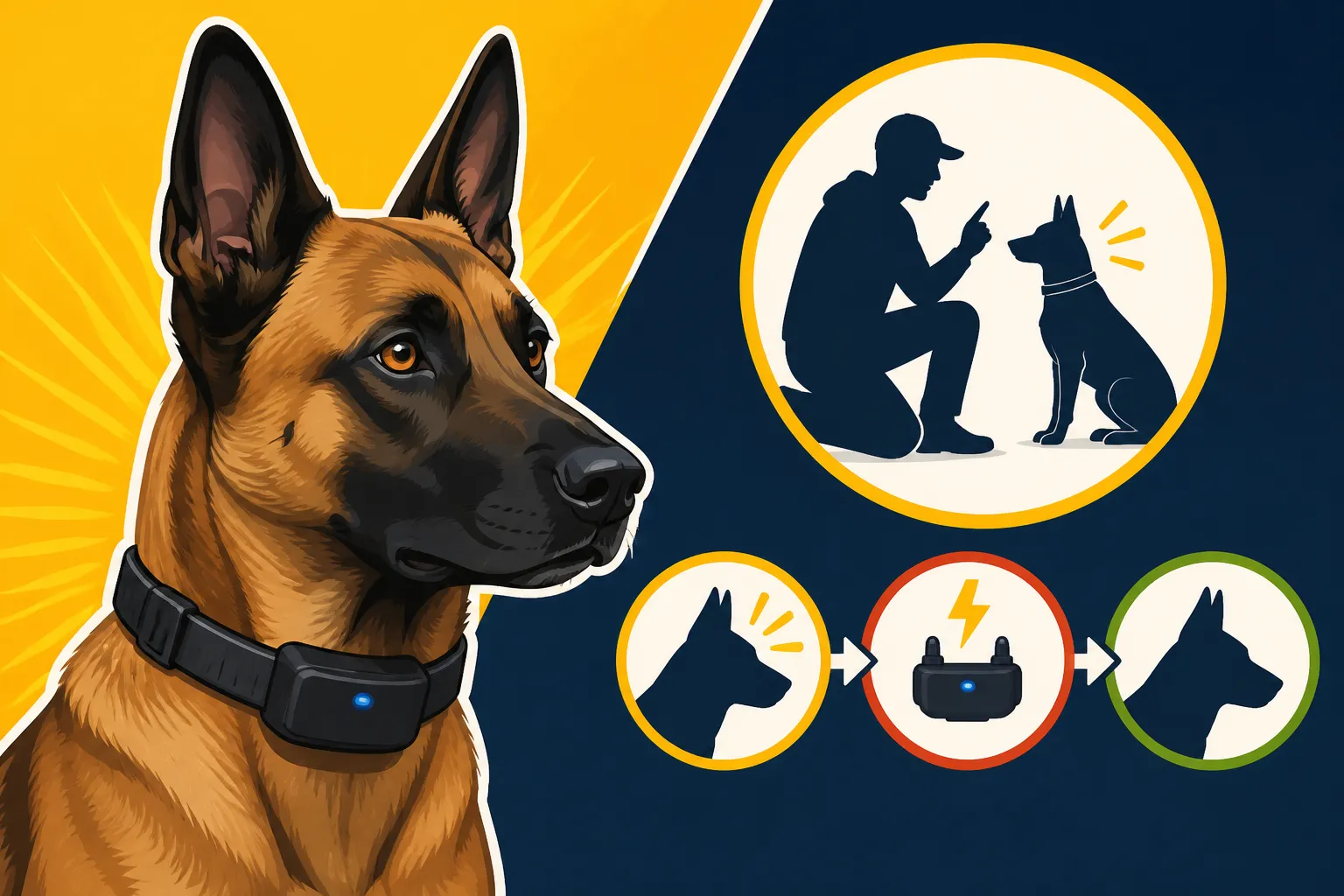
Let's illustrate: your Malinois is on a loose leash, and you see his ears perk, his body tense slightly, and his eyes lock onto a skateboarder down the street. That's the moment – the split second before he starts to lunge or bark. A quick, precise tap of the e-collar button, often at a very low working level (the level he barely feels), should happen right then. The moment he breaks eye contact, or his body relaxes even slightly, you immediately release the button. This teaches him, "That thought, that initiation of the chase/lunge, is what caused the sensation. Disengaging makes it stop." This rapid feedback loop is what makes the e-collar such an effective communication tool for Recalling a Belgian Malinois Off a Moving Target. This takes practice on your part, often requiring you to anticipate your dog's actions rather than reacting to them. Brands found on Amazon offer a wide range of e-collars with responsive buttons and different stimulation types, which can be critical for achieving this micro-timing.
Releasing the Stimulation for Correct Behavior
Just as crucial as when you apply the stimulation is when you release it. This is where many owners go wrong, holding the button down too long, or releasing it too late. The moment your Malinois shows any sign of complying with your command or disengaging from the undesirable action, the stimulation must stop instantly. This immediate cessation is the "release" or "negative reinforcement" aspect that teaches your dog exactly what action stops the uncomfortable sensation.
Consider a scenario where you've given your Malinois a "place" command, and he starts to drift off the mat. You apply a low-level continuous stimulation. The instant his paw touches the mat again, or he readjusts his body to be fully on the mat, you release the button. This clear, immediate feedback reinforces the correct behavior. Holding it down for even a second too long can confuse him; he might think the sensation is for being on the mat, or for moving at all. Following the release, a genuine, happy verbal "good!" and perhaps a reward (even just a quick pet or treat) further solidifies the positive association with making the correct choice. Many trainers, including those aligned with methodologies promoted by organizations like BAXTER & Bella, emphasize this balanced approach where clear communication tools are paired with positive reinforcement for lasting results. Conditioning a Belgian Malinois to an E-Collar involves consistent practice of these principles.
Common Timing Mistakes and How to Avoid Them
E-collar training, when done poorly, can be detrimental. With a high-drive, sensitive breed like the Belgian Malinois, mistakes in timing can quickly lead to a confused, anxious, or even aversive dog. Understanding these common pitfalls is vital for successful and humane e-collar use.
The "Too Late" and "Too Long" Problem
These are two sides of the same coin and represent perhaps the most frequent errors in e-collar timing.
The "Too Late" Problem: This occurs when you react to the unwanted behavior after it's already in full swing. For instance, your Malinois sees another dog, charges to the end of the leash, and is now barking and lunging. If you apply the e-collar stimulation at this point, his brain is already flooded with adrenaline and cortisol. He's unlikely to connect the sensation to his initial decision to react to the other dog. Instead, he might associate the feeling with the presence of the other dog, making his reactivity worse, or with the leash, or even with your frustration. The feedback loop is broken, and he's not learning anything constructive about his own choices. It becomes mere punishment, and a confusing one at that. This is particularly relevant when you're trying to figure out Whether Corrections Work on a High Drive Malinois.
The "Too Long" Problem: This is when the stimulation is held down for an extended period, rather than being a brief, precise tap or a momentary continuous pressure that stops the instant of compliance. If your Malinois is struggling to understand, or if you're holding the button while he tries to figure out what you want, it leads to prolonged discomfort without clear direction. A Malinois subjected to this might learn to "shut down," becoming unresponsive and withdrawn, rather than seeking the correct answer. They might also become habituated to the sensation, rendering the tool ineffective, or worse, start to anticipate negative feelings, which can lead to A Belgian Malinois That Shuts Down Under Correction. The e-collar is a precise scalpel, not a blunt instrument. Each application should be short, sharp, and immediately followed by relief when the dog makes the desired choice.
Inconsistent Application and "Popping" the Collar
Inconsistency is the enemy of all dog training, but especially with a Malinois and an e-collar. Your Malinois thrives on predictability and clear boundaries. If you use the e-collar sometimes, but not other times, or if your timing is sometimes good and sometimes way off, your dog will quickly learn that the signal isn't reliable. He might start to "test" you more, or simply ignore the collar, because he's not sure what to expect.
An older, less effective method of e-collar use involved "popping" the collar – a quick, high-level jolt delivered seemingly at random or without careful consideration for timing and the dog's understanding. This approach lacks the precision needed for effective learning and can easily create fear or avoidance rather than understanding. Modern, balanced e-collar training emphasizes using the lowest effective level of stimulation, applied with surgical precision, to communicate. It's about a conversation, not a scare tactic. Consistency means that when the e-collar is on and you give a command, you are prepared to reinforce it immediately and correctly, every single time. It's about establishing an unquestionable line of communication. Understanding What a Quality E-Collar Costs for a Belgian Malinois often comes down to the reliability and consistency of the device itself, allowing for these precise applications.
Here's a quick comparison to help visualize the impact of timing:
| Scenario | Timing Applied | Malinois's Interpretation (Likely) | Outcome |
|---|---|---|---|
| Correct Timing | At initial thought of lunging at a jogger; released when eye contact broken. | "The desire to lunge caused the sensation. Breaking focus made it stop. I should focus on handler." | Improved focus on handler, reduced reactivity. |
| Incorrect Timing | After Malinois is already fully lunging, barking, and pulling. | "The sensation happens when the jogger is there, or when I'm barking. Maybe the jogger is bad, or barking is bad (but not when?)." | Confusion, increased anxiety around distractions, potential worsening of reactivity. |
| Correct Timing | As Malinois turns head to chew forbidden object; released when disengages. | "That object causes the sensation. Ignoring it makes it stop. I should leave it alone." | Clear understanding of "leave it," better impulse control. |
| Incorrect Timing | After Malinois has chewed the object for 5 seconds; held down for 3 seconds. | "The sensation is for… chewing? Being near the object? Handler is mad? This is unpleasant and I don't know why." | Fear of handler, reluctance to interact with objects, potential "shutdown." |
The bottom line is that the e-collar, like any powerful tool, is only as effective and humane as the hand that wields it. For a Belgian Malinois, that means dedicating yourself to understanding and practicing impeccable timing. It takes patience, observation, and a commitment to clear, fair communication above all else.
Disclaimer
This article is for general informational purposes only and does not constitute professional advice. Laws, prices and regulations vary by location and change over time. Consult a qualified professional for guidance on your specific situation.