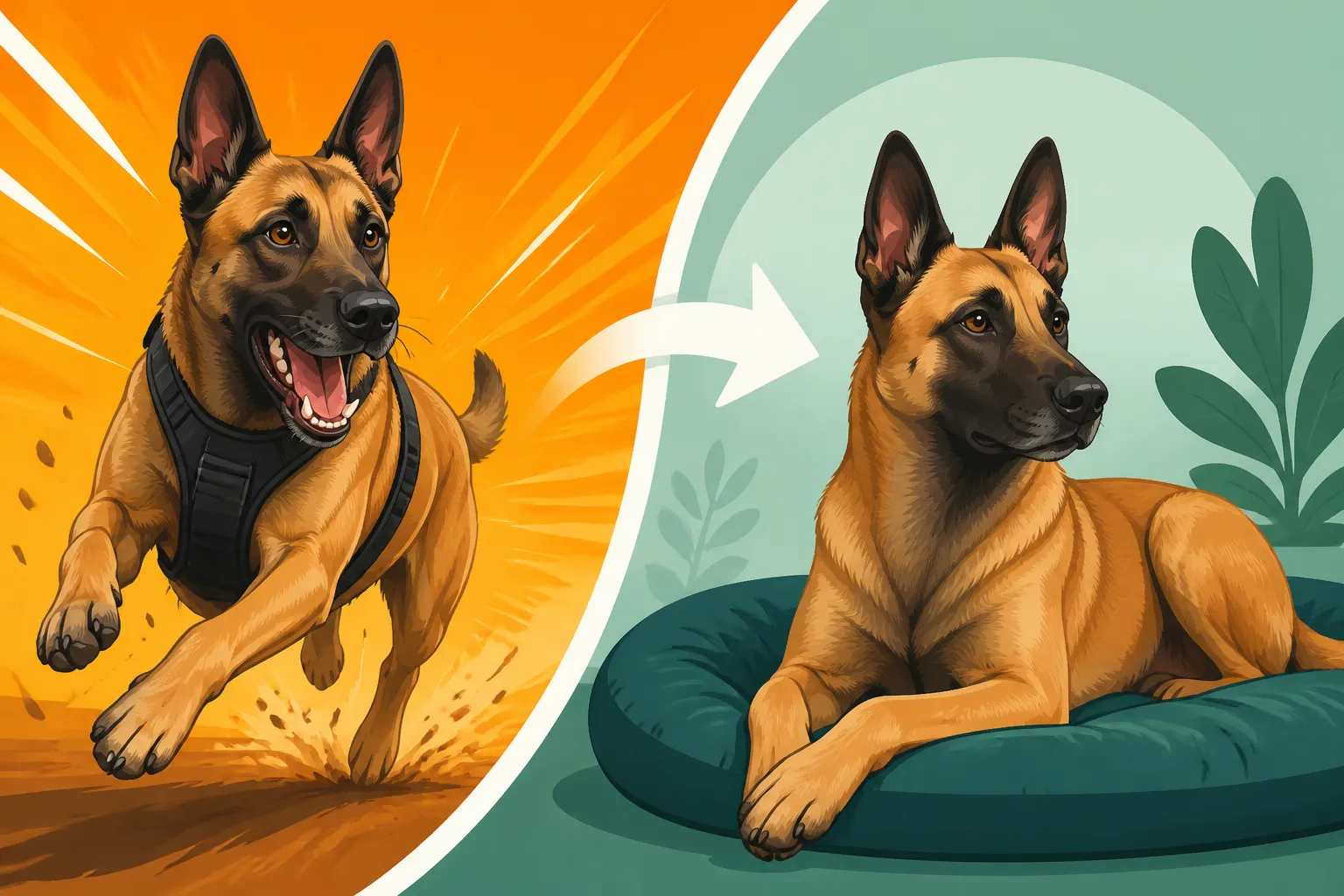
Whether a Belgian Malinois Calms Down at All
A Belgian Malinois can become more settled, but usually not by turning into a naturally low-energy dog. Many owners are waiting for the day their dog simply stops pacing, grabbing the leash, or demanding a job. This guide explains what “calming down” realistically looks like, how age affects a Malinois’s behavior, and what daily routines can help without making the dog more wired.
What calming down looks like in a Belgian Malinois
A calmer dog is not necessarily a less energetic dog
A Malinois may remain athletic, alert, and eager to work throughout adulthood. Calmness is better understood as a skill: the dog can rest when nothing is happening, recover after excitement, and respond to familiar cues even when distractions are present. That is different from expecting the dog to lose its interest in movement or engagement.
For example, a settled Malinois might watch you prepare dinner without circling the kitchen, lie on a mat while guests arrive, and nap after a walk rather than bringing you a toy every few minutes. The same dog may still spring into action when you pick up a training tug or head toward the car. That shift between rest and activity is a more realistic goal than constant quiet.
Owners sometimes mistake exhaustion for calmness. A dog that collapses after hours of fetch may appear peaceful, but if it becomes frantic again as soon as it wakes, the underlying issue may be poor settling skills or a routine built around ever-increasing stimulation. A useful starting point is Whether a Belgian Malinois Ever Truly Relaxes, which addresses the difference between rest and simply running out of energy.
Individual temperament matters as much as age
There is no single age at which every Malinois settles. Genetics, early experiences, health, training, and the dog’s daily environment all influence how intense it seems. One dog may learn to rest reliably as a young adult; another may continue to need careful structure for years. Even littermates raised in similar homes can differ in confidence, sensitivity, stamina, and ability to switch off.
Working-line background can also shape expectations, but labels alone do not tell you exactly how a dog will behave at home. A dog selected for work may be quick to notice movement, highly responsive to its handler, or persistent about getting access to activities it enjoys. Those traits can be valuable in the right setting and challenging in a household that expects the dog to entertain itself.
If your Malinois seems unusually restless compared with its own baseline, consider more than training. Pain, digestive discomfort, anxiety, poor sleep, or other health changes can affect behavior. A dog that suddenly cannot settle, starts pacing at night, or becomes irritable deserves a veterinary conversation rather than simply a harder exercise plan.
How age changes a Malinois’s energy
Puppyhood and adolescence can feel relentless
Malinois puppies often combine curiosity, quick learning, and immature impulse control. They may grab sleeves, race around the house, bark when frustrated, or become overtired and more difficult to manage. It can feel as though the puppy needs constant activity, but young dogs also need substantial downtime. Too little rest can make biting, frantic behavior, and difficulty concentrating worse.
Adolescence brings another set of challenges. A dog that once responded neatly may start testing boundaries, reacting more strongly to movement, or struggling to focus in familiar places. This is not necessarily evidence that the dog has become stubborn or that training has failed. As the body and confidence develop, skills often need to be practiced again in manageable settings.
During this stage, keep expectations simple and repeatable. Use short training sessions, quiet rest periods, safe outlets for chewing and sniffing, and predictable transitions between activity and downtime. For a broader look at how long this phase can feel, see The Year a Malinois Stops Being Frantic and The Shark Phase Every Malinois Puppy Goes Through.
Adulthood may bring better control, not a personality transplant
With maturity and consistent teaching, many Malinois become more predictable. They may wait more patiently, recover from excitement faster, and settle after a familiar routine. But maturity does not automatically teach a dog how to relax. If a young dog has learned that persistent barking, pacing, or pestering eventually produces play, those habits may continue unless the household changes what it reinforces.
Think of an adult Malinois who has spent years getting a ball thrown whenever it nudges an owner’s hand. The dog is not being difficult for the sake of it; the pattern has paid off. A calmer routine means teaching another pattern: after a brief activity, the dog goes to a bed or mat, receives calm reinforcement for staying there, and learns that quiet behavior does not make the day end or cause the handler to disappear.
Aging may reduce physical stamina, but it should not be treated as a substitute for training. An older dog can still need engagement, interaction, and appropriate movement. The goal is to adjust the pace to the dog’s body while preserving useful mental activity. The guide The Age a Malinois Starts Ignoring Known Cues can help explain why behavior may shift during adolescence, while Signs a Belgian Malinois Is Slowing Down focuses on changes later in life.
| Life stage | What owners may notice | Helpful focus |
|---|---|---|
| Puppyhood | Biting, short attention, bursts of activity, frequent naps | Safe exploration, brief learning sessions, predictable rest |
| Adolescence | More distraction, testing boundaries, big reactions to movement | Consistent rules, controlled practice, calm recovery after activity |
| Adulthood | Better capacity for routines, but strong work and play interests may remain | Reliable settling habits and purposeful outlets |
| Older age | Reduced stamina or longer recovery, sometimes with new restlessness | Adjusted activity and a check for pain or health changes |
Helping a Malinois settle without making it more wired
Build an off switch into ordinary routines
An off switch is not something a dog either has or lacks. It can be taught through everyday repetition. Choose a comfortable resting spot, such as a mat or bed, and reward the dog for lying there with a loose body and remaining settled. Begin when the home is relatively quiet; asking for a long stay while the dog is already bouncing at the door is often too difficult.
Keep the early practice manageable. Reward a few seconds of relaxation, release the dog calmly, and gradually extend the time as it succeeds. If your Malinois gets up, avoid turning the moment into a chase or an argument. Reset the exercise with less distraction or a shorter duration. The aim is not to pin the dog in place; it is to make resting a familiar, rewarding behavior.
Use the same idea after walks, training, meals, and visitors. A predictable sequence—activity, water, a brief decompression period, then rest—can help the dog understand what comes next. For a detailed approach, see Building an Off Switch Into a Belgian Malinois. If settling practice is turning into a struggle, scale the task back instead of adding more stimulation.
Choose structured outlets over nonstop excitement
A Malinois often benefits from activities that have a beginning, an end, and a clear purpose. A short obedience session, scent search, controlled tug game, or food-finding exercise can be more satisfying than repeatedly throwing a ball until the dog is frantic. The point is not to exhaust the dog; it is to give its attention somewhere useful and then help it transition back to rest.
Sniffing and searching are practical options for many households. Hide a few pieces of the dog’s regular food around a safe room or yard, or scatter them in an appropriate search area. A puzzle feeder can add problem-solving to a meal, but it should suit the dog’s experience and not create frustration. Chewy is one place owners may browse for puzzle feeders or durable enrichment items; check product suitability and supervise any toy, especially with a dog that chews intensely.
A useful routine balances physical movement, thinking, social contact, and quiet recovery. It should also change with weather, health, and the dog’s ability to cope. The Mental Work That Finally Tires a Malinois Out and Structured Work Against Random Running for a Malinois offer ideas for making activity more purposeful. Avoid assuming that the answer is always a longer run: Whether Too Much Exercise Makes a Malinois Worse explores why escalating exertion can backfire for some dogs.
When restlessness needs a closer look
Check the whole routine before adding more exercise
When a Malinois cannot settle, write down what the day actually looks like. Include walks, training, time alone, naps, meals, play, and moments when the dog becomes most unsettled. This can reveal patterns. Perhaps the dog becomes frantic after a high-energy game, struggles in the evening after too little daytime rest, or starts pestering whenever the household sits down.
Look for transitions that may be missing. A dog coming directly from intense play into a busy kitchen may need a calmer wind-down period. A dog left alone for long stretches may need a more thoughtful plan for movement, toileting, and enrichment. A dog that gets different rules from each family member may not understand when activity is finished. Consistency does not mean every day must be identical; it means the dog can recognize the basic rhythm.
Enrichment does not need to be complicated or expensive. Some owners use the dog’s meal in a snuffle mat, a simple food-search game, or a chew that is appropriate for that individual. Chewy may offer a range of these supplies, but the product is only useful if it is safe for your dog and does not encourage frantic chewing or guarding. Introduce new items while you can supervise and remove anything damaged.
Know when to ask for professional help
A dog that is merely energetic is different from one that seems distressed. Persistent pacing, inability to sleep, escalating vocalization, destructive behavior when alone, sudden aggression, or a sharp change from normal behavior can call for help. Start with a veterinarian if the change is sudden or accompanied by signs of discomfort, altered appetite, changes in movement, or disturbed sleep.
If health concerns are ruled out, a qualified trainer or veterinary behavior professional can help assess the dog’s environment and behavior. This matters especially if the dog is reacting to people or dogs, guarding resources, or becoming difficult to handle safely. A professional can help create a plan based on the individual dog rather than relying on generic advice to “wear it out.”
It is also worth being honest about what you can provide. A Malinois may become calmer and more manageable, but it is still a demanding breed. A stable routine, clear boundaries, suitable outlets, and deliberate rest are ongoing parts of ownership—not a temporary program that makes the dog permanently low-maintenance. The Handler Experience a Belgian Malinois Needs and The Kind of Owner a Belgian Malinois Requires can help put those demands in context.
Disclaimer
This article is for general informational purposes only and does not constitute professional advice. Laws, prices and regulations vary by location and change over time. Consult a qualified professional for guidance on your specific situation.