Judging a Malinois’s Condition by Hand
It's incredibly frustrating when you look at your lean, high-energy Belgian Malinois and wonder if they're truly at their peak physical condition, or perhaps just a bit too thin. Their naturally athletic build can make it a real challenge to differentiate between healthy leanness and an inadequate nutritional state. This guide will teach you the hands-on techniques to accurately assess your Malinois's body condition, moving beyond what your eyes alone can tell you, ensuring your working partner stays robust, resilient, and ready for anything.
Why Visual Cues Aren't Enough for a Malinois
Anyone who has lived with a Belgian Malinois knows they are a breed apart. Their sleek, muscular physique often draws comments from well-meaning friends about how "skinny" they look. But what looks lean to the untrained eye might be perfectly healthy, even ideal, for a Malinois. Conversely, a Malinois carrying just a few extra pounds can suffer significant health and performance consequences, even if they still appear trim compared to many other breeds. Relying solely on a glance can lead to misjudgments that impact their long-term well-being and working capacity.
The Deceptive Nature of a Malinois's Lean Build
Belgian Malinois are built for speed, agility, and endurance, not bulk. Their body composition naturally favors dense muscle over insulating fat. This means they often have a very tucked-up abdomen, prominent hip bones, and ribs that can be easily felt, sometimes even seen, especially when they are in motion or at the end of a hard training session. If you're used to breeds with heavier coats or more substantial builds, a Malinois can appear alarmingly thin. This visual perception can be incredibly misleading, prompting owners to overfeed in an attempt to "fatten them up," which is detrimental in the long run. Understanding The Lean Condition a Belgian Malinois Should Carry is crucial for any owner, as it sets the baseline for proper assessment. Their genetics dictate a specific athletic frame, and trying to force them into a broader, more "filled out" appearance typically means adding unhealthy fat.
Think of it like this: a marathon runner looks very different from a weightlifter. Both are athletes, but their ideal body compositions serve different purposes. Your Malinois is a canine marathon runner, a high-octane athlete designed for sustained effort and explosive movements. Their body needs to be efficient, and excess weight, even a small amount, acts as a drag on their performance and puts undue stress on their joints, heart, and respiratory system. Their short, single coat also doesn't hide much; what you see is largely what you get, making visual assessment tricky without context.
The Working Dog Standard vs. Pet Dog Norms
The ideal body condition for a working Belgian Malinois is often significantly leaner than what's considered "normal" for many companion dogs. In the pet world, a dog with visible ribs or hip bones might be flagged as underweight. For a Malinois actively involved in protection sports, detection work, or police duties, being able to easily feel (but not necessarily see from a distance) their ribs and hip bones is a hallmark of good condition. A Malinois carrying even a slight amount of extra weight will be slower, less agile, and more prone to overheating. Their joints will endure more impact with every jump, every turn, and every sprint.
This isn't about cruelty or deprivation; it's about optimizing their athletic performance and health. A police K9 or a competitive sport dog needs to be lightweight enough to perform strenuous tasks for extended periods without fatigue. Even for a Malinois who is primarily a family companion, if they maintain their breed-typical high energy levels and require significant daily exercise, a working dog body condition is still often appropriate. The benchmark for what constitutes an ideal weight must be aligned with their purpose and inherent athletic design, not generalized pet dog standards. Ignoring this distinction can inadvertently lead to health issues down the road, as even a small amount of extra fat can impact a breed so finely tuned for physical exertion.
The Hands-On Approach: Palpation Techniques
Since visual cues can be misleading, the most reliable way to assess your Malinois's body condition is through palpation – feeling their body with your hands. This method allows you to evaluate the layer of fat covering their bones and muscle, providing a much more accurate picture than simply looking. It's a skill that takes a little practice but becomes second nature with consistent effort. You'll learn to distinguish between bone, muscle, and fat, which is key to keeping your dog in peak form.
Feeling for Ribs: The Goldilocks Zone
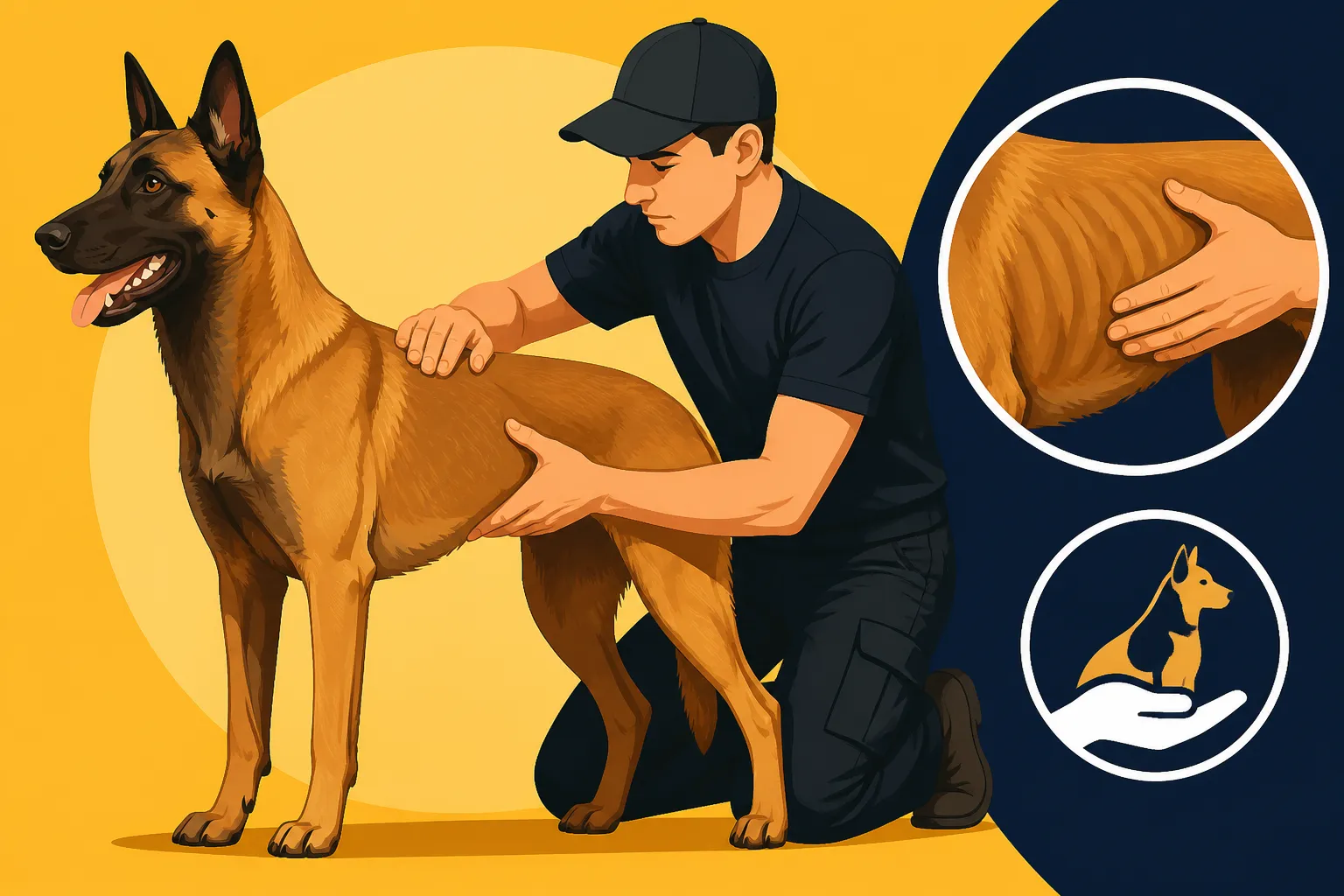
To assess your Malinois's ribs, place both hands flat on their chest, just behind their shoulder blades, and gently run your fingers along their rib cage. You should be able to feel each individual rib easily, almost like running your fingers over a venetian blind. There should be a thin, soft layer of tissue (subcutaneous fat) over the ribs, but no thick padding. If the ribs feel sharp, like you're touching bone directly with no cushioning at all, your Malinois is likely too thin. If you have to press hard to feel the ribs, or they feel spongy and indistinct, your Malinois is probably carrying too much weight. The "Goldilocks Zone" is where you can feel the ribs distinctively with minimal pressure, but they don't protrude excessively or feel like bare bone. This is generally accepted as The Lean Condition a Belgian Malinois Should Carry. Practicing this regularly helps you establish a baseline for your dog's specific ideal.
It's also important to do this when your dog is relaxed, not after an intense training session where their muscles might be more prominent or their body temporarily depleted. The consistency of this fat layer is what you're gauging, as it reflects their overall energy reserves. Remember, a Malinois often appears "ribby" when stretching or turning, and that's usually normal. The crucial part is what you feel when your hands are on them. If you're unsure, try palpating other healthy, active dogs of similar build to get a sense of what the ideal feels like.
Assessing the Spine and Hip Bones
Next, move your hands to your Malinois's spine. Run your fingers along the top of their back, from shoulders to tail. You should be able to feel the individual bumps of the vertebrae, but again, they shouldn't feel sharp or jagged. Similar to the ribs, a thin layer of fat should cushion them. If the spine feels like a row of pointy knuckles with no cushioning, your Malinois is too thin. If you can barely feel the vertebrae, or they feel buried under a thick layer of soft tissue, your Malinois is overweight.
Then, gently feel for their hip bones (iliac crests). These are the bony protrusions just above the tail base. In a lean Malinois, these will be fairly prominent and easily palpable, often slightly visible. However, they should not stick out sharply or look alarming. If they are very angular and you can see them clearly from a distance, it might indicate insufficient fat. Conversely, if you have trouble finding them or they feel rounded and covered, it's a sign of excess weight. The tuck of their waist, just before the hip bones, should also be evident. A Malinois in ideal condition will have a clear "tuck-up" from their rib cage to their hips, where their abdomen narrows significantly when viewed from the side and above. If this tuck-up is absent, or if their back appears flat or even concave rather than having a gentle curve, it's time to reassess their diet and exercise.
Checking the Muscle Mass on Your Malinois
Beyond just fat, assessing muscle mass is vital for a working breed like the Malinois. Their powerful musculature is what enables their incredible athletic feats. Feel the large muscle groups, especially over their hindquarters, thighs, and shoulders. These should feel firm, dense, and well-developed. You'll notice a distinct shape to these muscles when they are in peak condition, especially compared to a dog with a more sedentary lifestyle.
A Malinois that is underweight might show significant muscle wasting, where these areas feel soft, stringy, or simply diminished. On the other hand, an overweight Malinois might have good muscle mass, but it will be hidden under a layer of fat, making it harder to discern the definition. Regular exercise, particularly activities that involve sprinting, jumping, and biting work, contributes significantly to maintaining this crucial muscle mass. If you notice a decrease in muscle tone, even if their weight seems okay, it could indicate insufficient exercise, an underlying health issue, or a need for dietary adjustments focused on protein intake. You might want to consider The Protein a Working Malinois Actually Needs if you suspect muscle loss. The combination of optimal fat cover and strong muscle is the hallmark of a healthy, fit Malinois.
What Different Body Conditions Mean for Your Malinois
Understanding the spectrum of body conditions – underweight, ideal, and overweight – isn't just about aesthetics; it's about predicting and preventing health issues and optimizing performance. Each condition carries its own implications for your Malinois's health, energy, and longevity. Learning to accurately identify where your dog falls on this spectrum empowers you to make informed decisions about their care.
Underweight: When Your Malinois Needs More Fuel
An underweight Malinois will have ribs, spine, and hip bones that are very prominent, sharp, and easily visible from a distance, with little to no fat covering. Their muscles might appear wasted or feel stringy, especially over the hindquarters. You might also notice a very exaggerated abdominal tuck. While a Malinois should be lean, being truly underweight means their body isn't getting enough fuel to maintain its functions, build muscle, or sustain energy levels. This can happen due to insufficient food, extremely high energy expenditure without adequate caloric intake, or an underlying medical condition.
Being underweight can lead to a host of problems:
- Reduced Endurance: They simply won't have the energy reserves for sustained work or play. Why a Malinois Runs Itself Into Heat Exhaustion is a risk, as their bodies may struggle to regulate temperature without adequate reserves.
- Weakened Immune System: Lack of proper nutrition can compromise their ability to fight off illness.
- Poor Muscle Development and Recovery: They won't build or maintain the strong muscles essential for their breed, and recovery from exercise or injury will be prolonged.
- Increased Susceptibility to Injury: Without adequate cushioning and strength, bones and joints are more vulnerable.
If you suspect your Malinois is underweight, the first step is to consult your veterinarian to rule out any medical issues, such as parasites, malabsorption, or other diseases that could be preventing nutrient absorption. Once health issues are excluded, you'll need to gradually increase their caloric intake. This might mean feeding larger portions of their current high-quality performance food, or switching to a more calorie-dense formula. Brands like Ollie offer fresh, customized meal plans that can be tailored for weight gain, while Chewy provides a wide selection of high-calorie performance kibbles. Distributing meals throughout the day can also help with digestion and absorption.
Ideal Condition: The Peak Performer
This is the sweet spot for your Malinois. In ideal condition, their ribs are easily felt with light pressure, but not sharply visible. The spine is palpable but not prominent, and the hip bones are evident but well-covered. There's a clear, defined waist or "tuck-up" when viewed from the side and above. Their muscles are firm, well-developed, and clearly visible when they move. This is The Lean Condition a Belgian Malinois Should Carry to thrive.
A Malinois in ideal condition will display:
- Optimal Performance: Maximum speed, agility, and endurance with minimal risk of fatigue or overheating.
- Excellent Health: Strong immune system, healthy coat, and proper functioning of all bodily systems.
- Lower Risk of Injury: Muscles and fat provide necessary cushioning and support for joints and bones.
- Longevity: Maintaining an ideal weight throughout their life significantly reduces the risk of chronic conditions like arthritis, heart disease, and diabetes.
Achieving and maintaining this ideal requires a delicate balance of appropriate nutrition, tailored to their individual activity level, and consistent, challenging exercise. Many owners use a high-quality performance kibble, such as those found on Amazon, designed for active dogs, ensuring they are getting The Protein a Working Malinois Actually Needs and other vital nutrients. Regular body condition assessments and minor adjustments to food portions or exercise intensity are key to staying in this zone. The Daily Ration a Working Belgian Malinois Eats will fluctuate depending on workload, so vigilance is critical.
Overweight: The Hidden Risks in a Lean Breed
An overweight Malinois might still look "fit" to someone unfamiliar with the breed, but palpation will reveal a thick layer of fat over their ribs, spine, and hip bones, making them difficult to feel without significant pressure. Their waistline will be less defined, or even absent, and their body might appear more blocky or rounded. Even a few extra pounds on a Malinois can be considered overweight, given their lean genetic predisposition. This is where Whether a Belgian Malinois Can Be Too Lean becomes irrelevant, as the focus shifts to shedding unhealthy weight.
The consequences of being overweight, even slightly, for a Malinois are significant:
- Joint Strain: Extra weight puts immense stress on their joints, accelerating the onset of arthritis and increasing the risk of cruciate ligament tears, especially in such an active breed.
- Reduced Stamina and Heat Intolerance: They will tire more quickly during exercise and are much more prone to overheating.
- Increased Risk of Chronic Diseases: Obesity is linked to diabetes, heart disease, certain cancers, and respiratory problems.
- Decreased Performance: Their speed, agility, and jumping ability will all be compromised, making them less effective in their work or sport.
If your Malinois is overweight, the strategy involves a combination of controlled calorie reduction and increased, appropriate exercise. Again, consult your vet to rule out any metabolic issues. Then, gradually reduce their daily food intake, ensuring they are still getting balanced nutrition. Switching to a lower-calorie, high-fiber food can help them feel full. Increasing their structured exercise, focusing on sustained aerobic activity rather than just short bursts, will help burn fat. Remember that How Many Cups a Seventy Pound Belgian Malinois Eats will need to be adjusted downwards. This is where consistent effort and discipline from the owner are crucial, as a Malinois will often act like they're starving even when they're not.
Tools and Tips for Consistent Monitoring
Maintaining your Malinois's ideal body condition is an ongoing process, not a one-time achievement. Their activity levels, age, and even the seasons can influence their caloric needs and body composition. Having a system for consistent monitoring will help you stay on top of any changes and make timely adjustments to their diet and exercise regimen.
Regular Weigh-Ins and How to Interpret Them
While palpation is king for body condition, regular weigh-ins provide invaluable data, especially when tracking changes. For a Belgian Malinois, who can range significantly in size (e.g., The Sixty to Eighty Pounds a Male Malinois Carries or The Forty to Sixty Pounds a Female Malinois Carries), knowing their baseline healthy weight is crucial. Weigh your Malinois at least once a month, or more frequently if you're making dietary changes or monitoring a specific issue. It's best to use the same scale, at the same time of day (e.g., before breakfast), to ensure consistency. Many vet clinics will allow you to pop in for a quick weigh-in, or you can invest in a large, sturdy dog scale for home use, readily available from retailers like Amazon or Chewy.
Don't just look at the number; interpret it in conjunction with your hands-on body condition score. A slight fluctuation of a pound or two might be normal, especially for a working dog whose muscle mass can shift with training intensity. However, a consistent trend upwards or downwards, even small increments, should prompt further investigation. For instance, if your Malinois is dropping weight despite adequate food, it could signal an increased workload, stress, or an underlying health problem. If they're gaining, it's time to re-evaluate their caloric intake versus their energy expenditure. This routine is essential for Weighing a Belgian Malinois Through a Training Year and making data-driven decisions.
Photo Documentation for Tracking Progress
Beyond numbers and touch, visual records can be incredibly helpful for tracking subtle changes over time. Take photos of your Malinois from the side and from above (looking down on their back) every few weeks or months. Ensure the photos are taken in the same lighting conditions, at the same angle, and with your dog standing in a consistent posture. This creates a visual timeline that can reveal gradual changes that might otherwise go unnoticed day-to-day.
These photos can be particularly insightful when you're trying to gain or lose weight, or even just to confirm that your Malinois is holding their condition steady. You might be surprised at what a photo from two months ago reveals compared to today's image. It helps you see the "forest for the trees," preventing "kennel blindness" where you become so accustomed to your dog's appearance that you miss subtle shifts. These visual records are also excellent to share with your veterinarian, providing them with more context during health check-ups. They can help illustrate the effects of Feeding a Belgian Malinois Around Training Sessions and how these adjustments impact their physique.
Consulting Your Vet: When in Doubt
While these hands-on techniques are powerful tools for owners, they don't replace professional veterinary advice. If you're ever unsure about your Malinois's body condition, if they're experiencing rapid or unexplained weight loss/gain, or if you notice other symptoms like lethargy, changes in appetite, or digestive issues, it's crucial to consult your veterinarian. They can provide an objective assessment, rule out underlying medical conditions, and offer tailored dietary and exercise recommendations.
Your vet can help you establish a target weight range and body condition score for your individual Malinois, taking into account their age, activity level, and any pre-existing health concerns. They can also discuss specific dietary needs, such as Whether a Sport Malinois Needs a Performance Formula, or even prescribe therapeutic diets if necessary. Never hesitate to seek professional guidance, especially for a breed as high-performing and health-sensitive as the Belgian Malinois. Regular check-ups are also a great opportunity for them to physically assess your dog's condition, providing an expert second opinion to your own vigilant monitoring.
Adjusting Nutrition and Exercise Based on Condition
Once you've accurately assessed your Malinois's body condition, the next logical step is to make appropriate adjustments to their diet and exercise regimen. This isn't a set-it-and-forget-it process; it requires ongoing attention, especially with a breed whose energy demands can fluctuate wildly depending on their training schedule and lifestyle. The goal is always to maintain that ideal, athletic physique that allows them to perform at their best.
Tweaking the Daily Ration for Optimal Weight
If your hands-on assessment suggests your Malinois is a bit too lean, the most straightforward approach is to increase their daily caloric intake. This doesn't necessarily mean switching foods, though that's an option. Often, simply adding a small amount of their current high-quality kibble to each meal can make a difference. Start with an increase of about 10% of their current portion and reassess their condition in 2-4 weeks. If they're still too lean, increase again. Conversely, if they're starting to feel too padded, reduce their portion by a similar percentage. When considering How Many Cups a Seventy Pound Belgian Malinois Eats, remember that this is a guideline, and individual metabolism and activity play a huge role.
You might also consider supplementing their diet with healthy, calorie-dense additions, but always do this carefully to maintain nutritional balance. Cooked lean meats, eggs, or cottage cheese can be good options in moderation. Some owners find that adding a little healthy fat, like fish oil or a high-quality animal fat, can boost calories without significantly increasing meal volume. If you're feeding a commercial kibble, ensure it's a performance-grade formula designed for active dogs. Brands carried by Chewy often have detailed nutritional information, allowing you to compare calorie density. For working dogs, splitting their daily ration into two or three meals can aid digestion and nutrient absorption, especially Feeding a Belgian Malinois Around Training Sessions to ensure energy is available when needed.
Balancing Workload and Calorie Intake
It's not just about what goes into the bowl; it's also about what goes out in terms of energy. A Malinois involved in intensive training for protection sports, detection, or agility will burn significantly more calories than one who is primarily a family companion with daily walks. Their activity level can vary day to day, or week to week. A weekend of trials, for example, will necessitate a higher caloric intake than a week of lighter training. This direct link between energy expenditure and food intake is why What a Performance Kibble Costs for a Malinois is often justified; these foods are designed for peak fueling.
If you notice your Malinois is losing condition despite eating what seems like an adequate amount, consider if their workload has increased without a corresponding bump in food. Conversely, if an injury or forced rest period reduces their activity, their caloric intake needs to drop significantly to prevent unhealthy weight gain. This is a common pitfall for owners of highly active breeds when their dog is temporarily sidelined. An idle Malinois still has a high metabolism but isn't burning the extreme calories they usually do. Failing to adjust means fat accumulation. It's a constant balancing act, requiring keen observation and proactive adjustments to both sides of the energy equation.
Common Misconceptions About Malinois Body Condition
When it comes to Belgian Malinois, there are a few pervasive myths and misunderstandings about their ideal body condition that can lead owners astray. Dispelling these misconceptions is crucial for providing the best care and ensuring your high-drive companion lives a long, healthy, and fulfilling life.
The Myth of "Too Lean" for a Working Dog
One of the most common comments Malinois owners hear is, "Your dog looks too skinny!" This often comes from people accustomed to more heavily built breeds or pet dogs who are subtly overweight. However, for a high-performance Malinois, what looks "skinny" is often simply "fit." Their bodies are designed to be light, agile, and efficient, carrying minimal excess weight. This means a visible tuck-up, easily palpable ribs, and prominent hip bones are not signs of malnourishment but rather indicators of prime athletic condition. This lean build is central to their ability to excel in tasks requiring speed, endurance, and explosive power.
In reality, a Malinois that looks "filled out" or "chunky" by typical pet dog standards is very likely overweight for their breed and purpose. As we've discussed, even a small amount of excess fat can compromise their health and performance. The danger lies in owners trying to "bulk up" their Malinois based on these misconceptions, inadvertently putting their dog at risk for joint problems, heat intolerance, and other obesity-related illnesses. Trust your hands-on assessment and the advice of experienced working dog handlers and veterinarians over casual observations from those unfamiliar with the breed's ideal physique. Always refer to The Lean Condition a Belgian Malinois Should Carry as your true benchmark.
Why a Malinois's Energy Level Doesn't Always Reflect Condition
Another common misconception is that a Malinois's boundless energy automatically means they are in ideal physical condition. While it's true that Malinois are incredibly high-drive and energetic dogs, an unhealthy Malinois can still appear to have a high energy level, especially in bursts. A dog carrying too much weight might still chase a ball with enthusiasm for a short period, but they will tire more quickly, overheat sooner, and suffer more joint impact than a Malinois in peak condition. Conversely, an underweight Malinois might still be driven, but their stamina will be compromised, leading to faster fatigue during sustained work.
Energy levels are a function of genetics, drive, and mental stimulation, as much as physical condition. A Malinois could be slightly overweight and still appear "hyper" because they haven't had adequate mental or physical outlets. Their inherent drive pushes them, sometimes to their own detriment. Observing a Malinois that still has high drive but is struggling to sustain effort, or is showing signs of faster recovery needs, can often be a tell-tale sign that their physical condition isn't aligning with their mental willingness. This can be critical in preventing issues like Why a Malinois Runs Itself Into Heat Exhaustion. Therefore, while energy is a characteristic of the breed, it's not a reliable sole indicator of optimal body condition. Always combine observation of energy and performance with your hands-on body condition assessment for a complete picture.
| Body Condition | Ribs | Spine & Hip Bones | Waist/Tuck-up | Muscle Mass | Implications |
|---|---|---|---|---|---|
| Underweight | Very prominent, sharp, no fat cover | Very prominent, easily visible, no fat | Exaggerated, severe hour-glass shape | Wasted, soft, stringy, easily lost | Reduced endurance, weak immune system, injury risk, poor recovery. |
| Ideal | Easily felt with light pressure, thin fat | Palpable, not prominent, thin fat | Clearly defined, evident tuck-up | Firm, well-developed, visible definition | Optimal performance, excellent health, low injury risk, longevity. |
| Overweight | Difficult to feel, thick fat padding | Hard to feel, covered by thick fat | Absent or slight, straight/bulging | May be good, but hidden under fat | Joint strain, reduced stamina, heat intolerance, chronic disease risk, decreased performance. |
Disclaimer
This article is for general informational purposes only and does not constitute professional advice. Laws, prices and regulations vary by location and change over time. Consult a qualified professional for guidance on your specific situation.