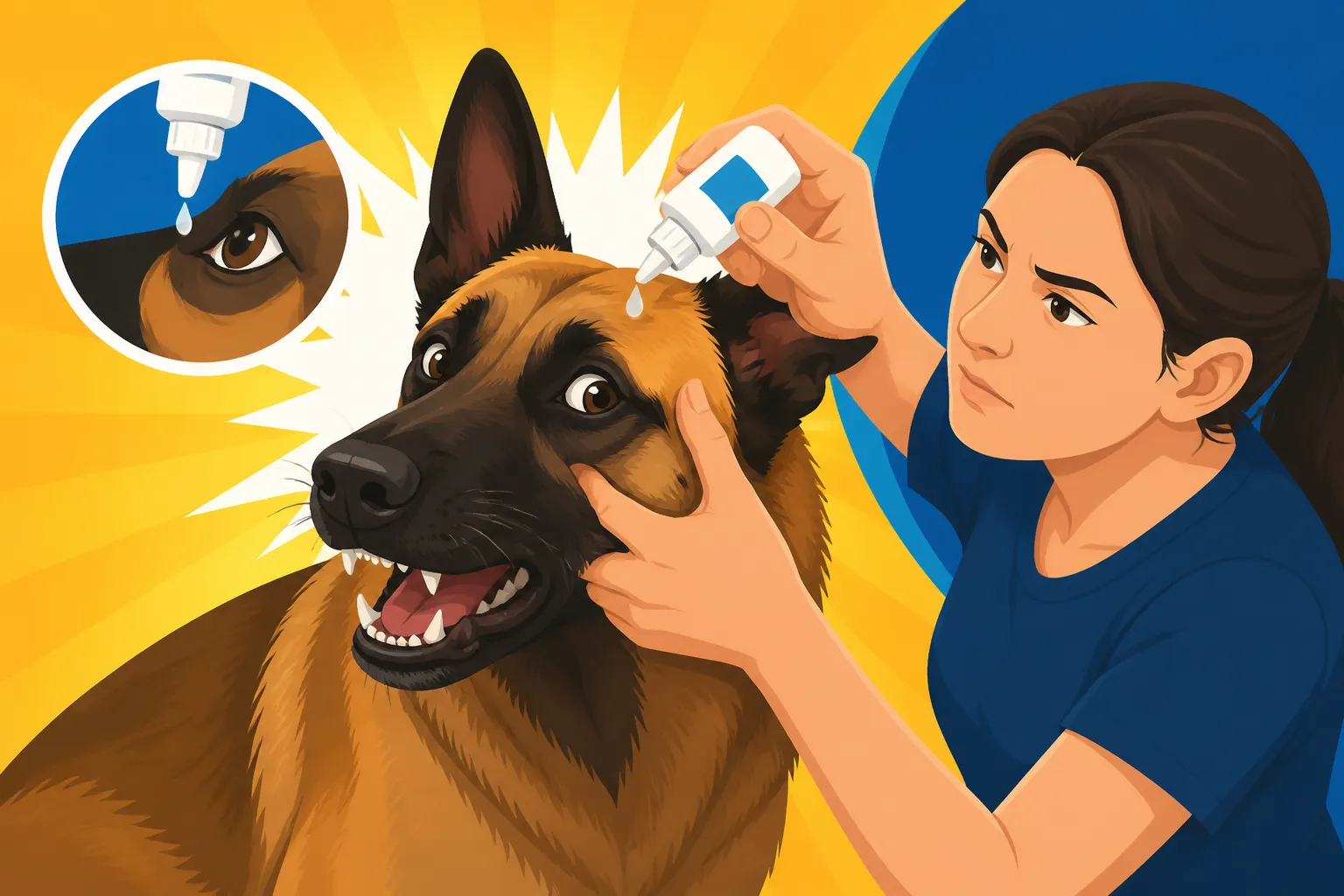
Applying Eye Medication to a Malinois That Objects
Trying to administer eye medication to a Belgian Malinois can feel like wrestling a greased-up, highly intelligent, and incredibly strong eel. Their natural suspicion, high drive, and sheer physical power make this seemingly simple task a genuine test of wills for many owners. This comprehensive guide will walk you through understanding why your Malinois objects so strongly, how to prepare effectively, master gentle handling techniques, and ultimately, get those vital eye drops or ointments into your dog's eyes with less stress for both of you.
Why Your Malinois Fights Eye Medication
Understanding the root cause of your Malinois's resistance is the first step toward finding a solution. It's rarely about maliciousness; it's deeply ingrained instinct and learned behavior.
The Instinct to Protect Vulnerable Areas
For a breed like the Belgian Malinois, which has been bred for protection, herding, and demanding work, there's a primal instinct to guard their face and eyes. In the wild, an injury to the eyes means compromised vision, which is a death sentence for a predator or a working animal. Even in our modern homes, this instinct persists. A hand coming swiftly towards their face, especially near their eyes, can trigger a defensive reaction. They might pull back, duck, or even snap, not out of aggression, but a deep-seated need for self-preservation. It's a quick, hard-wired response to protect a vital, vulnerable organ. They aren't thinking "medicine," they're thinking "threat."
This natural wariness is amplified in a high-drive dog who is constantly assessing their environment for potential threats or tasks. They are observant and often don't appreciate being caught off guard, especially with something so intrusive. Imagine someone trying to squirt liquid into your eyes without warning; your immediate reaction would likely be to flinch away, right? Your Malinois is doing the same, perhaps with more intensity than a laid-back couch potato breed.
High Drive and Lack of Patience
Belgian Malinois are not typically known for their boundless patience, especially when it comes to being still for something they find unpleasant. Their high drive means they are constantly seeking engagement, action, and purpose. Asking them to hold perfectly still while you manipulate their head and face goes against their very nature. They want to move, to do, to work. This isn't laziness or defiance; it's a manifestation of their incredible energy and focus. When they're restless, that energy has to go somewhere, and often it translates into squirming, head-shaking, or trying to escape.
Their threshold for discomfort or perceived invasiveness can be very low. A quick, slightly rough handling during a previous vet visit, or even an accidental poke in the eye, can create a strong negative association. They are smart, and they remember. This makes building a positive association crucial. They need to understand that this momentary discomfort leads to something highly rewarding, something even better than their current high-drive pursuit. Until that connection is made, their default is often to try and get away from the perceived unpleasantness. You're fighting against a dog that would rather be running, jumping, or biting a sleeve. Two Hours and a Job a Belgian Malinois Demands Daily clearly outlines how demanding these dogs are, and that demand for activity often clashes with the need for stillness.
Previous Negative Experiences
It's entirely possible your Malinois has had a previous bad experience with eye medication, or even just with having their face handled. Perhaps a painful eye infection necessitated medication, or a hurried vet tech was a bit too rough. Dogs, especially intelligent and sensitive breeds like Malinois, can form strong negative associations very quickly. Once that trust is broken, or a fear response is established, it can take significant effort to rebuild. The moment they see the eyedropper, smell the medication, or even just perceive you are preparing for "that thing," their defenses go up.
These past experiences can create a "poisoned cue," where the sight of the bottle or the specific body language you adopt signals impending unpleasantness. This is why a calm, consistent, and positive approach is so vital. If every attempt has been a struggle, your dog has learned that fighting works, or at least delays the inevitable. We need to break that cycle by introducing gentleness, predictability, and above all, high-value rewards to override those past negative memories. Remember, for a Malinois, a strong memory often equals a strong reaction.
Setting the Stage for Success: Preparation is Key
Trying to wrangle a Malinois for eye medication without proper preparation is a recipe for frustration and potential injury. A little foresight goes a long way in making the process smoother for everyone involved.
Gathering Your Supplies and Treats
Before you even think about approaching your Malinois, ensure everything you need is within arm's reach. This means the eye medication itself, a very high-value treat (think cooked chicken, cheese, or even a dollop of peanut butter on a spoon – something your Malinois adores), and perhaps a soft towel or a helper if you anticipate a real struggle. Having everything ready means you can work quickly and efficiently, minimizing the time your dog has to object or escape. Fumbling for supplies only prolongs the ordeal and increases stress.
Consider the medication itself. Is it drops or ointment? Drops are often quicker but require more precision. Ointments can be a little trickier to get into the eye but often stay in place better. If you have a choice, discuss with your vet which form might be easier for your specific dog. Also, ensure the medication is at a comfortable temperature if possible, as cold drops can be startling. Some owners even have a Muzzle Conditioning Before a Malinois Ever Needs One in their toolkit, which can be useful in extreme cases, especially if there's any risk of a bite. You might keep these supplies in a designated spot, away from where you normally store other dog items, so your Malinois doesn't immediately associate that specific cabinet or drawer with the dreaded eye drops.
Choosing the Right Time and Environment
Timing is everything. Avoid trying to give eye medication when your Malinois is at the peak of their energy, fresh off a nap, or right before a scheduled walk or training session. Ideally, you want to catch them when they are relatively calm and relaxed, perhaps after a strenuous play session or a long walk when they are physically tired but not so exhausted they are grumpy. This is when their drive for movement is slightly subdued, making them more amenable to being still. The Mental Work That Finally Tires a Malinois Out suggests that mental exertion can also help calm them down, making them more receptive.
The environment matters just as much. Choose a quiet, confined space where distractions are minimal. This could be a small bathroom, a laundry room, or a corner of a larger room where you can block off escape routes. Avoid open areas where your dog feels they have an easy escape path. Ensure the lighting is good so you can clearly see what you're doing, but not so bright that it causes your dog discomfort. A non-slip surface is also important, as a struggling Malinois can easily lose their footing on slick floors, potentially injuring themselves or you. If you have other pets, make sure they are out of the room to prevent additional distractions or jealousy.
Desensitization and Counter-Conditioning
This is the long game, but it's crucial for long-term success. Desensitization means gradually exposing your Malinois to the sight and feel of the eye medication without actually administering it. Counter-conditioning means changing their emotional response from negative to positive. Start by simply showing them the bottle, then immediately giving them a high-value treat. Repeat this many times. Don't even open the bottle at first. Just show and reward.
Once they are comfortable with the sight of the bottle, move on to opening it, letting them hear the click or rustle, and then immediately reward. Next, touch the outside of the bottle to their head, then reward. Gradually, work up to touching their muzzle, then their cheek, then near their eye with your finger (without the bottle), always followed by a treat and praise. The key is to go at their pace, keeping sessions short (a minute or two) and always ending on a positive note. The goal is to create an expectation of good things happening when the bottle comes out, rather than dread. This process takes patience, but it can transform a fight into a routine. Building Engagement With a Belgian Malinois highlights the importance of making interactions positive and rewarding, which directly applies here.
Safe and Effective Handling Techniques
Even with the best preparation, a Malinois might still object. Having safe and effective handling techniques is paramount to protect both you and your dog, and to ensure the medication actually gets where it needs to go.
Recruiting a Helper (If Needed)
There's no shame in admitting you need an extra pair of hands, especially with a strong, athletic dog like a Malinois. A calm, confident helper can make a world of difference. Their role isn't to wrestle the dog, but to provide gentle, reassuring restraint and distraction. One person can hold the dog's head steady and provide treats, while the other administers the medication. The helper should stand behind the dog, gently but firmly holding their body against their own legs, perhaps with one arm gently around their chest to prevent backing away. Their primary focus should be on keeping the dog's body still and offering continuous, high-value treats or a lick-mat.
Communication between you and your helper is vital. A shared understanding of the process, a quiet tone, and coordinated movements will minimize stress. Practice a few times without the actual medication to get your rhythm down. If your Malinois isn't used to being handled by multiple people for such a task, introduce the helper slowly, allowing them to offer treats and gentle pets first, building a positive association before attempting medication.
Gentle Restraint for Security
"Gentle" is the keyword here. You're not trying to overpower your Malinois, but to provide just enough physical security so they cannot escape the treatment. Often, the best position is to have your dog sitting or standing with their back against a wall or in a corner. This prevents them from backing up. If you are alone, you can straddle them lightly if they are sitting, using your legs to prevent them from moving sideways, while gently holding their head with one hand and applying medication with the other. For a particularly squirmy dog, wrapping them in a sturdy, heavy towel (like a "burrito" wrap) can help immobilize their body, leaving only their head accessible.
The key is to use minimal force, just enough to prevent escape. Too much force will only escalate their resistance and fear. Keep your movements fluid and calm. Speak in a low, soothing voice, even if you're feeling frustrated. Focus on holding their head steady, perhaps by placing your thumb above their eye socket and your fingers below their jaw, gently tilting their head up slightly. This gives you control without putting undue pressure on their neck. The goal is a controlled hold, not a wrestling match.
Muzzle Training as a Proactive Measure
For some Malinois, especially those with a strong aversion or a history of snapping, muzzle training isn't just about safety; it's about making the process less stressful for everyone. A basket muzzle, properly fitted and introduced positively, allows your dog to pant and take treats, yet prevents bites. It can actually reduce stress because you are less stressed about potential nips, which in turn makes them less stressed. It becomes a tool for safe cooperation, not punishment.
Start muzzle training long before you actually need it for medication. Pair the muzzle with high-value treats, making it a positive experience. Let them wear it for short periods, increasing the duration gradually, always with rewards. Once they are comfortable wearing it, you can introduce eye handling exercises while they are muzzled. Many working Malinois are already accustomed to muzzles for various training scenarios, making this an easier transition. Whether a Belgian Malinois Needs Muzzle Training for the Vet touches on similar concepts for general handling. You can find comfortable, well-fitting basket muzzles through retailers like Chewy or Amazon, making sure to measure your dog's snout correctly for a safe fit.
| Technique/Tool | Purpose | Pros | Cons |
|---|---|---|---|
| Helper | Extra hands for stability and distraction | Increased control, shared burden, distraction for dog | Requires a trusted, calm individual; can confuse some dogs |
| Gentle Physical Restraint | Prevents escape during application | Minimizes struggle, can be done alone if dog is cooperative | Too much force increases fear; risks injury if dog panics |
| Towel Wrap | Immobilizes body for focus on the head | Highly effective for squirmy dogs; reduces movement | Can be stressful if dog is claustrophobic or not conditioned |
| Muzzle (Basket Type) | Prevents bites, enhances handler confidence | Safety for handler; can reduce dog's overall stress | Requires prior positive conditioning; can still be resisted |
| High-Value Treats | Positive reinforcement and distraction | Motivates cooperation; builds positive association | May not be enough for highly fearful or resistant dogs |
The Art of Administering Eye Drops and Ointments
Now for the moment of truth. With preparation and handling techniques in place, the actual application becomes a more manageable task.
Approaching Your Malinois Calmly
Your demeanor is contagious. If you approach your Malinois with anxiety, tension, or frustration, they will pick up on it immediately and mirror that energy. Take a few deep breaths before you even enter the room. Speak in a soft, reassuring voice, even if you're just narrating your actions to yourself. Avoid making direct, sustained eye contact, which can be perceived as a challenge by some dogs. Instead, use a calm, confident, and gentle approach.
Position yourself to the side or slightly behind your Malinois, rather than directly facing them, which can feel less confrontational. Offer a high-value treat before you even touch them, just for being calm in your presence. The goal is to start the interaction on a positive note. Remember that your Malinois is incredibly observant; they will notice any hesitation or apprehension on your part. A firm but gentle touch, coupled with calm reassurance, communicates that you are in control and they are safe.
Applying Drops: The Overhead Method
This method is often preferred because it's less confrontational than coming at their eye from the front. With your Malinois's head gently but securely held (either by you or your helper), use the hand not holding the medication to gently lift their upper eyelid with your thumb. With your other hand, hold the dropper directly above their eye, perpendicular to their head. The key is to avoid touching the eye or eyelid with the dropper tip, as this can cause injury or contamination.
Aim for the center of the eye, or slightly towards the inner corner, then squeeze out the prescribed number of drops. The gravitational pull helps the drops spread across the eye. Immediately after the drops are in, release your hold (but not completely if they might rub their eye immediately) and offer a big reward – that special treat and enthusiastic praise. The quick release and immediate reward help them associate the moment of medication with something positive rather than just the unpleasant drops. Don't forget that consistent Daily Eye Drops for a Malinois With Pannus can be a lifelong routine for some dogs, so establishing this positive habit early is critical.
Applying Ointment: A Different Approach
Ointment application requires a slightly different technique. Instead of dropping, you'll be creating a small "pocket" in the lower eyelid. Gently pull down the lower eyelid with your thumb or forefinger to create a small pouch. Hold the tube of ointment horizontally, parallel to the eye, and squeeze a small ribbon of ointment (usually the length of a grain of rice, but always follow your vet's specific instructions) into that pocket.
Once the ointment is in, release the eyelid and allow your Malinois to blink naturally. Their blinking will help distribute the ointment across the surface of the eye. Again, the same rules apply: avoid touching the eye or eyelid with the tube tip, work quickly, and immediately follow with a fantastic reward. Some owners find that having the tube ready with the small ribbon already squeezed out before approaching the dog can save precious seconds and reduce the duration of the hold. This precision can be challenging, but with practice, it becomes second nature.
Post-Medication Care and Reinforcement
The moment the medication is in isn't the end of the process. What happens immediately afterward can significantly impact your Malinois's willingness to cooperate next time.
Immediate Rewards and Praise
This is where the magic truly happens, especially with a Malinois. The moment that medication is administered, even if they resisted, immediately offer that high-value treat you prepared. This needs to be a truly coveted reward, not just a plain kibble. Couple it with enthusiastic, calm praise ("Good job! Yes! Such a good boy/girl!"). The goal is to create a strong positive association with the completion of the task. They learn that the momentary discomfort is always followed by something incredibly rewarding.
Make a big deal out of it. Pet them gently (if they are receptive), praise them, and let them enjoy their treat. This positive reinforcement should be consistent every single time. Malinois are intelligent, and they quickly learn patterns. If the pattern is "eye drops = delicious treat," they'll be far more likely to tolerate the process. Remember, you're not rewarding the resistance, but the moment they allow the medication to go in, even if it took some convincing.
Preventing Rubbing and Pawing
After administering eye medication, many dogs will try to rub or paw at their eyes. This is a natural reaction to the foreign sensation, but it can remove the medication, irritate the eye, or even cause injury. Your primary goal is to prevent this for a few minutes while the medication has a chance to settle in. Distraction is your best friend here. Engage them immediately with their high-value treat, or perhaps a favorite chew toy (if it won't make them drop the treat).
For persistent eye-rubbers, an Elizabethan collar (E-collar or "cone of shame") might be necessary for a short period after each application. While most dogs hate them, they are sometimes unavoidable. Introduce the E-collar gradually and positively if you anticipate needing one. You can purchase these at most pet supply stores or online through retailers like Chewy or Amazon. Make sure it's properly fitted so it doesn't chafe or interfere with their breathing or eating. Some dogs respond well to a gentle head rub immediately after, which can redirect their attention away from their eyes. If the medication stings or causes prolonged discomfort, consult your vet; there might be an alternative. For specific conditions like Pannus and the Sunlight That Drives It in Malinois, preventing rubbing is even more critical as it can worsen irritation.
Making Each Session a Positive Experience
Every single eye medication session is an opportunity to reinforce positive associations. Consistency, patience, and a positive attitude on your part are key. Keep the sessions as short and efficient as possible. Always end on a high note with praise and rewards. If you have to do multiple applications a day, consider making each one a slightly different "game" to keep things interesting and less predictable in a negative way. For example, sometimes it's chicken, sometimes it's cheese.
Over time, your Malinois should start to tolerate the process, and some may even come to view it as just another routine that leads to good things. Never punish your dog for resisting; this will only increase their fear and make future applications even harder. If you feel yourself getting frustrated, take a break if possible, and try again when both you and your dog are calmer. The long-term goal is to build enough trust and positive association that the necessity of eye medication becomes a minor blip in your daily life, rather than a significant battle. Eye Care on a Malinois Prone to Pannus is a good reminder that this might be an ongoing part of your routine.
Troubleshooting Persistent Challenges
Despite your best efforts, some Malinois remain exceptionally difficult. Don't despair; there are still strategies and resources available.
When Your Malinois is a Master Evader
Some Malinois are simply too quick, too strong, or too smart to be easily medicated. They might anticipate your moves, duck their head at precisely the wrong moment, or become a whirlwind of motion. For these "master evaders," you might need to try a few different approaches. One technique is to briefly surprise them with a treat and administer the drops during that split second of distraction. Another is to try the application when they are truly tired, perhaps after a long, intense training session or a vigorous run. Whether a Malinois Is Ever Safe Off Leash might point to their incredible athleticism, which makes them such good evaders.
You could also work on teaching them a specific "chin rest" or "head down" cue, rewarding heavily for holding still while you gently touch their face. This builds voluntary cooperation. Practice this outside of medication times, making it a fun game. For extreme cases, a "chill protocol" involving calming supplements (with vet approval) or even a mild sedative prescribed by your veterinarian might be a temporary solution to get the initial doses in and break the negative cycle. This isn't a long-term fix, but it can provide a necessary reset.
Seeking Professional Veterinary or Training Guidance
If you've tried everything and are still struggling, it's time to reach out to professionals. Your veterinarian can offer guidance on techniques, discuss alternative medications that might be easier to administer (e.g., once-a-day vs. multiple times), or even demonstrate the process themselves. They might also be able to check if there's any underlying pain or discomfort making the process worse. For example, if your Malinois has a corneal scratch, Corneal Scratches on a Malinois Working Brush indicates the eye might be particularly sensitive.
Beyond veterinary advice, a professional dog trainer specializing in behavior modification or working dogs can be invaluable. They can assess your Malinois's specific temperament and behavioral patterns, then work with you on a tailored desensitization and counter-conditioning plan. They might use specialized tools or techniques that you haven't considered. Sometimes, an experienced external observer can spot subtle cues or handling errors that are contributing to the problem. Don't feel like a failure for asking for help; caring for a Malinois, especially one with unique needs, often requires a team approach.
Considering Alternative Delivery Methods
While most eye medications come as drops or ointments, in some rare instances, your veterinarian might be able to suggest or even compound an alternative if the eye remains unmedicated. This could include systemic medications (oral pills or injections) that treat the underlying issue, or in very specific cases, long-acting implants. However, these are generally reserved for situations where topical application is absolutely impossible or ineffective, and they carry their own set of considerations and potential side effects. Always discuss these options thoroughly with your vet.
It's crucial to understand that eye health is paramount, especially for active working dogs. Untreated eye conditions can lead to pain, permanent vision loss, and even necessitate surgical intervention. Never give up on finding a way to get your Malinois the medication they need. Be persistent, be patient, and don't hesitate to leverage the expertise of your veterinary team and trusted trainers. Your dedication to their care, even through these challenging moments, is what makes you a true Malinois owner.
Disclaimer
This article is for general informational purposes only and does not constitute professional advice. Laws, prices and regulations vary by location and change over time. Consult a qualified professional for guidance on your specific situation.