The Sixty to Eighty Pounds a Male Malinois Carries
It's incredibly common for new (and even experienced!) Belgian Malinois owners to obsess over their dog's weight. You see these athletic, intense dogs in videos and working photos, and they always look so lean, almost wiry. Then you look at your own male Mal, and you start to wonder if he's too thin, or perhaps, heaven forbid, getting a little soft. This guide will dive deep into what the healthy weight range of 60 to 80 pounds really means for a male Belgian Malinois, and how to tell if your boy is thriving.
Understanding the Typical Weight Range for Male Belgian Malinois
When you bring home a male Belgian Malinois, you'll quickly discover that these dogs are built for speed, agility, and endurance, not bulk. Unlike some other large breeds that can carry a lot of mass, the Malinois has a very specific body type that's optimized for intense physical activity. This isn't a breed where you want to see soft curves or a round belly; their entire structure is designed to be efficient and powerful.
Why the "Sixty to Eighty Pounds" Range Matters
The widely accepted weight range of 60 to 80 pounds for a male Belgian Malinois isn't just a random number; it's a reflection of their breed standard and the functional demands placed upon them. This range signifies a dog that is well-muscled but incredibly lean, without excess fat that would hinder their performance. Think of them as canine athletes, finely tuned machines where every pound counts. A Malinois that's heavier than 80 pounds might be carrying too much fat, putting undue stress on their joints and cardiovascular system, especially considering their high-octane lifestyle. Conversely, a male significantly under 60 pounds could be underweight, indicating insufficient nutrition, an underlying health issue, or simply not enough muscle mass for their frame.
This ideal range is what allows them to maintain their incredible drive and stamina without breaking down. When you watch a Malinois perform in bite work, agility, or detection, you're seeing a dog that relies on every ounce of its lean strength and explosive power. Any deviation from this athletic build can impact their ability to perform their job, whether that job is protecting a handler, sniffing out contraband, or simply tearing across a field after a frisbee for hours on end. It's not about vanity; it's about functional fitness. For many owners, especially those new to the breed, understanding this fundamental principle is key to raising a healthy, capable Malinois. You're aiming for condition, not just a number on the scale.
Factors Influencing a Malinois's Weight
Several factors contribute to where your individual male Malinois falls within that 60-80 pound spectrum, or even if they lean slightly outside it. It's never a one-size-fits-all situation, and what's healthy for one Malinois might not be for another.
First, genetics play a huge role. Just like people, some Malinois lines are naturally more fine-boned, while others might have a slightly heavier structure. A dog from a long line of very intense, smaller working dogs might naturally sit on the lower end of the spectrum, while a boy from a different lineage might be taller and carry more muscle, tipping the scales closer to 80 pounds or even a little over. It's worth looking at the parents and close relatives if you can, to get an idea of the typical build for that specific line.
Activity level is another massive factor. A working Malinois, whether in law enforcement, military, or high-level sport like IGP or Ring Sport, will naturally burn an enormous number of calories daily. Their muscle mass will be incredibly dense, and their fat percentage extremely low. A pet Malinois, while still requiring significant exercise, might not have the same intensity of structured work. Even with daily runs and training, they might carry a tiny bit more fat simply because their caloric output isn't as extreme as a full-time working dog. However, a "pet" Malinois that's still doing things like advanced obedience, regular hiking, or intense fetch sessions will definitely still fall into that very lean category. If you're wondering about the commitment, consider Two Hours and a Job a Belgian Malinois Demands Daily.
Finally, diet and age are critical. Puppies, of course, will be far below this range, growing rapidly. Owners must be careful not to "power feed" them, as Why Pushing Growth Hurts a Malinois Puppy can lead to orthopedic problems later on. A young adult Malinois typically reaches their full height around 12-18 months, but may continue to fill out with muscle until they're two or even three years old. Their metabolism is incredibly high, so providing them with a high-quality, calorie-dense diet, often a performance-oriented kibble available on sites like Chewy, is essential for maintaining their condition, especially for Feeding a Malinois That Is Never Not in Drive. As they age, their metabolism might slow slightly, and activity levels could decrease, necessitating adjustments to their food intake to prevent them from becoming overweight. You really need to monitor The Daily Ration a Working Belgian Malinois Eats closely.
Assessing Your Male Malinois's Body Condition
The number on the scale is just one piece of the puzzle. Far more important than hitting an exact pound mark is your dog's overall body condition. You can have a 70-pound Malinois who is overweight, and a 70-pound Malinois who is perfectly conditioned, depending on their individual frame size. This is where learning to "read" your dog's body becomes invaluable.
The Visual Cues of a Healthy Malinois
When you look at a healthy male Belgian Malinois, you should immediately see an athletic and powerful silhouette. They should have a distinct tuck-up behind their ribcage, meaning their abdomen rises sharply towards their flanks rather than hanging straight down. This isn't an exaggerated greyhound-like tuck, but a clear curve indicating tightness and a lack of abdominal fat.
From above, you should observe a noticeable waistline. It should narrow behind the ribs before widening again at the hips. If your Malinois looks like a straight line from ribs to tail, or worse, bulges out at the sides, they're likely carrying too much weight. Their ribs should be easily palpable, but not sharply visible to the eye. You shouldn't see individual ribs jutting out, but rather a smooth, lean contour where you can discern the underlying bone structure.
Their musculature should be well-defined, especially in the hindquarters and over the shoulders. You should see definition, not just bulk. The powerful arch over their loin and the strong thighs are indicators of fitness. Their coat should lie flat and sleek, reflecting good nutrition and overall health. A dull, sparse, or poorly conditioned coat can sometimes be a sign of nutritional deficiencies that could also impact weight. Getting a clear picture of The Lean Condition a Belgian Malinois Should Carry involves a holistic look at these visual cues.
Feeling for a Lean, Athletic Build
Beyond what you see, what you feel when you run your hands over your Malinois's body is perhaps the most accurate indicator of their condition. This tactile assessment is what seasoned handlers and vets rely on.
Start by running your hands along their sides, over their ribcage. You should be able to feel each individual rib distinctively, almost like feeling the knuckles on your hand, but without having to press hard. If you have to press firmly to feel the ribs, your dog is likely carrying too much fat. Conversely, if the ribs feel sharp and prominent, almost like they're poking out, your dog might be too thin. This is a crucial step in Judging a Malinois's Condition by Hand.
Next, move your hands along their spine. You should be able to feel the bony protrusions of their vertebrae, again, without them being overly prominent or recessed. You shouldn't see the individual vertebrae sticking up like a row of beads, but you should certainly be able to feel them underneath a thin layer of muscle and skin.
Pay attention to their hip bones and shoulder blades. These should also be easily palpable. A well-conditioned Malinois will have minimal fat covering these areas, highlighting their angular, athletic structure. Remember, a Malinois is a lean machine. If you find significant padding or softness in these areas, or if you can't easily feel bone structure, it's a red flag. Keep in mind that a common mistake is underestimating how lean a Malinois truly needs to be to perform optimally and stay healthy long-term. Sometimes owners worry Whether a Belgian Malinois Can Be Too Lean, but often what appears "too lean" is actually ideal for the breed.
Navigating Weight Management Challenges
Maintaining that ideal athletic condition isn't always straightforward, especially with a breed as high-energy and metabolic as the Malinois. Life happens, routines change, and sometimes, despite our best efforts, our dogs can start to stray from their optimal weight.
Addressing Underweight Concerns
If your male Malinois is consistently below the 60-pound mark for his frame, or if you notice his ribs, spine, and hip bones becoming sharply prominent, it's time to investigate. The first step should always be a vet visit to rule out any underlying medical conditions. Parasites, dental issues, malabsorption problems, or other health concerns can all lead to unexplained weight loss or an inability to gain weight.
Once health issues are ruled out, look at his diet. Is he getting enough calories for his activity level? Remember, Malinois burn a lot of energy. A high-quality, high-protein performance dog food is often necessary. You might need to increase his daily ration, add an extra small meal, or incorporate calorie-dense supplements like salmon oil, or even cooked lean meats or eggs into his diet. Brands like Ollie offer fresh food options that can be highly palatable and calorie-rich for dogs needing to gain weight. Ensure he's actually eating all his food; sometimes pickiness or stress can lead to under-eating. Consider whether he's getting enough How Many Cups a Seventy Pound Belgian Malinois Eats.
Finally, consider his stress levels and environment. A highly stressed Malinois might burn through calories faster or be too anxious to eat properly. Ensure he has a consistent routine, a calm eating environment, and plenty of appropriate mental and physical stimulation. Sometimes, simply ensuring he's adequately warm in colder weather can help, as shivering burns calories. Consistent monitoring and small, incremental changes are often key to bringing an underweight Malinois back to a healthy condition. For puppies, it’s also important to track what a Malinois puppy weighs at four months and The Weight a Malinois Hits by Six Months to ensure steady, healthy growth without pushing them too fast.
Preventing Overweight Issues in Malinois
While less common than in some other breeds, a Malinois can absolutely become overweight, especially if their intense activity level isn't maintained, or their diet isn't adjusted as they mature or if their work changes. An overweight Malinois is at higher risk for joint problems (which are already a concern for active dogs), heart issues, diabetes, and a decreased lifespan. This is why Slimming a Pet Belgian Malinois That Has Gone Soft is so important.
The primary culprits are usually too many calories and not enough exercise. Even a few extra treats throughout the day can add up quickly. Be honest about portion sizes and the number of treats given, especially if you're using high-value rewards during training. Remember, those little training morsels add up! If your dog isn't actively working or training intensely, their caloric needs will naturally decrease. Consult your vet or a canine nutritionist to determine an appropriate feeding plan. Using a measuring cup rather than free-pouring food is a simple but effective way to control portions. Many good quality foods can be found on Amazon, but always check their ingredient list.
Increasing appropriate exercise is also vital. This doesn't just mean more walks; a Malinois needs intense, structured activity. Think about high-speed retrieves, flirt pole sessions, agility, or engaging in protection sports. Simply letting them out in the yard isn't usually enough for a Malinois to maintain peak condition. Why Walks Alone Do Nothing for a Belgian Malinois is a common trap owners fall into. Regular, vigorous exercise coupled with a controlled diet will help shed those extra pounds and prevent them from returning.
Fueling a High-Drive Male Malinois
The metabolic engine of a Belgian Malinois is truly astounding. These dogs are built for sustained intensity, and their diet needs to reflect that. You can't just feed them any kibble and expect them to perform at their peak or maintain their lean physique.
Nutritional Needs for an Active Lifestyle
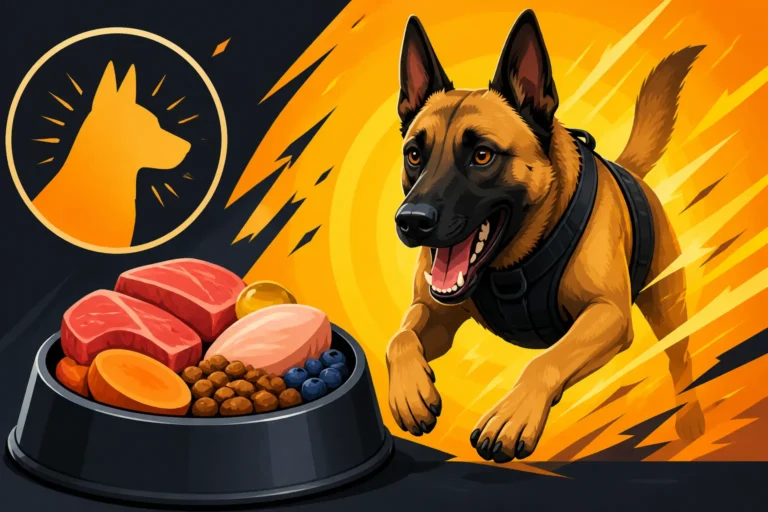
For a male Malinois weighing 60-80 pounds and maintaining a high level of activity, their nutritional requirements are significantly higher than an average companion dog. They need a diet rich in high-quality protein, which is essential for muscle maintenance and repair. Look for dog foods where meat is the first ingredient, and ideally, the first few ingredients. Performance formulas, often found through reputable brands on Chewy or specialized pet stores, are generally designed with higher protein and fat percentages to meet these demands.
Healthy fats are equally crucial, providing a dense source of energy for endurance and supporting skin and coat health. Ingredients like chicken fat, salmon oil, or flaxseed oil are beneficial. Carbohydrates also play a role, offering readily available energy for those explosive bursts of speed. Whole grains or easily digestible starches can be part of a balanced diet, despite some myths about "grain-free" being superior for all dogs. Always ensure the food is complete and balanced, meeting AAFCO guidelines.
Beyond the macronutrients, adequate vitamins and minerals are vital for overall health, immune function, and bone strength. Some working dog owners also choose to add joint supplements, especially as their dogs age or engage in high-impact sports, but always consult with a vet first. The goal is to provide consistent, high-quality fuel that supports their rigorous physical demands without causing digestive upset.
The Role of Diet and Exercise in Maintaining Ideal Weight
Think of your Malinois's ideal weight as a delicate balance between the calories they consume and the calories they burn. It's a dynamic equation that you'll constantly be fine-tuning throughout their life.
When your Malinois is in heavy training for a trial, or during a period of increased work, they will naturally need more calories. This might mean larger portions, an extra meal, or incorporating more calorie-dense additions. Conversely, if there's a period of reduced activity due perhaps to an injury (fingers crossed that never happens!), or simply a less demanding week, their caloric intake should be slightly reduced to prevent unwanted weight gain. Being able to read Whether a Malinois Is Finished at Twelve Months versus still filling out is important for these adjustments.
Exercise, as we've discussed, isn't just about burning calories; it's about building and maintaining the dense muscle that defines the Malinois physique. Consistent, challenging exercise prevents muscle atrophy and keeps their metabolism running efficiently. It's a virtuous cycle: a well-exercised Malinois maintains muscle, which helps them burn more calories, which keeps them lean, allowing them to exercise even more effectively.
Establishing a consistent feeding schedule can also aid in digestion and metabolism. Many working Malinois do well on two or three meals a day, rather than one large meal, to help manage energy levels and reduce the risk of digestive issues. Always ensure fresh water is available, especially around exercise sessions. By carefully managing both their input (diet) and output (exercise), you'll be well on your way to keeping your male Malinois within that healthy, athletic 60 to 80-pound range, ensuring he remains the powerful, capable partner he was born to be.
Disclaimer
This article is for general informational purposes only and does not constitute professional advice. Laws, prices and regulations vary by location and change over time. Consult a qualified professional for guidance on your specific situation.